


PolinovelMining Locomotive Battery
Explosion-proof LiFePO4 traction packs rated Ex d ib mb IIC T1~T5 Gb and IP67, built from your locomotive drawings so the pack bolts into the battery box you already run — 51.2V and 96V platforms in production, 48V to 384V on custom order.

10 years
Design life
3,500+
Cycle life
-4 to 131°F
Work environment
IP67
Ingress

Explosion-Proof LiFePO4 Locomotive Battery Packs for Underground Rail Haulage
Two production platforms sit under this category: the 96V 300Ah LSV96300 for rail-bound haulage locomotives, and the 51.2V 315Ah LSV51315 for lighter tunnel locomotives, shuttle cars and underground loaders.
Both use LiFePO4 cells in a sealed SPCC steel enclosure with an explosion-proof BMS, REMA charge and Anderson discharge terminals, and RS485/CAN output to the vehicle controller. The system platform extends to 48V, 96V, 192V and 384V at 100Ah–500Ah when locomotive tonnage and duty cycle require it.
Most orders here are custom mining locomotive battery packs rather than catalogue pulls: enclosure footprint, connector orientation and pack weight are set from your drawings so the unit fits the existing battery box without frame modification.
Retrofit conversions, OEM series production and single evaluation samples all run through the same engineering process.
Mine Locomotive Battery Models Available From Our Factory
Both models ship with an LED display, RS485/CAN communication and UN3480 Class 9 transport documentation.
-
![96V 300Ah Mining Locomotive Lithium Battery]() 96V 300Ah Mining Locomotive Lithium Battery● Model: LSV96300● Explosion-proof LiFePO4 cells for safe mining operation● Integrated BMS with real-time voltage, current and temperature monitoring● High rate discharge to support heavy-duty
96V 300Ah Mining Locomotive Lithium Battery● Model: LSV96300● Explosion-proof LiFePO4 cells for safe mining operation● Integrated BMS with real-time voltage, current and temperature monitoring● High rate discharge to support heavy-duty -
![51.2V 315Ah Mining Battery]() 51.2V 315Ah Mining Battery● Model: LSV51315● Certified LiFePO4 cells compliant with mining safety standards● Intelligent BMS provides overcharge/overdischarge/overcurrent protections● Zero emissions reduces underground
51.2V 315Ah Mining Battery● Model: LSV51315● Certified LiFePO4 cells compliant with mining safety standards● Intelligent BMS provides overcharge/overdischarge/overcurrent protections● Zero emissions reduces underground


Choosing Between the 96V and 51.2V Mining Locomotive Battery Platforms
Select by locomotive tonnage and the internal volume of the existing battery box, not by voltage preference. The 96V LSV96300 mining locomotive lithium battery carries 28,800 Wh in a 1370 mm long enclosure at 420 kg; the 51.2V LSV51315 mining locomotive battery carries 16,128 Wh in a 910 mm square enclosure at 235 kg.
On rail haulage, pack weight is not a penalty the way it is on a wheeled vehicle — it contributes to adhesion. What usually decides the platform is whether the locomotive frame can accept the 1370 mm footprint and whether the traction motor already runs at 96V nominal.
Verified specifications — LSV96300 vs LSV51315
| Parameter | LSV96300 | LSV51315 |
|---|---|---|
| Nominal voltage | 96 V | 51.2 V |
| Nominal capacity | 300 Ah | 315 Ah |
| Energy | 28,800 Wh | 16,128 Wh |
| Cell chemistry | LiFePO4 | LiFePO4 |
| Dimensions (L×W×H) | 1370 × 920 × 410 mm | 910 × 910 × 400 mm |
| Weight | 420 kg | 235 kg |
| Case material | SPCC steel | SPCC steel |
| IP rating | IP54 / IP65 / IP67 | IP54 / IP65 / IP67 |
| Charge current | 100 A | 100 A |
| Charge cut-off voltage | 105 V | 58.4 V |
| Discharge current | 150 A | 150 A |
| Discharge cut-off voltage | 82.5 V | 44 V |
| Charge / discharge terminal | REMA / Anderson | REMA / Anderson |
| Communication | RS485 / CAN | RS485 / CAN |
| Charge temperature | 0°C to 55°C | 0°C to 55°C |
| Discharge temperature | -20°C to 60°C | -20°C to 60°C |
| Self discharge | <3% per month | <3% per month |
| Shipping classification | UN3480, Class 9 | UN3480, Class 9 |
Discharge behaviour under load and on gradient
Rated continuous discharge on both models is 150 A, and the platform specification lists 2C–3C as the standard maximum discharge band with higher rates available as a build option. In practice the figure that matters underground is voltage sag on a loaded uphill pull: LiFePO4 holds a flat discharge curve, so traction motor torque stays predictable through most of the pack's usable range instead of tapering the way a lead-acid string does at the end of a shift.
On loaded downhill runs, regenerative braking returns roughly 10–15% of cycle consumption directly to the pack, which extends range per charge on ramp-heavy circuits.


Explosion-Proof Rating and High-Voltage Insulation on Every Mining Locomotive Battery Pack
Every pack in this category carries the marking Ex d ib mb IIC T1~T5 Gb and uses MA-certified cells, verified against a 2500 V AC one-minute withstand test and insulation resistance above 10 MΩ between the high-voltage bus and the enclosure.
Operating at 96 V or above in a wet, dust-laden tunnel creates insulation problems that a 24 V machine never faces. Conductive coal dust and condensation build leakage paths between the bus and the shell, and a marking on a nameplate is only worth what the test regime behind it verified.
Internal bus bars use double-layer insulation wrapping rated for continuous service at 130°C, and inter-module joints are torqued to specification then sealed with dielectric potting compound to keep moisture out of the terminals. Before final insulation measurement, each pack goes through a 48-hour humidity soak at 95% RH — the point is to read the margin that survives real conditions, not a lab-dry pass mark.
EMC performance is verified to GB/T 18387-2017, which matters if the pack shares a tunnel with signalling and comms equipment.
Three-level overcharge protection
Overcharge is handled by three independent protection layers rather than a single cut-off, with intelligent cut-off on over-discharge and rapid-response short-circuit protection.
Multi-level temperature monitoring
Over-temperature protection reads multiple points inside the pack, so a single hot module triggers action before the average pack temperature would show a problem.
Abuse testing to GB/T 31485
Cells and packs are tested for nail penetration, crush and vibration under GB/T 31485, with explosion-proof enclosure testing under the GB 3836 series.
Thermal Management and Auxiliary Output in a Locomotive Battery System
All-climate thermal management holds over 85% of rated capacity at -20°C and keeps pack temperature below 50°C in a 60°C ambient through liquid cooling, with intra-pack temperature difference controlled to within 5°C.
Pre-heating is rated at a maximum of 30°C/h, which is the specification to check if your portal or winter stockpile area sits below freezing at shift start — a pack that cannot accept charge current until it warms will silently extend your changeover window. The control algorithm switches between heating and cooling strategies based on ambient and cell conditions rather than fixed thresholds.
Storage range runs -30°C to +60°C, and charging is restricted to 0°C to +50°C, which is normal for LiFePO4 and worth designing your charging bay around.

Multi-channel auxiliary output for locomotive lighting and cab instruments
Beyond traction, a battery locomotive needs stable low-voltage supply for headlamps, tail markers, the signal horn and cab instruments. The conventional answer is a separate small battery or a bolt-on DC-DC converter — extra weight, extra wiring, and one more item on the maintenance checklist that fails on its own schedule.
Polinovel packs include built-in multi-channel low-voltage outputs (commonly 12 V and 24 V taps) governed by the same BMS that manages traction discharge. The lighting circuit draws from a dedicated channel with independent overcurrent protection, so a short in a headlamp harness cannot pull down the main traction supply. For a maintenance planner, that removes a standalone lighting battery from the inspection and replacement schedule entirely.

IP67 sealing, SPCC enclosure
Fully sealed against water and dust ingress with a formed SPCC steel shell, rugged connectors and internal support structures that carry vibration load away from the cells during underground hauling.
CAN data to the locomotive controller
Operational data passes to the vehicle controller over CAN bus or RS485, with Modbus, Ethernet and Wi-Fi/Bluetooth interfaces available on the BMS.
24-hour remote monitoring
Real-time fault alerts and remote diagnostics, so a fault code is read before the locomotive is pulled out of the circuit rather than after.
Mining Equipment Powered by These Industrial Battery Platforms
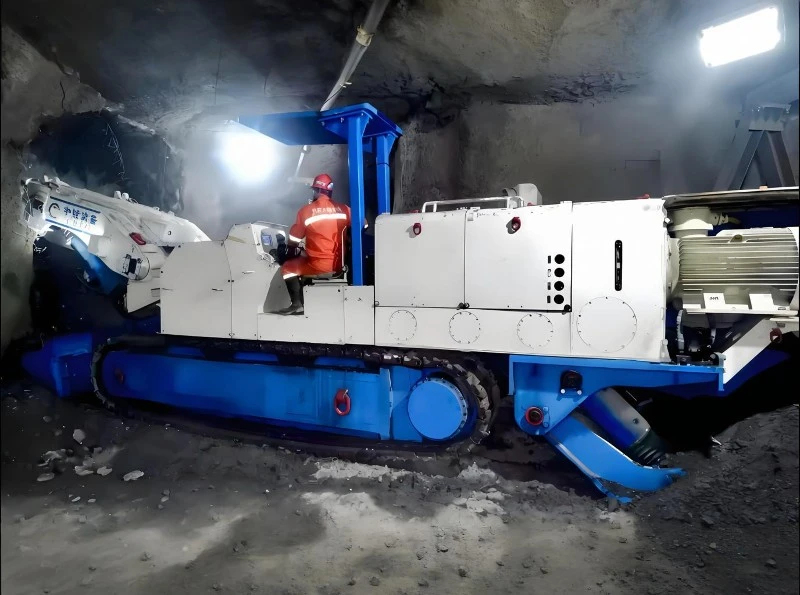
Underground rail locomotives
Traction, regenerative braking recovery and auxiliary supply from one pack, with zero exhaust emissions that would otherwise add ventilation load.

Electric mine haulers
High-rate discharge for heavy loads on rough grade, in an explosion-proof enclosure built for the duty.

Underground loaders and shuttle cars
The 51.2V platform suits confined machines where the 96V footprint will not fit but shift energy still has to hold up.
Custom Mining Locomotive Battery Engineering: From Drawings to a Bolt-In Pack
The common failure in a retrofit is not chemistry, it is 15 mm — a pack that clears the battery box but fouls a tie-down, or a connector that exits on the wrong side of the frame. Polinovel builds enclosure geometry from your locomotive drawings for exactly that reason.
What we design around
- Internal battery box dimensions, tie-down positions and lid clearance
- Connector type and exit orientation — REMA charge and Anderson discharge are standard, alternatives on request
- Pack weight and ballast, so rail adhesion and weight distribution are set deliberately rather than inherited from the old lead-acid unit
- Controller communication: CAN, RS485 or Modbus, with the message set agreed before build
- Charger compatibility with the infrastructure already in your bay
- Gas group and temperature class required by the mine's own compliance regime
What to send with an enquiry
A quotation that arrives without these details is a guess. Sending them up front is the difference between a two-week and a two-month engineering loop:
- Locomotive make, model and tonnage
- Nominal system voltage and required Ah, or the shift energy in kWh you need to cover
- Battery compartment drawing or measured internal dimensions
- Existing charger brand, output and connector
- Controller protocol and any required message IDs
- Quantity, delivery phasing, and destination port
Samples, series orders and tooling ownership
Because enclosure tooling differs by locomotive model, minimum order quantity and lead time in this category are set per project rather than published as a single number — a repeat build on existing tooling and a first-article pack with a new shell are not the same order. Ask for both figures in writing on the quotation, along with the tooling arrangement: who holds the enclosure tooling, whether tooling cost is amortised against volume, and what happens to it if the programme stops.
The same applies to labelling. If you need the pack delivered under your own nameplate, case colour or manual language for onward sale, put those requirements on the purchase order rather than agreeing them verbally — nameplate content is also what a mine inspector reads first.
Polinovel manufactures as a factory in Shenzhen and supplies wholesale and customised orders directly, so specification changes are handled by the people who build the pack. See the customisation process.

19 years of manufacturing
Polinovel has been building custom lithium packs for industrial vehicles for 19 years, across forklift, GSE, AWP, AGV and mining equipment platforms.
Technical support, 24/7
Remote diagnostics and troubleshooting support, which matters more than a datasheet line when a locomotive is stopped mid-shift.
5-year warranty
Backed by a 5-year warranty against a 10-year design life. Confirm the warranty's stated conditions — cycle count, DOD and temperature limits — before signing.

Certifications and Test Standards Behind a Mining Locomotive Battery Shipment
Certification scope is granted to a specific cell, model and enclosure — it does not transfer automatically to a modified shell. Request current certificate scans with certificate numbers and validity dates for the exact configuration you are buying, and check that the model number on the certificate matches the model number on your PO.
For underground mining, compliance is not a marketing badge — it is the document a mine safety officer asks for before the pack is allowed past the portal, and the document your freight forwarder asks for before the pack leaves the port. The list below states what each one covers and why it appears on your desk.
Further reading: mining locomotive battery safety standards explained.
MA
Applies to the cells used in these packs. It is the certification that governs use of electrical equipment in Chinese underground coal mines, and the reference point buyers in other jurisdictions use when comparing explosion-proof credentials.
GB 3836
The test series behind the Ex d ib mb IIC T1~T5 Gb marking. It defines how the enclosure contains an internal ignition event so it cannot propagate to a flammable atmosphere outside the shell.
GB/T 31485
Mechanical and electrical abuse testing. For a locomotive that spends its life on uneven track, the vibration element is the one to read.
GB/T 18387-2017
Confirms the pack's emissions will not interfere with signalling, radio or gas-detection equipment sharing the same tunnel.
UN 38.3 + MSDS
Required for international shipment. These packs are classified UN3480, Class 9 — the classification your forwarder and insurer will both ask for by name.
IEC 62619:2017
Safety requirements for secondary lithium batteries in industrial applications. Often the standard cited in European and Australian tender documents.
ISO 9001 / ISO 14001
Process-level certification. It tells you the traceability and quality-control system exists across the production run, not just on the sample you evaluated.
CE / UL / IEC
Compliance stated for these product lines. The LSV51315 datasheet additionally lists MSHA, IECEx, ATEX and ISO 12405 — request those certificates directly if your mine operates under US or EU explosive-atmosphere rules.
Mining Locomotive Battery FAQ for Sourcing Managers and Project Engineers
What voltage and capacity range is available?
The platform covers 48V, 96V, 192V and 384V nominal at 100Ah to 500Ah, with energy density at or above 150 Wh/kg and charging efficiency at or above 95%. Two models are in current production: the 96V 300Ah LSV96300 (28,800 Wh) and the 51.2V 315Ah LSV51315 (16,128 Wh). Anything outside those two is quoted as a custom build.
Can these packs be retrofitted into locomotives currently running lead-acid?
Yes, and it is the most common order type in this category. The enclosure is built to your battery compartment dimensions so the pack drops into the existing box without frame modification, with connector orientation and cable exit matched to the installation. Send the compartment drawing, the nominal system voltage and your charger details, and the fit is engineered rather than assumed.
Is the pack rated for explosive underground atmospheres?
Packs in this category carry the marking Ex d ib mb IIC T1~T5 Gb and use MA-certified cells, with enclosure testing under GB 3836 and abuse testing under GB/T 31485. Insulation is verified at 2500 V AC for 60 seconds with resistance above 10 MΩ. Because certification scope is tied to a specific configuration, request the certificate for the exact model and enclosure you intend to order.
How long does one charge last, and how quickly does the pack recharge?
Runtime depends on locomotive load, gradient, speed and duty cycle, so no single hour figure applies across mines. Use the energy content as the calculation basis: 28,800 Wh for the LSV96300 and 16,128 Wh for the LSV51315, against your measured kWh per shift. Both models charge at 100 A, and the LSV51315 datasheet cites roughly two hours to full charge, which is what makes opportunity charging during shift changeover practical instead of swapping packs.
What cycle life and warranty apply?
The category specification states a minimum of 2,000 cycles at 80% DOD; the individual model datasheets rate cycle life above 4,000 cycles, against a 10-year design life and a 5-year warranty. Treat the lower figure as the contractual floor and ask for the guaranteed number, its DOD, its temperature assumption and its capacity-retention end point to be written into the order — that is what makes two quotations comparable.
What is the minimum order quantity and lead time?
Both are set per project rather than published, because enclosure tooling differs by locomotive model: a repeat build on existing tooling and a first-article pack with a new shell carry different quantities and different schedules. Send locomotive model, voltage, capacity, compartment dimensions and quantity, and the quotation will state MOQ, sample lead time, production lead time and tooling ownership as written figures you can hold.
Do the packs power auxiliary circuits, or only traction?
Both. Multi-channel low-voltage outputs (commonly 12 V and 24 V taps) run headlamps, tail markers, horn and cab instruments from the same pack, each channel with independent overcurrent protection so a lighting fault cannot affect traction supply. That removes the separate lighting battery or DC-DC converter from the maintenance schedule.
Send your locomotive drawings, get a specified quotation
Include the battery compartment dimensions, nominal voltage, required capacity and quantity. You will get a specification sheet with dimensions, weight, terminal layout, communication mapping and the certificate list for that exact configuration.
We're professional mining trucks/locomotives battery manufacturers and suppliers in China. If you're going to wholesale customized mining trucks/locomotives battery, welcome to get more information from our factory. For price consultation, contact us.
Popular Products


