


Lithium battery forklift adoption has moved past the question of whether lithium works. The live question for fleets and OEMs is whether it pays in a specific operation, now. Battery pack prices averaged $108/kWh in 2025, down 8% on 2024, according to BloombergNEF's annual survey (BloombergNEF). That figure is a cross-industry average, not a forklift battery price, and it moves forklift quotes only part of the way. The cost case is strongest for multi-shift fleets, which otherwise buy spare lead-acid batteries and pay for battery changes. For single-shift sites and retrofits of older trucks, the answer still depends on three things: what you compare lithium against, what your site needs to charge safely, and whether the truck maker will sign off.
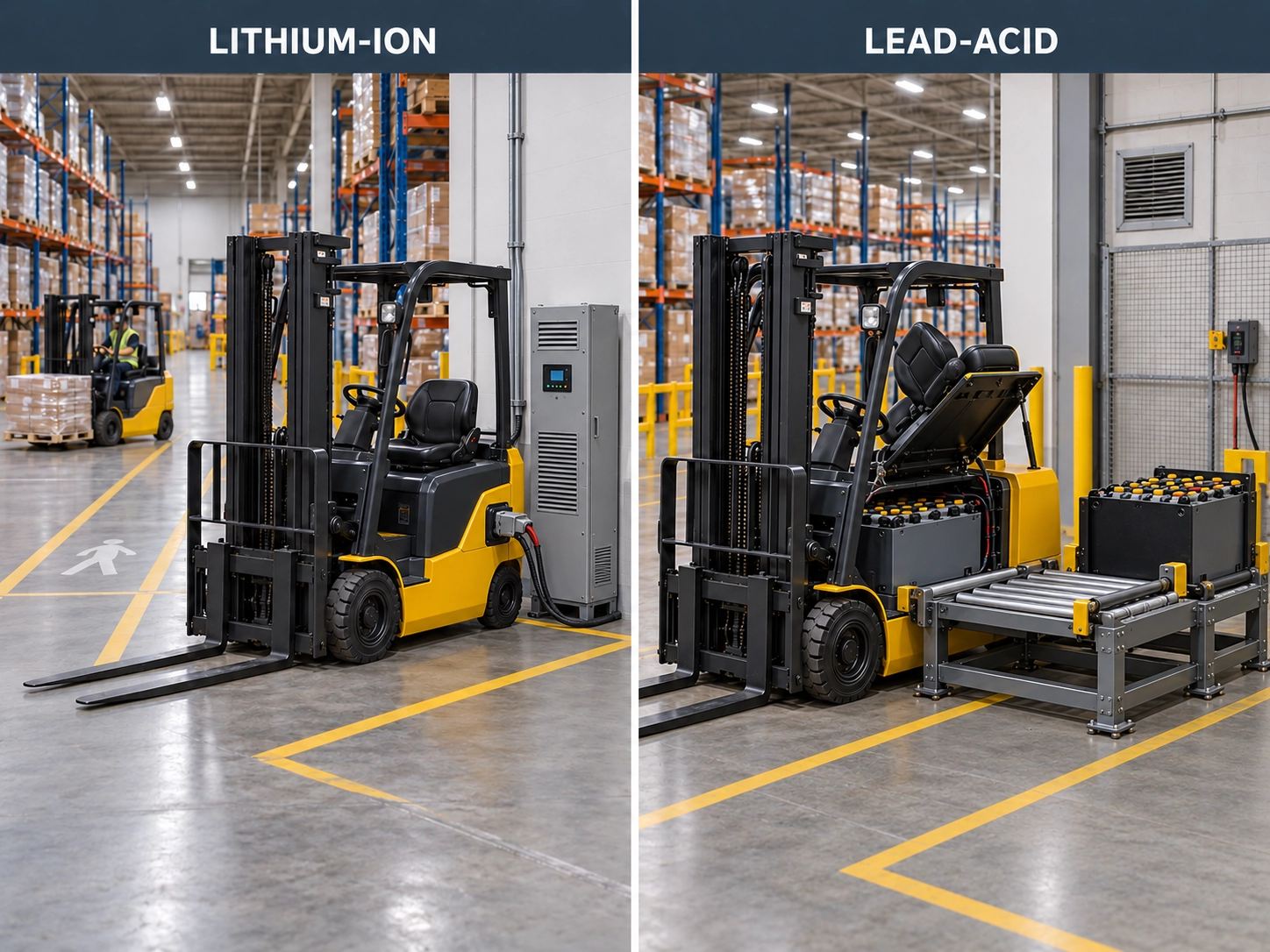
What the "tipping point" actually measures
When analysts talk about a lithium tipping point in forklifts, they usually mean one thing: lithium-ion overtaking lead-acid among electric forklifts. Citing its Forklifts – 2025 report, Interact Analysis puts lithium-ion penetration in the full-electric forklift segment at about 32% in 2024 and forecasts that it will surpass lead-acid in that segment around 2026. The same analysis estimates that 83% of new electric forklifts shipped in 2034 will use lithium-ion batteries (Interact Analysis via SDCExec). An earlier Interact Analysis release, from December 2024, put the 2034 figure at 81% of fully electric forklifts (Interact Analysis); the two numbers come from different editions of the research and should not be mixed.
The 2026 crossover is a forecast, not a recorded result. Whether it has happened will show up in shipment data after the year closes, and the published article does not state whether the 32% figure counts unit shipments or another measure.
The global picture also hides large regional differences. The same analysis forecasts that the US will not reach 50% lithium penetration until 2032, while China's lithium forklift shipments are projected to grow from 26,436 units in 2018 to more than one million a year by 2034 (Interact Analysis via SDCExec). The 2018 figure is a historical base; the 2032 and 2034 figures are forecasts. For a buyer, the practical point is that a global crossover does not mean your local market, dealer network or service base has tipped.
If you need the overall market size and the current lead-acid versus lithium split, our forklift battery market size and share overview covers that. This article focuses on how falling battery costs reach a forklift quote and how to judge timing.
Battery prices fell - why your forklift quote fell less
The $/kWh figures in the news are real, but they are not forklift battery prices. BloombergNEF's 2025 survey covers battery packs across end uses such as electric vehicles and stationary storage. It reports $81/kWh for LFP packs and $128/kWh for NMC packs, and expects prices to fall again in 2026. It does not publish a forklift-specific figure (BloombergNEF).
LFP chemistry is widely used in lithium forklift batteries, so the LFP figure is the more relevant reference. Even so, cell costs are only one layer of what you pay. A forklift battery is a low-volume, heavy product built to fit a specific truck, and several of its costs do not fall when cell prices do.
Cell, pack, finished forklift battery: three different prices
| Price layer | What it includes | Tracked by BNEF's survey? |
|---|---|---|
| Cell | The individual LFP or NMC cells | Reported separately from packs |
| Pack (EV or storage) | Cells plus module, housing and BMS, built at high volume | Yes - the $108/kWh average |
| Finished forklift battery | Pack plus steel tray, ballast where the truck's minimum battery weight requires it, communication with the truck controller and charger, certification, packaging and freight | No |
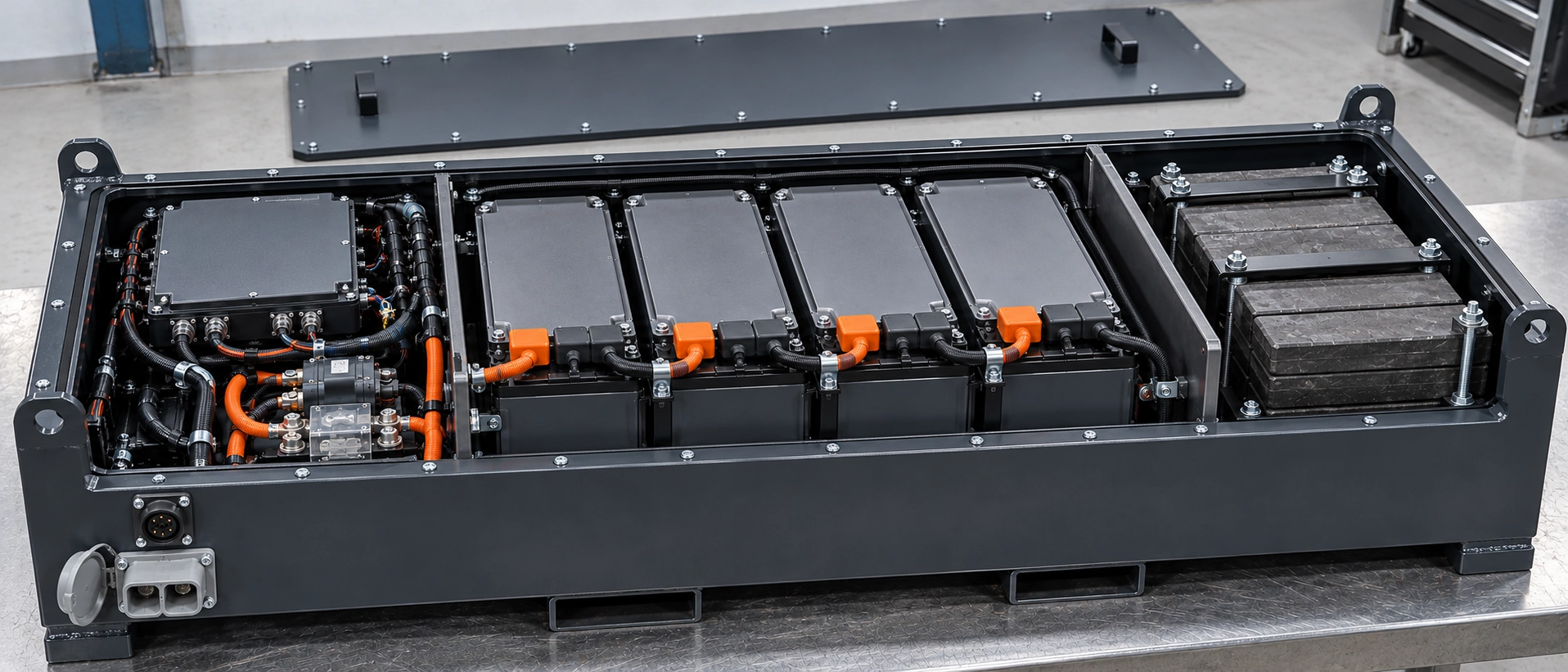
The last row is where forklift quotes differ from headline prices. Steel, ballast, engineering for a specific truck model and safety testing are priced per unit, not per kWh, so a fall in cell prices passes only partly into the finished battery.
To compare two forklift battery quotes on a like-for-like basis, line up the same items for each: rated and usable energy at the truck's system voltage; total battery weight against the data plate minimum, and how any ballast is built and secured; outer dimensions against the compartment; the BMS communication protocol and the truck models it has been matched to; whether a charger is included and which one; the certification standard and the models the certificate covers; warranty terms and what they are based on; and freight, duties and local service. A lower $/kWh figure on one quote means little if it leaves out items the other includes.
Regional price gaps
Where you buy also matters. BloombergNEF puts China's average pack price at $84/kWh, with North American prices 44% higher and European prices 56% higher (BloombergNEF). These are regional averages across end uses. A buyer in the US or EU should not benchmark a delivered quote against the Chinese average, and should compare landed cost, including freight, duties and local service, rather than ex-works price alone.
How OEMs are responding: factory-fit lithium vs retrofit
Some forklift makers have made lithium a stated part of their product strategy. In a 2022 press release, Jungheinrich reported delivering its 100,000th lithium-ion truck and set a target for lithium-ion trucks to make up 70% of the trucks it sells by 2025 (Jungheinrich). That is one manufacturer's target, not an industry result, and whether it was reached should be checked against the company's 2025 reporting. Falling battery prices are one factor in such plans; OEMs also cite energy efficiency, maintenance and customer demand, so cost alone does not explain the shift.
For buyers, this creates two routes, and the choice between them changes cost and paperwork more than chemistry does.
Factory-fit lithium means buying a new truck already configured for lithium. The truck maker has matched the battery to the truck's controller, counterweight and charger for that model. It is the simplest route when you are replacing trucks anyway, but still confirm that the certification documents cover the exact model and configuration you are ordering and meet the requirements in your market.
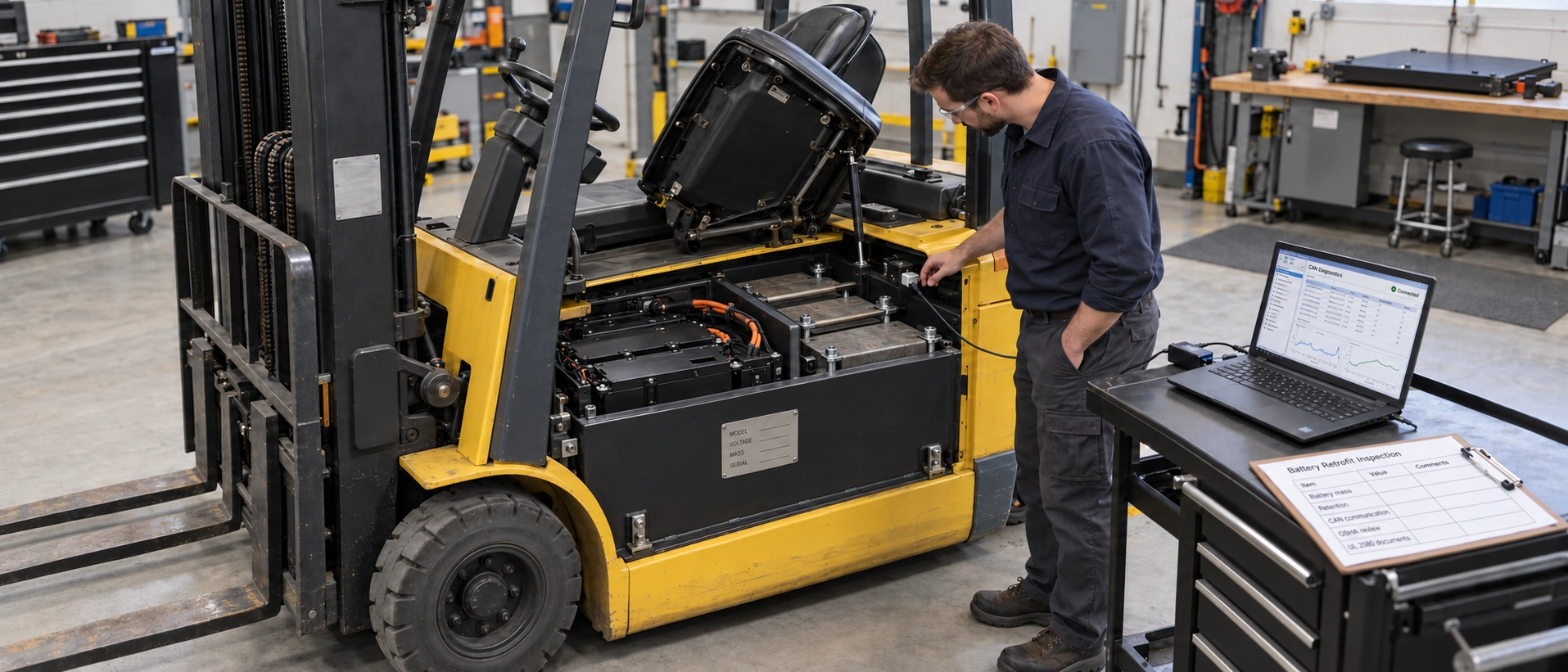
Retrofit means putting a lithium battery in a truck designed around lead-acid. It extends the life of a fleet you already own, but it adds steps:
- Manufacturer approval (US). OSHA's rule at 29 CFR 1910.178(a)(4) requires the truck maker's prior written approval for modifications that affect capacity and safe operation. OSHA has said that if the manufacturer does not respond or refuses, it will accept written approval from a qualified registered professional engineer - but only after that engineer performs a safety analysis and addresses any safety or structural issues raised in the manufacturer's refusal, and the truck's data plates must be changed to match (OSHA). This is a US interpretation; other countries have their own rules.
- Certification labels. At a 2024 MHI industry panel, a Hyster-Yale executive explained that, in the North American market, lithium forklifts are expected to carry UL marks on both the truck and the battery: UL 2580 covers the battery and UL 583 covers electric industrial trucks. In that executive's account, fitting a battery without a UL listing means the truck's UL label must be removed (MHI). This is an industry view, not a universal legal rule, and a battery's own certificate does not by itself confirm that the modified truck keeps its original certification. Standards are still evolving, so check the current position with your insurer and truck dealer.
- Weight, ballast and fit. On counterbalance trucks, the data plate specifies a minimum battery weight because the battery is part of the counterweight. A lithium pack that is lighter than that minimum cannot be made acceptable simply by adding steel until the number is reached: the ballast design, how the ballast and battery are secured, the resulting weight distribution and the truck's stability all have to be verified and approved, and the pack must fit the compartment exactly. In the US, 29 CFR 1910.178(q)(6) states that additional counterweighting of fork trucks requires the truck manufacturer's approval, in addition to the (a)(4) approval for modifications described above (29 CFR 1910.178). Other truck types have their own stability and weight requirements, set by the truck maker.
- Controller communication. The battery's BMS should exchange state of charge and fault information with the truck and charger in the way the truck maker specifies. CAN bus is common, but older trucks may use other interfaces, and a matching protocol name does not by itself mean the messages are compatible, so confirm the protocol and data mapping for each model before ordering.
If you are planning a custom pack for an OEM or ODM program, the engineering choices are covered in custom battery pack design decisions.
Has your operation crossed the tipping point?
Whether lithium pays depends on how hard your trucks work and what you are replacing. Published views disagree mainly because they use different baselines. A 2026 post in MHI's Advanced Energy Council blog series argues that even operations running trucks only a few hours a day can see worthwhile returns - in a comparison against internal-combustion trucks (MHI). Our own TCO framework, which compares lithium against lead-acid, notes that light single-shift use may not pay back within a reasonable financial horizon. Both can be right. The first question is: compared with what?
| Operation | Why lithium helps or doesn't | What decides it |
|---|---|---|
| Two or three shifts | Opportunity charging on breaks can replace spare batteries, a battery-change area and change labor | Charge windows long enough in each shift; site power for chargers |
| Cold storage | Both chemistries lose usable capacity in the cold, and charging LFP cells below freezing is commonly restricted | Whether the pack heats its cells or charges outside the cold zone; insulation; the supplier's rated charge and discharge temperature ranges for that pack |
| Single shift, low hours, replacing lead-acid | Lead-acid can charge overnight with no spare battery, so lithium's main savings shrink | Remaining life of current batteries; maintenance labor you would avoid |
| Single shift, replacing IC trucks | Fuel and engine maintenance savings apply even at low hours | Charger installation cost; truck purchase price |
| Retrofit of an older truck | Avoids buying a new truck | OEM or engineer approval; remaining truck life; ballast and controller compatibility |
To run the numbers for your own fleet, use the inputs in our forklift battery TCO framework. A simple payback check divides the extra upfront cost of lithium (battery, chargers, site work) by the annual net saving: the costs it removes (spare batteries, change labor, watering and equalizing, downtime) minus any costs it adds or changes, such as charger maintenance or a different electricity bill. Use your own figures; there is no industry-wide payback period that holds across operations.
Costs that cheaper cells don't remove
Lower cell prices shrink the battery line of the budget, not the rest of the project. Three costs deserve a line item before you approve a switch.
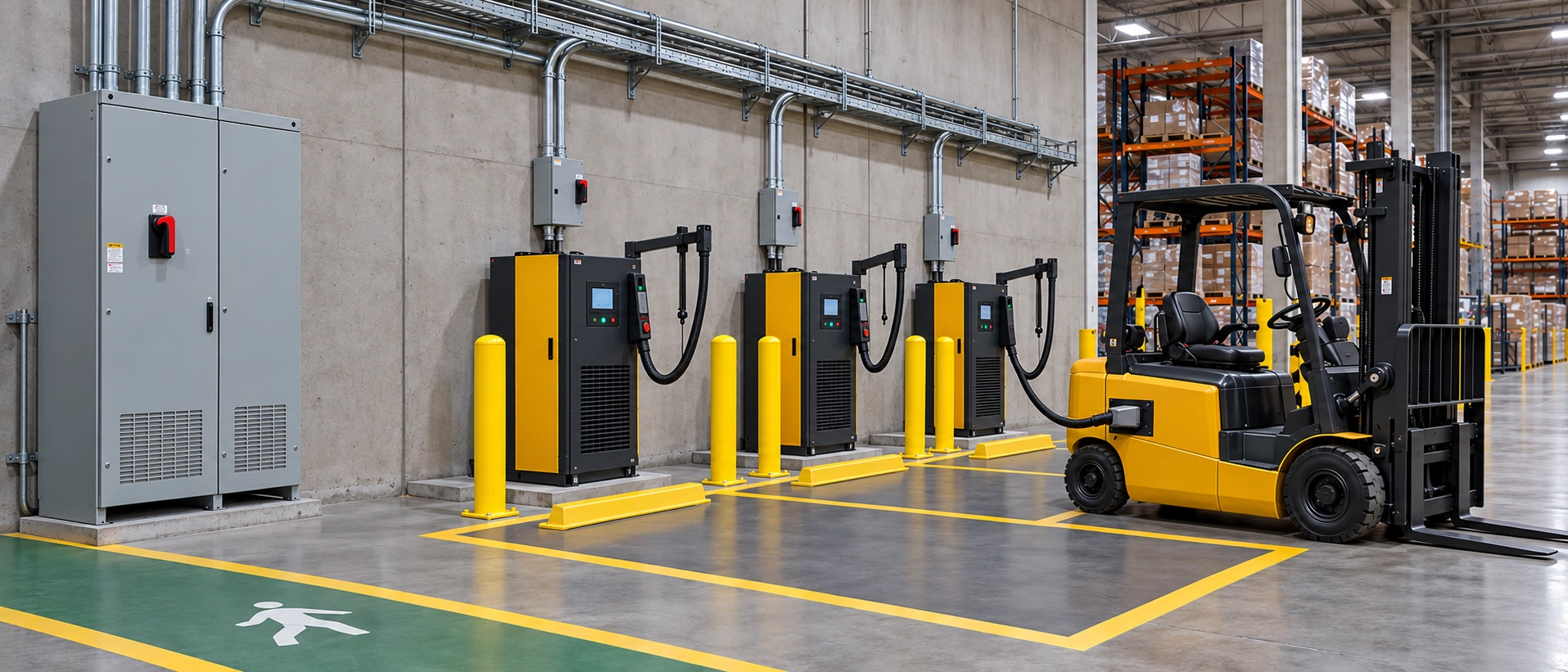
Charging infrastructure. Interact Analysis reports that 50–60% of charging installations require facility upgrades, which can add up to 25% to total project cost (Interact Analysis via SDCExec). The article does not publish the sample or regions behind these figures, so treat them as a prompt to survey your site's electrical capacity early, not as a budget benchmark for your site.
Compatibility engineering. Approved ballast where the truck's minimum battery weight requires it, the right connector, and BMS communication with the truck and charger all have to be specified per model. Ask the supplier which truck models the pack has been matched to, which communication protocol it uses with each, and how the BMS reports faults to the operator.
Approvals and certification. Budget time for manufacturer or engineer sign-off on retrofits, and ask for the battery's certification documents up front: the exact standard (for example UL 2580), the certificate number and the models it covers. The Electric Forklift Battery page sets out the selection factors to check, from voltage and compartment size to weight, BMS communication and operating environment.
A note for EU buyers: the battery passport applies to both chemistries
The EU Battery Regulation does not ban lead-acid forklift batteries. Under Article 77 of Regulation (EU) 2023/1542, industrial batteries with a capacity above 2 kWh that are placed on the EU market or put into service from 18 February 2027 must have a digital battery passport (EUR-Lex). The requirement is set by battery category and capacity, not by chemistry, so it applies to lead-acid and lithium forklift batteries alike. It adds data obligations whichever chemistry you choose, and is not by itself a reason to switch.
Buy now or wait? A timing check
BloombergNEF expects pack prices to fall again in 2026 (BloombergNEF), so waiting may lower the battery price. But waiting is not free: lead-acid maintenance, battery changes and spare batteries keep costing money in the meantime, and, as the price table above shows, a further fall in cell prices passes only partly into a finished forklift battery. The better trigger is usually your own fleet's calendar, not the market's. Five questions settle most timing decisions:
Are your current lead-acid batteries near end of life? If you would buy replacements within a year or two anyway, the comparison is lithium versus new lead-acid, not lithium versus batteries you already own.
How many shifts do your trucks run, and are there charge windows? Multi-shift work with breaks favors lithium most.
Is factory-fit lithium available for the trucks you plan to buy, or will you retrofit? Retrofits need approval and compatibility work before the first battery ships.
Can your site supply power to the chargers you need? An early electrical survey avoids the infrastructure surprises noted above.
Who will service the batteries locally? In markets where lithium is still a minority, check the supplier's local support before you commit a whole fleet.
Next step
Market forecasts put lithium on course to overtake lead-acid among electric forklifts around 2026, but your own break-even depends on shifts, baseline, site power and approvals. If the checks above point toward switching, the fastest way to a realistic quote is to share the specifics of your trucks.
On our Electric Forklift Battery page you can send:
truck make, model and year;
battery compartment dimensions and the minimum battery weight from the truck's data plate;
shift pattern, daily operating hours and operating environment (for example, cold storage);
system voltage and the current battery's data plate (capacity and weight);
connector type and the charger you use now;
photos of the truck data plate, battery tray, connector and charger, if available.
Our engineering team will review these details and recommend a battery and charger configuration for further compatibility evaluation, and tell you if anything else is needed to complete it. That review is not a substitute for the truck maker's approval of a retrofit; where manufacturer approval, a stability assessment or a certification review is required, it remains a separate step before installation.


