


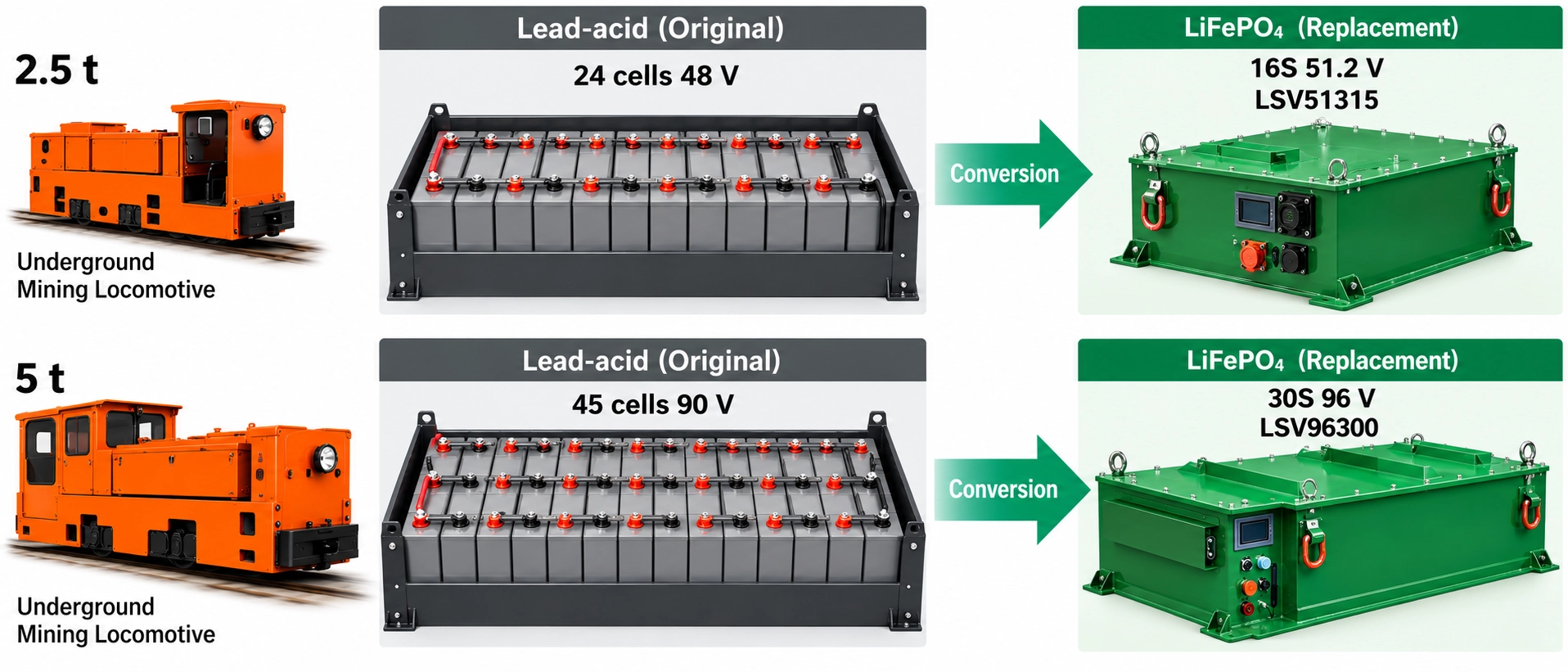
For most lead-acid retrofits, the voltage of a mining locomotive battery is not a free choice. The traction motor, controller and charger have already set it. A 24-cell lead-acid battery (48V nominal) lines up with a 16-series LiFePO4 pack at 51.2V. A 45-cell battery (90V nominal) lines up with a 30-series pack at 96V.
Voltage is only the first filter. A pack that matches on paper can still fall short if it:
sits outside the controller's voltage window;
cannot supply the locomotive's sustained or peak current;
runs out of energy before the end of the shift;
does not fit the battery box, or leaves the locomotive too light to pull;
lacks the approvals your mine requires.
Quick answer
- 24-cell (48V) locomotive with moderate current draw: start with the 51.2V platform.
- 45-cell (90V) locomotive whose sustained current stays within 150A: start with the 96V platform.
- 110V and above, heavy sustained loads, or long shifts on steep gradients: a custom configuration is usually the better route.
The fastest way to a firm answer is to send us your locomotive data. Our engineers check it against both platforms before quoting.
Start With the Locomotive You Already Run
Lead-acid cells sit at roughly 2V each, while LiFePO4 cells sit at 3.2V. That is why the same system voltage needs far fewer lithium cells in series (U.S. Federal Railroad Administration, 2017). For mining locomotives this gives two clean conversions:
| Existing lead-acid battery | LiFePO4 configuration | Polinovel platform |
|---|---|---|
| 24 cells, 48V nominal | 16S, 51.2V | LSV51315 (51.2V / 315Ah) |
| 45 cells, 90V nominal | 30S, 96V | LSV96300 (96V / 300Ah) |
As a rough guide, battery voltage tends to rise with locomotive weight. The examples below are typical values used in this guide, not the specification of any particular model:
| Example locomotive | Battery voltage | Traction motor(s) | Likely route |
|---|---|---|---|
| 2.5 t class | 48V | 3.5 kW | 51.2V platform |
| 5 t class | 90V | 2 × 7.5 kW | 96V platform or higher-current custom pack |
| 8 t class | 110–144V | 2 × 11 or 2 × 15 kW | Custom pack |
Locomotives of the same class are built for different voltages, and older units are sometimes rewired. Always work from the nameplates on your own motor, controller and battery tray.
The Controller and Charger Must Accept the Whole Voltage Range
A lithium pack swings between a low cut-off and a full-charge voltage:
LSV51315: 44V to 58.4V
LSV96300: 82.5V to 105V
These windows sit close to where lead-acid systems of the same nominal voltage operate, but close is not the same as compatible. Three points need checking on every retrofit:
Under-voltage and derating thresholds. If the controller cuts out or derates too early, the locomotive loses performance while usable energy remains in the pack.
The charger. Lead-acid charging profiles, especially equalization stages, are not suitable for lithium. Most retrofits need a lithium profile or a new charger.
Over-voltage margin during regenerative braking. When the pack is nearly full, braking pushes the DC bus close to the charge-end voltage.
We check your controller trip points and charger profile against the pack window as part of every assessment. This is also where the BMS-to-controller communication gets agreed.
Power and Current: What Changes Between 51.2V and 96V
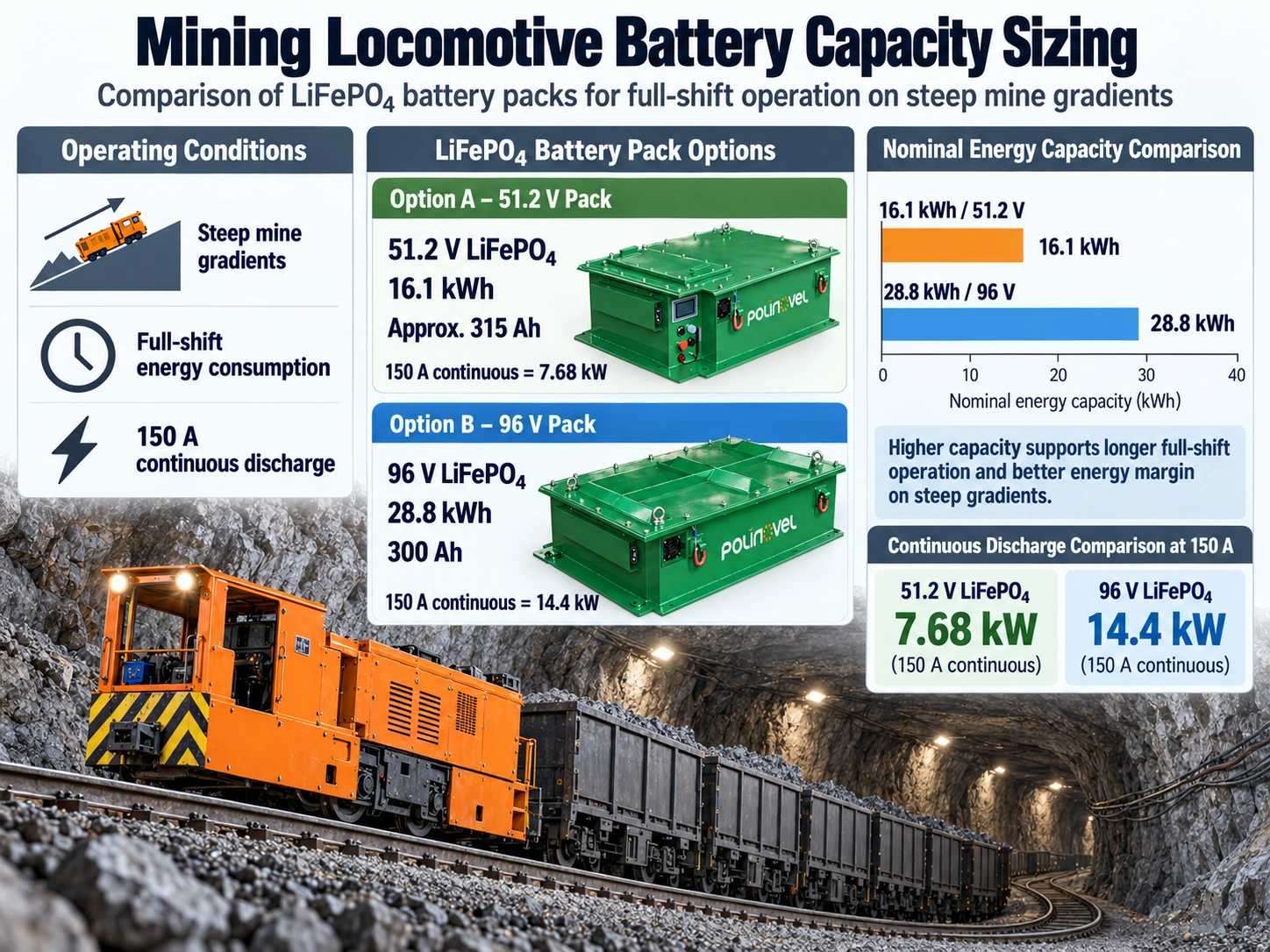
For the same power, halving the voltage roughly doubles the current. Both standard Polinovel packs are rated for 150A continuous discharge. That is about 7.7 kW at 51.2V and about 14.4 kW at 96V. Toward the end of discharge, when the voltage is lower, the same current delivers less power.
What this means in practice:
2.5 t class, 3.5 kW motor. Battery current stays comfortably within the 51.2V platform's continuous rating.
5 t class, 2 × 7.5 kW motors. If the locomotive runs at full rated output for long periods, its battery current goes above 150A at 96V. For that duty, we specify a higher-current configuration. Many 5 t locomotives spend little time at full output, though, and for them the standard 96V platform can still be a fit. The deciding factor is the logged current profile, not the motor nameplate alone.
Starting current, acceleration peaks and regenerative braking current matter just as much as the continuous rating. These limits depend on the configuration, so we confirm them against your duty cycle rather than quoting a single generic number.
Do not rely on regeneration to stop the train. A BMS limits charge current when the pack is full or cold. On a downgrade at the start of a shift, electrical braking can therefore be weaker than it was with lead-acid. Confirm that the mechanical brakes, or a braking resistor, can stop a loaded train on the steepest downgrade on their own.
Size Capacity From Shift Energy, Not Old Ah Ratings
Comparing Ah figures across chemistries is misleading. Lead-acid traction batteries are usually rated at the 5-hour discharge rate. They deliver less than that rating when discharged faster, and in daily service they are rarely run close to empty. Compare energy in kWh instead:
| Example | Lead-acid (nominal) | LiFePO4 platform (nominal) |
|---|---|---|
| 2.5 t class | 48V × 330Ah ≈ 15.8 kWh | 51.2V × 315Ah ≈ 16.1 kWh |
| 5 t class | 90V × 330–385Ah ≈ 29.7–34.7 kWh | 96V × 300Ah = 28.8 kWh |
Matching nominal energy is not enough. The pack has to cover the worst shift with margin for usable range, ageing over the battery's service life, and an end-of-shift reserve. Once those factors are applied, a locomotive that uses around 20 kWh per shift can already need more than a standard 28.8 kWh pack provides. In that case, either a mid-shift opportunity charge or a larger configuration closes the gap.
The most reliable starting point is real data. Log battery voltage and current at the battery terminals over a full shift, including the loaded run on the steepest gradient. Do not count on regenerative energy you have not measured on your own route. Recovery on mining locomotives varies widely and is often modest (Polnik et al., 2020).
Send us the shift log, and we will size the pack and tell you whether a standard platform covers it.
Physical Fit, Weight and Adhesion
| LSV51315 (51.2V) | LSV96300 (96V) | |
|---|---|---|
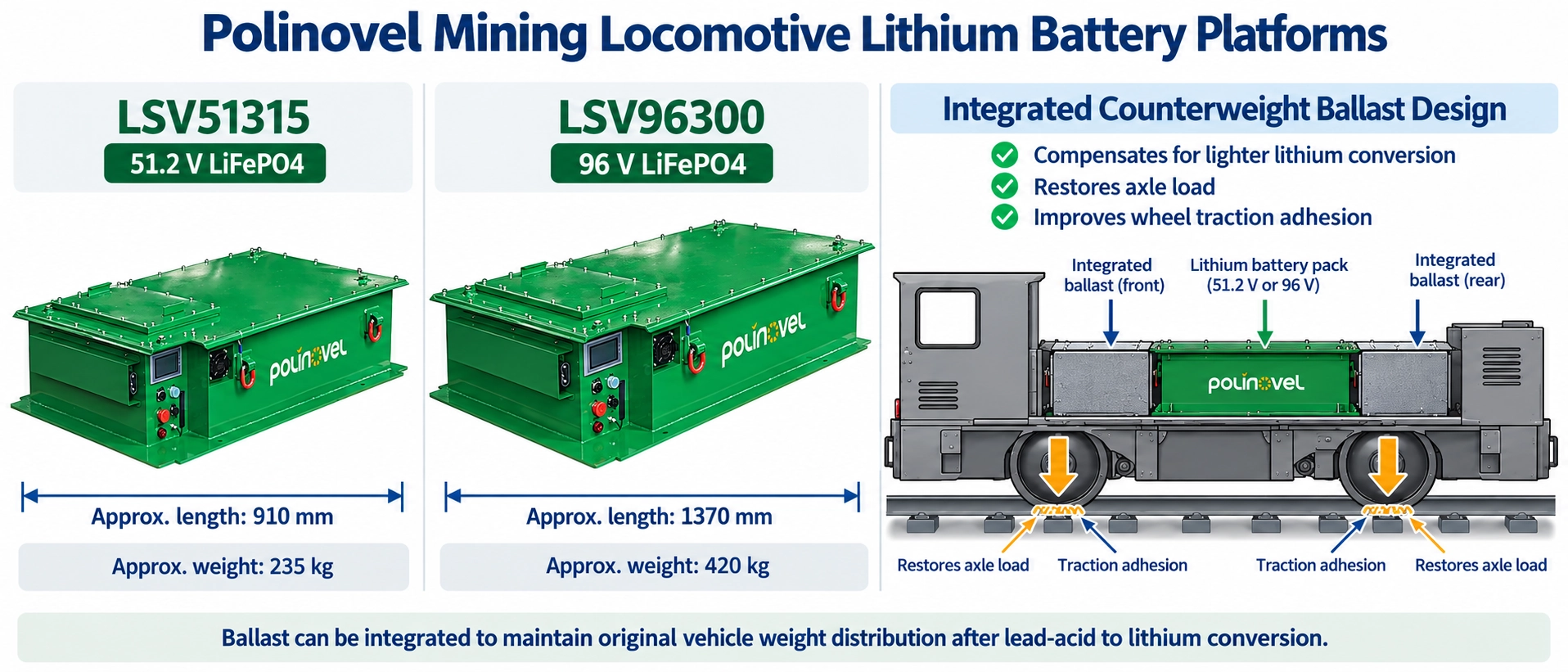
| Dimensions (L × W × H) | 910 × 910 × 400 mm | 1,370 × 920 × 410 mm |
| Weight | 235 kg | 420 kg |
| Nominal energy | 16.1 kWh | 28.8 kWh |
Check the inside dimensions of the battery box, and allow room for cable entry and lifting points.
Weight is easy to overlook. A locomotive's pulling force before wheel slip depends on the weight on its driven wheels. A lithium pack is usually much lighter than the lead-acid battery it replaces, so a retrofit can leave the locomotive too light. Take a hypothetical 5 t locomotive that loses around 580 kg of battery weight: that is more than a tenth of its mass. On a wet gradient with a full train, that can be the difference between starting and slipping.
Ballast can restore the original weight and axle-load distribution. Polinovel can build it into the pack or the battery tray as part of a custom configuration.
Safety: Crossing 60V and Explosion Protection
Both platforms store tens of kilowatt-hours and can deliver very high short-circuit current. Both therefore need correct fusing, a main disconnect, protected cable routes and a defined isolation procedure.
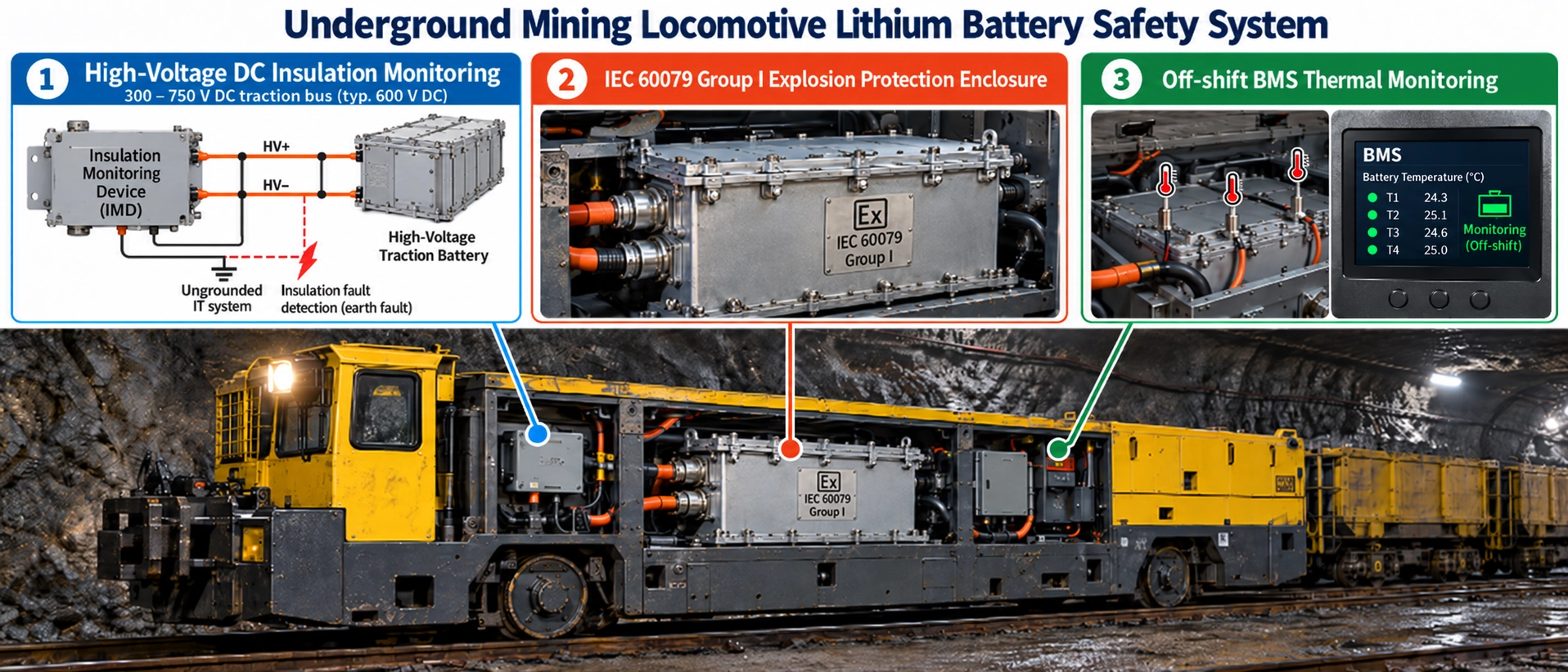
The two platforms sit on opposite sides of a widely used voltage boundary. UN ECE Regulation No. 100 classes DC circuits above 60V as high voltage (UNECE R100). That regulation covers road vehicles, not mines, so treat it only as a reference point. The 51.2V pack stays below 60V even at full charge. The 96V pack is above it at all times. A 96V installation usually brings insulation monitoring, shrouded terminals and maintenance procedures written for that voltage class. Your local mining rules decide what actually applies.
Explosion protection depends on the equipment group, not just the word "explosion-proof." Under IEC 60079, Group I equipment is for mines susceptible to firedamp. Group II is for other explosive gas atmospheres. A Group II marking on its own does not approve a battery for an underground coal mine, and many jurisdictions also require a national mining approval. Certification is issued for a specific configuration, so tell us your mine's hazardous-area classification and required approvals. We will advise on the documentation for the configuration you need.
Monitoring also has to continue after the shift ends. The NSW Resources Regulator notes that cell overheating can occur at any time, including while a vehicle is parked or charging. It recommends local alarms plus central monitoring (NSW Resources Regulator, SB21-05). If your mine requires remote reporting, specify it at the start of the project.
Charging Infrastructure and Shift Pattern
Both platforms charge at 100A. Actual charge time depends on the starting state of charge, the charging curve and the temperature. We provide charge curves matched to your shift pattern. Three points apply to every installation:
Use a charger with a lithium profile, with equalization disabled, that stops when the BMS requests it.
Do not charge either pack below 0°C. This matters mainly for surface yards in cold climates.
Lithium accepts short opportunity charges during breaks. Many operations can therefore run one pack per locomotive instead of swapping between two, provided the charger, BMS and shift schedule allow it.
When Neither 51.2V Nor 96V Fits
A custom configuration is usually the better route when the locomotive:
runs at 110V or above;
draws sustained current beyond the standard rating;
needs more energy per shift than either standard pack provides;
has a battery box that neither standard footprint fits;
uses a lead-acid cell count other than 24 or 45.
Polinovel's mining locomotive platform covers configurations at 48V, 96V, 192V and 384V, from 100Ah to 500Ah. Each configuration is designed around your controller window, current profile, box drawing and shift energy. For the engineering steps behind that process, see our custom battery pack design article.
Which Polinovel Platform Fits Your Locomotive
| Option | Key parameters | Typical fit |
|---|---|---|
| LSV51315 | 51.2V, 315Ah, 16.1 kWh; 150A continuous; 910 × 910 × 400 mm, 235 kg | 24-cell (48V) locomotives with moderate current draw |
| LSV96300 | 96V, 300Ah, 28.8 kWh; 150A continuous; 1,370 × 920 × 410 mm, 420 kg | 45-cell (90V) locomotives whose sustained current stays within 150A |
| Custom configuration | 48V–384V, 100–500Ah | Higher voltage, current or energy, or non-standard battery boxes |
Send Us Your Locomotive Data
Include whatever you have from the list below; we will tell you which platform fits, or what a custom configuration would look like, and what needs to change on the charger, controller or braking setup:
- nameplate data for the traction motor, controller and existing battery;
- the controller model and its voltage trip points;
- the charger model and output profile;
- the battery box drawing and the weight of the original battery;
- a shift log of battery voltage and current, if available;
- the steepest gradient and the loaded train mass;
- the mine's hazardous-area classification and the approvals it requires.


