


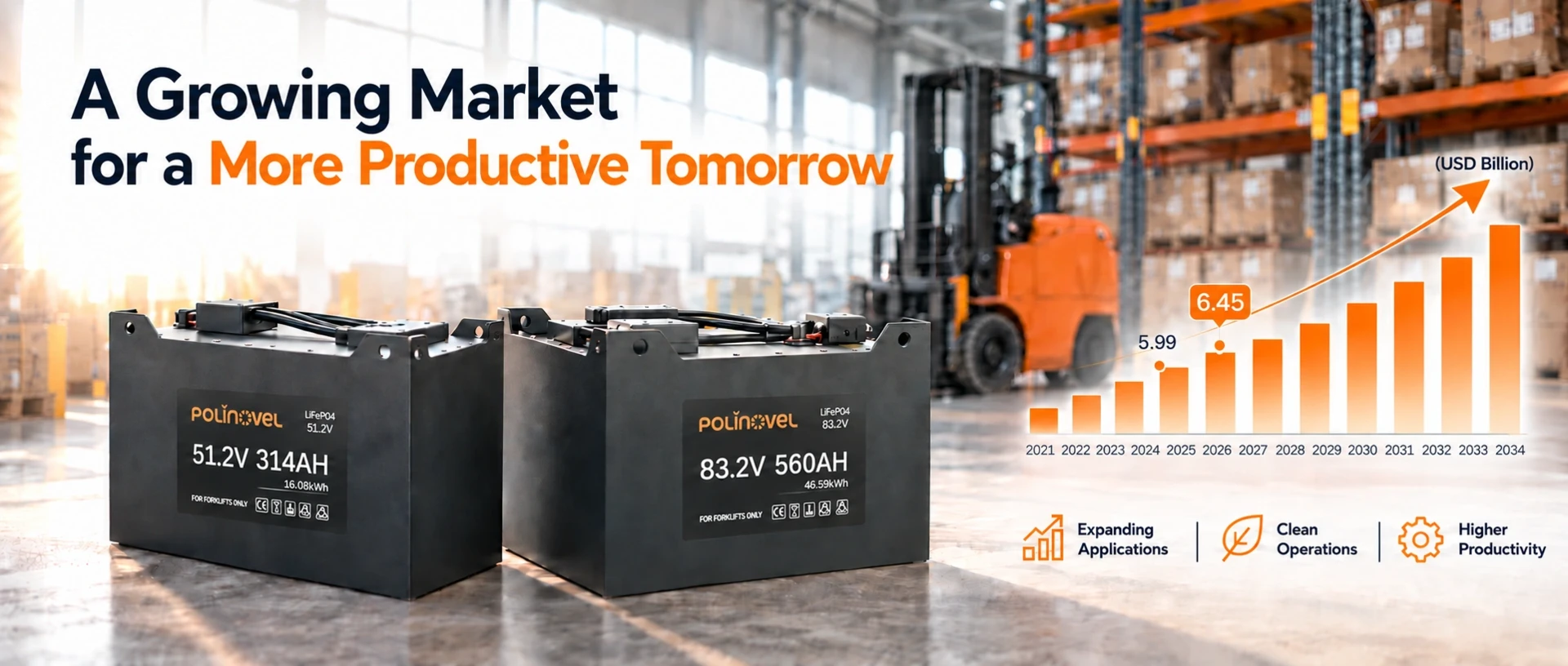
Fortune Business Insights estimates the global forklift battery market at USD 6.45 billion in 2026, compared with USD 5.99 billion in 2025. The market is projected to grow at a 7.7% CAGR through 2034.
At the same time, battery demand is changing. Lead-acid batteries remain widely used, while lithium-ion batteries are gaining ground in fleets that need faster charging, less routine maintenance, and higher equipment availability.
Here, we look at what is shaping the forklift battery market in 2026, how battery technology is changing, and what these shifts mean for fleet operators and buyers.
Forklift Battery Market at a Glance
The forklift battery market is expanding in both size and scope. Beyond overall growth, demand is also shifting across battery technologies, applications, and regions.
| Market Indicator | Key Data |
| 2025 Market Size | USD 5.99 billion |
| 2026 Forecast Market Size | USD 6.45 billion |
| 2034 Forecast Market Size | USD 11.68 billion |
| Forecast CAGR, 2026-2034 | 7.7% |
| Largest Regional Market, 2025 | North America - approx 33% |
| Lead-Acid Battery Share, 2025 | Approx 44% |
| Lithium-Based Battery Share, 2025 | Approx 38% |
| Largest Application Segment, 2025 | Warehousing-approx 46% |
Fortune Business Insights uses 2025 as the base year and 2026–2034 as the forecast period. The 2026 market size is therefore a forecast, while the market-share figures below are based on the report's 2025 base year. These figures are based on Fortune Business Insights market estimates. Results from other research firms may differ because of differences in market scope, segmentation, and methodology.
What Is Driving Growth in the Forklift Battery Market?
The forklift battery market is growing as electric material handling equipment becomes more widely used and fleet operating demands increase.
More Electric Forklifts in Material Handling
Warehouses, factories, and distribution centers continue to rely more heavily on electric forklifts. Each new electric truck creates demand for a compatible traction battery, while existing fleets also generate ongoing replacement demand.
This shift is supported by several practical advantages:
- Lower on-site emissions
- Quieter indoor operation
- Easier use in enclosed facilities
As electric fleets grow, so does the need for reliable battery systems across different forklift classes and duty cycles.
Higher Uptime and Longer Operating Hours
Many forklift fleets now operate for longer hours, and some run across two or three shifts. In these environments, battery downtime can quickly reduce truck availability.
As a result, fleet operators pay closer attention to:
- Runtime per charge
- Charging speed and available charging windows
- Battery swapping requirements
- Routine maintenance needs
The battery is no longer judged by capacity alone. It is increasingly evaluated by how well it supports daily fleet utilization.
Growth of High-Throughput Warehousing and Logistics
E-commerce fulfillment, distribution, and warehouse automation have increased the pace of material movement. Forklifts may have shorter idle periods and less time available for conventional charging. This makes predictable energy availability and flexible charging more valuable, especially in operations where delays can affect the wider workflow.
Lead-Acid vs. Lithium-Ion: How the Forklift Battery Market Is Shifting
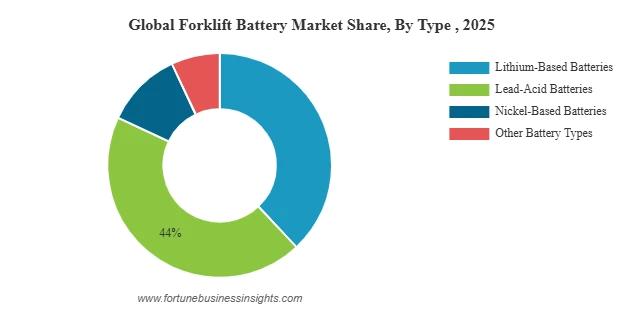
Lead-acid batteries still hold the largest share of the forklift battery market, at about 44%. Lithium-based batteries account for around 38% and are the fastest-growing battery type, according to Fortune Business Insights.
The shift is mainly driven by changing operating priorities. Lead-acid remains attractive for its lower upfront cost and established use, while lithium-ion is gaining adoption where fleets need:
- Faster and opportunity charging
- Lower routine maintenance
- Less battery swapping
- Integrated Battery Management System (BMS) monitoring
- Higher availability in multi-shift operations
Lead-Acid Battery vs. Lithium-Ion for Forklift
| Aspect | Lead-Acid Battery | Lithium-Ion Battery |
| Upfront Cost | Generally lower | Generally higher |
| Charging | Typically 8-10 hours | Typically 1-3 hours |
| Maintenance | Requires regular maintenance | Low routine maintenance |
| Cycle Life | Typically around 1,000-1,500 cycles | Typically 3,000+ cycles |
| Power Delivery | Voltage typically declines during discharge | More consistent power output during discharge |
| Typical Use | Predictable duty cycles | Multi-shift and high-utilization fleets |
Note: Charging time and cycle life vary by battery design, charger, depth of discharge, temperature, and operating conditions. Crown Equipment reports typical lead-acid charging times of 8–10 hours and a service life of about 1,000–1,500 charging cycles when properly maintained.
Which Applications Are Driving Forklift Battery Market Demand?
Demand in the forklift battery market is closely linked to how intensively electric forklifts are used. Warehousing, manufacturing, e-commerce logistics, cold storage, and heavy material handling are among the main demand areas, but each drives battery demand for different operational reasons.
| Application | Why It Drives Battery Demand |
| Warehousing & Distribution | Large electric forklift fleets, long operating hours, frequent charging |
| Manufacturing | Continuous material movement and multi-shift operation |
| E-commerce Fulfillment | High throughput, short idle periods, strong uptime requirements |
| Cold Storage | Growing need for batteries designed for low-temperature operation |
| Heavy Material Handling | Higher energy and power requirements for demanding workloads |
Warehousing and Logistics Remain Core Demand Areas
Warehouses and distribution centers operate large numbers of electric forklifts, often for extended hours. As fleet utilization rises, demand grows not only for replacement batteries but also for battery systems that support shorter charging windows and higher equipment availability.
Specialized Applications Are Creating New Demand
Market demand is also becoming more segmented. Cold-storage fleets need reliable low-temperature performance, while heavy-duty forklifts require higher power and energy capacity.
This means growth in the forklift battery market is not coming from fleet expansion alone. It is also being driven by more demanding applications and more specific battery requirements.
What Do Market Changes Mean for Forklift Battery Buyers?
The forklift battery market is becoming more application-specific. Buyers are no longer comparing batteries by voltage and capacity alone. Fleet utilization, charging strategy, operating environment, and system compatibility now play a larger role in purchasing decisions.
| Market Change | What Buyers Need to Consider |
| Longer operating hours | Runtime and daily energy demand |
| More multi-shift fleets | Charging windows and opportunity charging |
| More specialized applications | Temperature, workload, and operating environment |
| Smarter battery systems | BMS, CAN/RS485, and forklift communication |
| Greater system integration | Battery size, weight, connector, and charger compatibility |
Two points are especially important.
Higher Ah does not automatically mean a better battery. Capacity should match actual energy demand and available charging time.
The same voltage does not guarantee direct compatibility. Battery dimensions, weight, connector, communication protocol, and charger requirements also need to match the forklift.
For a more detailed selection process, see our guide on how to choose the right forklift battery for your fleet.
Forklift Battery Market Outlook: Trends Shaping Future Demand
Forklift fleets are running longer, and battery systems are becoming more connected with charging and material-handling operations. These changes are shaping several important trends in battery demand.
- Opportunity charging: More fleets now charge during breaks, shift changes, and other idle periods. This is especially useful in multi-shift operations.
- Smarter battery monitoring: SOC, temperature, fault alerts, and usage data give operators a clearer view of battery condition and daily use.
- Charging infrastructure planning: Battery selection also depends on the charging setup. Charger capacity, site power, charging windows, and the number of trucks charging at once all need to be considered.
- Greater system integration: Batteries increasingly need to work smoothly with forklifts, chargers, and warehouse systems.
- System-level safety: Safety depends on more than the battery itself. BMS protection, thermal management, charging equipment, and operating conditions all play a part.
These trends point to a broader shift in forklift battery selection. For a deeper look at these developments, see our guide to lithium forklift battery trends in 2026.
Overall, the forklift battery market is growing as electric material handling continues to expand. Lead-acid batteries remain widely used, while lithium-ion adoption is increasing in fleets that need faster charging, lower maintenance, and higher uptime.
Need the right battery for your forklift fleet? Explore Polinovel's forklift battery solutions or contact our team for a tailored recommendation.


