


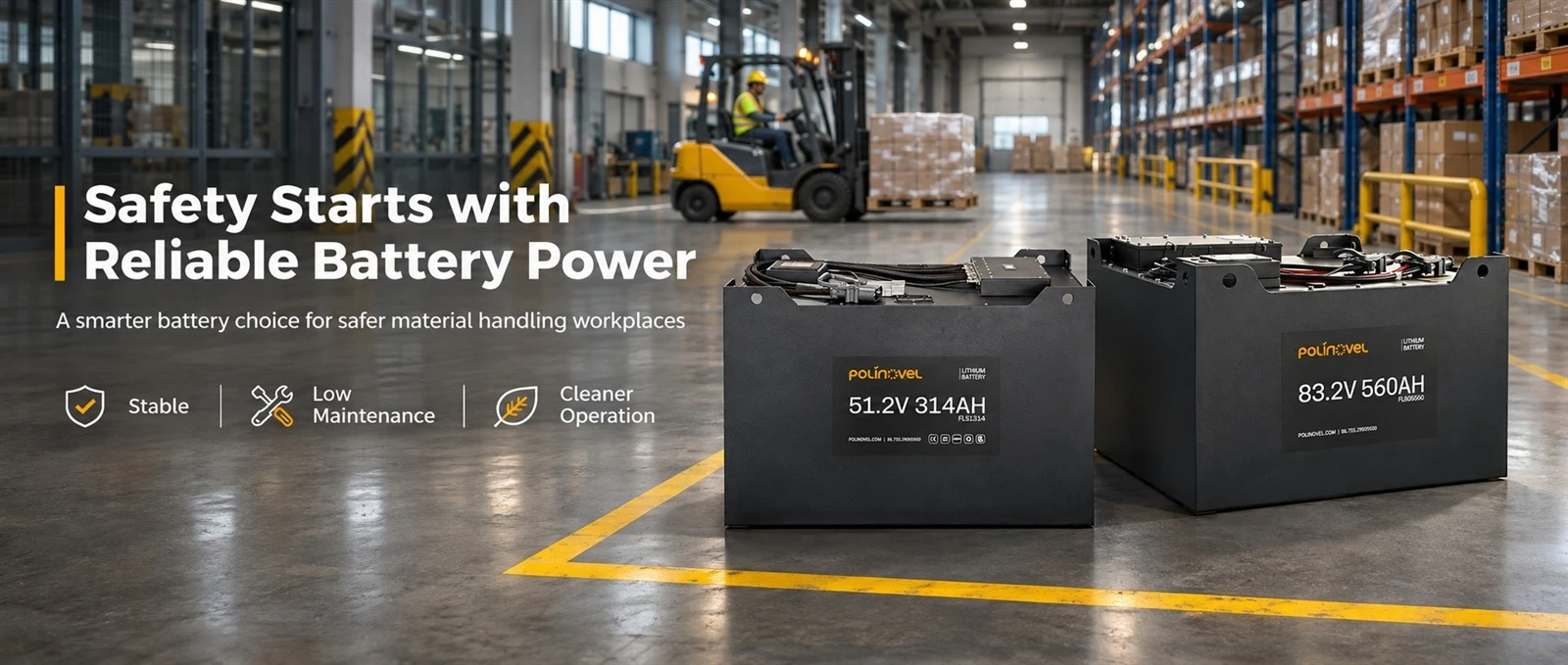
Lithium Forklift Batteries can help address several safety concerns in warehouse operations. Traditional lead-acid batteries require regular watering, can release hydrogen gas during charging, and involve heavy lifting during battery changes.
These risks can be reduced with the right lithium battery solution. Here are five ways lithium forklift batteries can improve workplace safety.
Reduce Routine Acid Handling and Watering Risks
Flooded lead-acid forklift batteries require regular maintenance to keep electrolyte levels within the recommended range. Workers need to check liquid levels and add distilled water when necessary. During this process, accidental spills or splashes can expose workers to corrosive sulfuric acid, causing skin burns or eye injuries.
The Canadian Centre for Occupational Health and Safety (CCOHS) also identifies sulfuric acid exposure as a key hazard during forklift battery handling and maintenance.
How Do Lithium Forklift Batteries Reduce These Risks?
- No Routine Watering: LiFePO4 batteries do not require regular electrolyte checks or distilled-water top-ups. This removes a recurring maintenance task.
- Less Acid Handling: Without routine watering, workers no longer need to handle lead-acid electrolyte during this maintenance process. This reduces opportunities for accidental acid exposure.
Although lithium batteries do not require routine watering, they still need regular maintenance. Workers should inspect battery enclosures, cables, and connectors to identify signs of damage and maintain safe operation.
Reduce Hydrogen Gas Hazards During Charging
Charging can create another safety concern with flooded lead-acid batteries. During charging, the electrolysis of water in the electrolyte can release hydrogen gas. If it builds up in a poorly ventilated area, a spark or other ignition source may cause an explosion.
According to CCOHS guidance on industrial lead-acid battery charging, adequate ventilation is essential to prevent hydrogen accumulation and reduce the risk of fire or explosion.
How Do the Two Battery Types Differ?
| Flooded Lead-Acid Batteries | LiFePO4 Batteries |
| Can release hydrogen during charging due to water electrolysis. | Do not generate hydrogen through this process during normal charging. |
| Require proper ventilation to prevent hydrogen accumulation. | Avoid this particular source of hydrogen accumulation. |
LiFePO4 batteries avoid hydrogen generation through water electrolysis during normal charging. They still require compatible chargers and proper charging conditions. Damaged or overheating lithium batteries may also release gases under abnormal conditions.
Reduce Battery Change-Outs and Manual Handling Risks
Frequent battery changes can create additional safety risks in busy warehouses. Each replacement involves disconnecting cables, lifting heavy batteries, moving them, and securing them in place. These operations require trained personnel and proper lifting equipment.
How Opportunity Charging Reduces Battery Change-Outs
Lithium forklift batteries can support opportunity charging during scheduled breaks. This allows operators to recharge without removing the battery from the forklift.
For example, Polinovel's 36V 770Ah Reach Truck Battery is designed for multi-shift material handling applications. Its high-capacity configuration and opportunity charging support can help reduce reliance on spare batteries when matched with the right charging schedule.
Key operational benefits include:
- Fewer Battery Changes: Reduce the need for frequent battery swaps during shifts.
- Less Repeated Lifting: Minimize some of the handling operations associated with battery replacement.
- Better Equipment Availability: Use scheduled breaks for charging instead of relying entirely on battery change-outs.
The extent of these benefits depends on the forklift's workload, battery capacity, and available charging time. Whenever battery removal is necessary, proper lifting and handling procedures must still be followed.
Improve Electrical Safety with Intelligent Battery Management
Forklift batteries operate under changing loads during lifting, acceleration, and charging. These conditions can affect battery voltage, current, and temperature. A Battery Management System (BMS) helps monitor these changes and protect the battery against abnormal operating conditions.
Key BMS Protection Functions:
- Voltage Protection: Monitors cell voltage and helps prevent overcharging and over-discharging.
- Overcurrent Protection: Responds when charging or discharging current exceeds preset limits.
- Short-Circuit Protection: Helps protect the battery when an electrical short circuit occurs.
- Temperature Protection: Monitors battery temperature and activates protection when preset limits are exceeded.
Polinovel's 48V 315Ah Counterbalance Forklift Battery integrates several BMS protection functions, including overcharge, over-discharge, overcurrent, short-circuit, and temperature protection. These functions help monitor battery operating conditions and respond to abnormal electrical or thermal conditions. RS485/CAN communication also supports data exchange with compatible forklift monitoring systems.
These functions provide an additional layer of protection during daily operation, but they cannot eliminate every battery-related risk. Proper charging, correct installation, and routine inspections remain essential.
Protect Battery Components from Dust and Moisture
Forklifts often operate in environments with dust, moisture, vibration, and occasional impacts. These conditions can put stress on the battery enclosure and internal electrical components. Without suitable protection, dust or water ingress may affect electrical connections and battery reliability.
How Does Battery Enclosure Design Improve Protection?
Two features are worth considering when selecting a forklift battery:
- Steel Enclosure: An SPCC steel enclosure provides a physical housing for the battery's internal components. It adds an outer layer of protection during normal handling and operation. However, its actual resistance to vibration and mechanical impact depends on the overall enclosure design and should be verified through relevant test data.
- IP-Rated Protection: A properly designed and sealed enclosure helps limit dust and water ingress. Different IP ratings are available for different working conditions, from indoor warehouses to dusty production floors and outdoor environments.
Polinovel's 48V 315Ah Counterbalance Forklift Battery features an SPCC steel enclosure, with IP54, IP65, and IP67 protection options. These configurations allow buyers to select a suitable protection level based on the actual operating environment.
It's also important to understand the limits of these ratings. IP ratings describe protection against solid particles and water ingress, not fire resistance or mechanical impact resistance. If a forklift operates in an environment with frequent vibration or potential impacts, check the battery's relevant test data and installation requirements. Regularly inspect the enclosure, connectors, and seals to maintain reliable operation.
Are Lithium Forklift Batteries Completely Safe?
Lithium forklift batteries offer several safety advantages, but no battery technology is completely risk-free. LiFePO4 batteries have good thermal stability. Even so, severe physical damage, internal electrical faults, or charging outside the recommended limits may still cause overheating and, in serious cases, thermal runaway. This can lead to fire and the release of hazardous gases.
According to UL Research Institutes, thermal runaway is an uncontrolled self-heating process that can result in extremely high temperatures, gas release, smoke, and fire.
What Should Operators Pay Attention To?
- Charging Conditions: Use a charger compatible with the battery. Follow the specified voltage, current, and temperature limits.
- Physical Condition: Check the battery enclosure, cables, and connectors regularly. Any signs of damage or unusual heating should be investigated.
- BMS Warnings: Pay attention to battery alarms and abnormal readings. Stop using the battery if a serious fault is detected and arrange an inspection by qualified personnel.
A BMS and protective enclosure provide important layers of safety, but they cannot replace proper installation, regular inspection, and safe operating procedures.
What Should You Check When Choosing Lithium Forklift Batteries?
Choosing lithium forklift batteries involves more than matching voltage and capacity. Several factors should be checked to ensure the battery fits the forklift and meets its operating and safety requirements.
| Selection Factor | What to Check | Why It Matters |
| Battery Weight & Dimensions | Weight limits, battery compartment size, and mounting requirements | Maintains proper forklift balance and fitment |
| BMS Protection | Overcharge, over-discharge, overcurrent, short-circuit, and temperature protection | Helps manage abnormal battery conditions. |
| Charger Compatibility | Charging voltage, current, and charging profile | Prevents incompatible charging conditions. |
| Enclosure Protection | IP rating, enclosure strength and environmental requirements |
Protects battery components in demanding environments. |
| Battery Safety Documentation | Applicable test reports, certifications and technical specifications | Helps verify product safety and compliance. |
For some electric counterbalance forklifts, the battery also serves as part of the counterweight. A replacement battery that falls outside the manufacturer's specified weight range may affect the truck's stability. Always check the minimum and maximum battery weight before selecting a replacement.
When evaluating a lithium forklift battery, always consider the forklift model, operating environment, and charging requirements together. Polinovel offers LiFePO4 battery solutions for different material handling applications, with configurations to meet various equipment and operating needs.
Lithium forklift batteries can help reduce several workplace safety risks, from routine acid handling and charging hazards to frequent battery changes. BMS protection and suitable enclosure designs provide additional safeguards during daily operation.
Safe operation also depends on proper battery selection, charger compatibility, correct installation, and regular inspection. Choosing the right battery configuration is essential for reliable forklift operation.
Looking for reliable lithium forklift batteries for your material handling equipment?
Explore Polinovel's LiFePO4 Forklift Battery Solutions and find a configuration that matches your forklift model and operating requirements.


