


A replacement battery for airport ground support equipment (GSE) should carry the vehicle through its busiest dispatch sequence while preserving enough energy for the next assignment. Size a LiFePO4 pack from measured battery-side energy and charging sessions the fleet can reliably complete. Then check voltage, peak current, charger compatibility and installation fit separately. A baggage tractor's loaded pull-away and a belt loader's loaded conveyor start are different events, even when two vehicles use similar energy over a shift.
Screen the Vehicle Before Sizing the Battery
Record the make, model, serial range, controller revision, original battery nameplate and charger model. Obtain the vehicle manufacturer's approved DC input limits, including regenerative braking limits where applicable. For the battery bay, record usable length, width and height, connector and service clearance, cable exit, restraint points and allowable pack mass. Compare the candidate's full operating and charging voltage range with the vehicle and charger limits before shortlisting it by capacity.
TLD lists an 80 V DC lead-acid option for the JET-16 baggage tractor and a 48 V lead-acid configuration for the RBL belt loader. Those figures identify the published configurations. Use the vehicle-specific documents to determine permissible controller voltage, charger end voltage and regenerative limits for the vehicle being converted. (TLD JET-16 fact sheet, TLD RBL)

Measure the Energy Your Shifts Actually Use
Log the vehicle from the first dispatch through the end of the later shift, including travel to and from the charger. Record battery-side DC voltage and current or power, timestamps, vehicle state, pack temperature and state of charge (SOC). Use positive power when energy leaves the pack and negative power when it enters. For every work or standby block, integrate signed power over time to get net kWh out. Any energy that actually returns to the pack through regeneration is already included in that integral. Record plugged-in charging separately as net kWh added at the same pack boundary. Use controller or battery management system (BMS) event traces with enough time resolution to capture brief current peaks. If those records miss short events, have a qualified technician use an OEM-approved measurement method and suitably rated logging equipment to capture synchronized pack-side voltage and current. Select the sampling rate for the shortest event you need to resolve. Keep the peak-current check pending if you cannot capture it reliably.
A 2024 National Academies report on airport charging describes GSE duty cycles that alternate between short high-load periods and inactivity. Fleet logs supply the energy and current values for the actual vehicle. (National Academies airport charging report)
Baggage Tractor Duty Cycle
Tag loaded trips, empty returns, repeated starts, grade changes and queues. Record the cart count or estimated tow mass, route and time in each state. Capture current and event duration at loaded pull-away and on the steepest section of the normal route. Group trips by flight wave so the ledger shows when towing demand builds and when dispatch can release the tractor to charge.
Belt Loader Duty Cycle
Separate travel and repositioning from loaded conveyor runtime, boom functions where applicable, and standby. Record the current and duration of loaded belt starts and capture any overlapping auxiliary loads the vehicle is designed to run. Check when dispatch can release the loader from its assigned stand. A pause between aircraft turns belongs in the charging plan only if the loader can reach a port and charge during that time.

| Time block | State and load | Net work energy out (kWh) | Net plug-in charge added (kWh) | Peak current (A), duration (s) and frequency | Start and end SOC and pack temperature |
|---|---|---|---|---|---|
| One row per work, standby or charge block | Loaded tow, empty return, conveyor, standby or charge | Record signed net pack energy for work or standby | Record net pack energy for plugged-in charging | Record peak, duration and repetitions | Record SOC and pack temperature at both ends |
Calculate Usable Capacity Around Real Charging Windows
Set an operating SOC floor that includes the dispatch reserve and a starting SOC the fleet can reliably reach. Use measured energy between those setpoints when data are available for the planned temperature and pack condition. For a first-pass estimate when SOC is expressed as a percentage, use this relationship.
Usable kWh ≈ nominal kWh × (starting SOC − floor SOC) ÷ 100 × capacity retention factor
The retention factor is the fraction of nominal energy capacity measured at the planned temperature and pack condition. This approximation assumes the energy in the selected SOC window is proportional to the SOC span. If you have measured usable kWh across that window at the relevant condition, use that value directly without applying the retention factor again. For procurement, rerun the ledger at the fleet's agreed end-of-service condition using pack-specific usable energy at the planned temperature. Verify the current and loaded voltage limits at that condition as well. Lithium-ion packs can lose both energy capacity and power as they age. (U.S. Department of Energy battery technology review)
Count charging from the time the pack starts accepting power. Deduct travel, port queues, connection and handshake delays from the scheduled break. Keep travel and standby energy in the work ledger. For a first-pass estimate, use net pack-side kWh measured during a representative session or average net pack power multiplied by effective charging hours. Verify the usable energy recovered against comparable pack data or a representative charge-and-discharge test before committing to the schedule. Account for conversion losses where applicable, taper, pack temperature and shared charger capacity. A battery warm-up period before charging reduces the available time. See the Polinovel lithium battery charger compatibility guide for charger matching principles.
San Diego Gas & Electric's 2021 final report documents eight chargers with 16 ports in the first phase of its airport pilot. The December 2019 to August 2020 session records covered 19 baggage tugs and 12 belt loaders. Those counts describe the pilot. Model your busiest handover using your own port schedule and the power each connected vehicle can actually receive. (SDG&E final report, section 2.10)
Two-Shift Energy Balance With and Without a Charge Break
For this calculation, assume 30 kWh of full-scale planning energy at the chosen condition, an energy-proportional SOC and no additional storage losses. A 90% start gives 27 kWh, and a 20% floor corresponds to 6 kWh, leaving 21 kWh for dispatch. Assume a 35-minute break yields 20 minutes of effective charging at an average net pack input of 15 kW, adding 5 kWh. The work blocks include the corresponding travel and standby loads. These are calculation inputs, independent of any vehicle or product test.
| Event | Net work energy out (kWh) | Planned net charge in (kWh) | Energy remaining with charge (kWh) | Energy remaining if charge is missed (kWh) |
|---|---|---|---|---|
| Dispatch | 0 | 0 | 27.0 | 27.0 |
| Morning flight wave | 12.0 | 0 | 15.0 | 15.0 |
| Handover charging | 0 | 5.0 | 20.0 | 15.0 |
| Afternoon flight wave | 11.0 | 0 | 9.0 | 4.0 |
| Final moves and parking | 1.5 | 0 | 7.5 | 2.5 |
Subtract net work energy and add net pack charge at each step, capping the recharge credit at the headroom to the permitted charge ceiling. Compare the lowest balance with the 6 kWh floor. Split long blocks at any point where the balance could dip below the floor before recovering. The largest cumulative net draw in this example is 19.5 kWh with charging and 24.5 kWh with a missed session, against a 21 kWh dispatch budget. With charging, the pack finishes 1.5 kWh above the floor. Without it, the pack crosses the floor during the afternoon wave. If dispatch cannot reliably protect that charging window, run the same ledger with more usable capacity, a confirmed alternate port or a vehicle reassignment. Recheck route energy and standby time when the backup plan changes either. Check the starting SOC for the next dispatch if the sequence repeats.
Check Peak Loads, Charger Compatibility and Installation Fit
For a loaded tractor start or a loaded conveyor start, record the current, event duration, lowest pack voltage and repetition rate. Compare those traces and any sustained loads with the approved current-versus-time envelope at the intended SOC and pack temperatures. Include regenerative charge current and voltage where applicable.
| Check | Evidence for a preliminary pass | When to keep the check open or rule out the candidate |
|---|---|---|
| Operating voltage and regeneration | Vehicle and controller limits cover the expected discharge, charge and regenerative events, including loaded voltage sag and any controller derating. | Limits are missing or an expected event exceeds an approved limit. |
| Continuous and peak current | The logged currents, durations and repetition fit the pack's approved limits at the planned SOC and temperature. | The available amp rating lacks a time or temperature basis, or the measured demand exceeds a verified limit. |
| Charger and interlock | Approved charge profile, mating connector and pinout, BMS handshake where required, and vehicle charge interlock behavior are documented. | The charger profile, pinout, communications or drive-enable behavior remains unverified. |
| Installation | Dimensioned drawings confirm enclosure and service clearance, restraint, cable routing, allowable mass and any vehicle weight-distribution limits. | Drawings or tolerances are missing, or mounting or mass conflicts with the vehicle requirements. |
Mark each check preliminary pass, pending evidence or mismatch. For systems that exchange BMS data with the vehicle or charger, confirm the protocol revision, required messages, fault handling and behavior on loss of communication. Before installation and release to service, have qualified vehicle and site personnel verify the vehicle manufacturer's limits, the pack and charger documentation, and the agreed acceptance requirements.
Compare Polinovel Airport GSE Battery Options
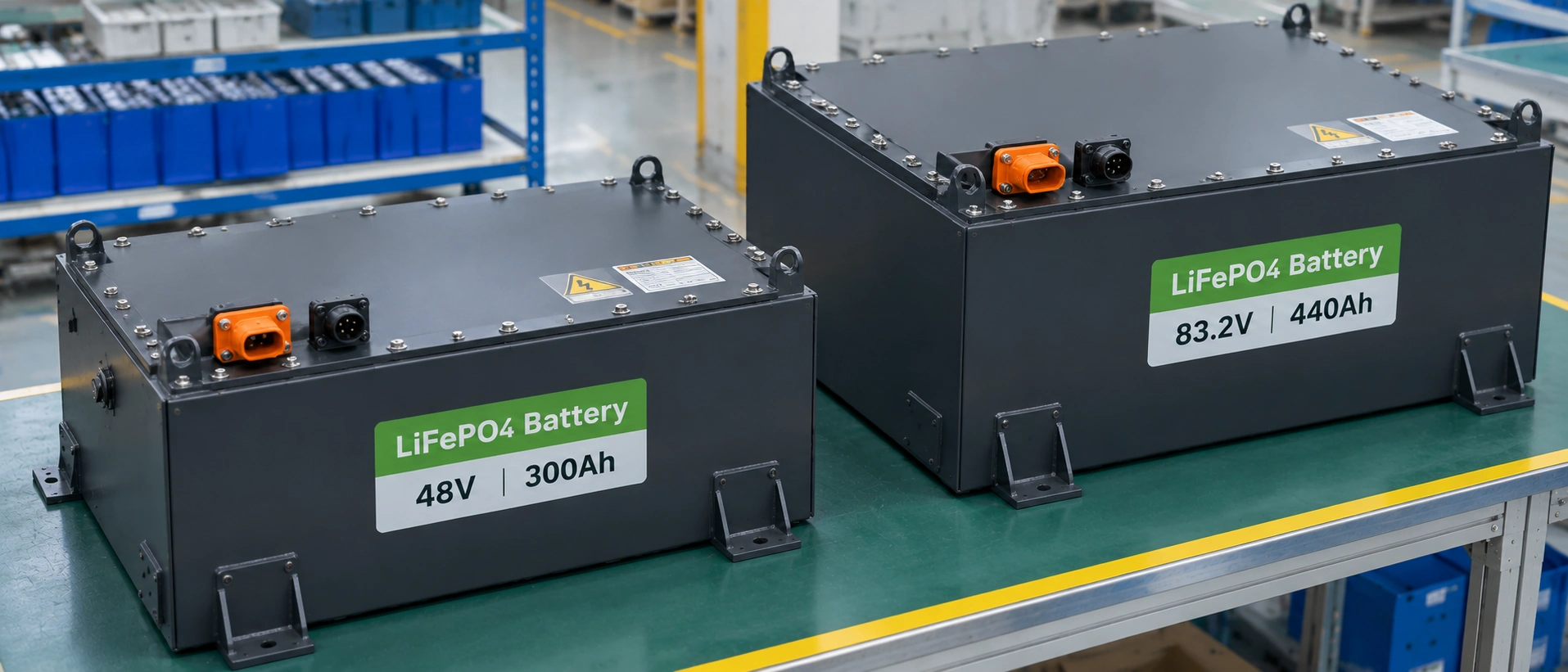
Use the published configurations to shortlist candidates. Confirm vehicle-specific fit with the approved pack revision, vehicle and charger documentation, and agreed acceptance checks.
| Polinovel route | Published configuration | Evidence needed to shortlist it |
|---|---|---|
| FL83440 standard GSE battery | Polinovel publishes the FL83440 as a LiFePO4 pack rated at a nominal 83.2 V and 440 Ah, equivalent to about 36.6 kWh nominal. Use this figure to identify the candidate and ask for usable energy over your operating SOC window. | Compare the offered revision's operating voltage range with the vehicle limits. Request usable kWh at the specified temperature, current limits by duration, charging data, mounting drawings and mating interface details. |
| Custom baggage tractor batteries | Polinovel lists built-to-order LiFePO4 options for 48 V and 80 V baggage tractor platforms. Set the capacity from the vehicle's energy ledger and approved voltage range. | Send the full vehicle voltage window, loaded pull-away and grade traces, usable kWh target, pack bay and restraint drawings, and charger requirements. Specify the required configuration from the vehicle data. |
| Custom belt loader battery project | Polinovel reports a 48 V, 300 Ah LiFePO4 configuration for a conveyor belt loader project in Malaysia. | For a new loader, submit the voltage window, loaded conveyor runtime and starting current, auxiliary demand, usable charging window and installation drawings. Treat the published configuration as a project reference. |
For an existing 80 V baggage tractor, keep the FL83440 on the shortlist only if the offered revision meets the documented voltage, current and installation limits. Use its usable energy and charge-session data in the dispatch ledger once those inputs are available. If the standard pack fails a check, use the same vehicle requirements to scope a built-to-order option. For an electric belt loader replacement, use the measured conveyor duty and the time the loader can spend away from the stand to set the capacity and charging requirements.
What to Send for a Battery Fit Review
Include the following in your request for quotation (RFQ) or technical inquiry.
Vehicle make, model, serial range and controller revision, plus the original pack nameplate and drawings where available.
Approved vehicle DC limits, including regeneration where applicable, and the compartment, restraint, allowable mass and weight-distribution requirements.
Time-stamped logs from the busiest dispatch sequence with net battery-side kWh, starting SOC, peak current and duration, and pack temperature. Identify loaded tractor starts or loaded conveyor starts in the log.
Charger make and model, charge profile, connector and pinout, communications details where required, and effective charging time and port availability.
Dispatch reserve, consecutive-shift schedule, missed-charge acceptance criteria and the temperature conditions the fleet must cover.
Request a Polinovel GSE Battery Fit Review to discuss whether the FL83440 merits further evaluation or which requirements should define a custom pack. Flag any pending measurements so the review can identify what still needs to be verified before a quote or trial fit. You can also send the fit-review request to sales@polinovelpowbat.com.


