


Charging lithium batteries correctly plays a major role in system life, safety, and long-term performance. While many treat it as a "plug-and-play" utility, improper charging logic often triggers premature capacity fade and avoidable thermal stress.
Based on Polinovel's field observations, this guide provides a technical deep-dive into CC/CV protocols and hardware synchronization.
How Lithium Battery Charging Works
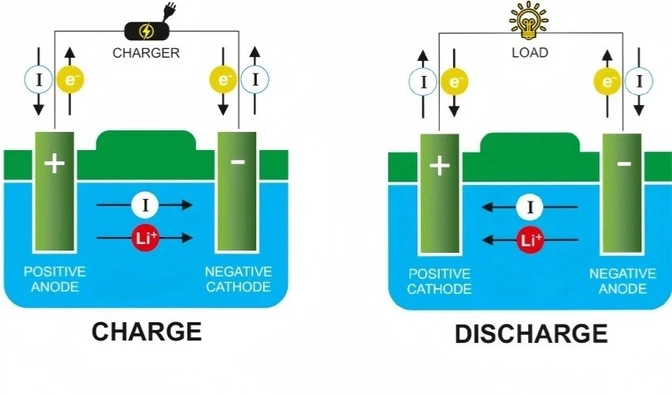
Charging is more than just forcing current into a pack. It is a delicate migration of lithium ions. When you apply a lithium battery charger, lithium ions move from the cathode to the anode through the electrolyte and separator, where they are stored in the anode structure during charging.
This process must be controlled. If you push too fast or with the wrong charge voltage, you risk damaging the internal structure.
The CC/CV Charging Profile: The Industry Standard
Lithium-ion chemistry follows a strict two-stage protocol: Constant Current (CC) and Constant Voltage (CV).
Constant Current (CC) Stage: This is the bulk charging phase. The charger delivers a steady current while the voltage rises. For many industrial applications, the CC stage brings the battery to about 80% SoC.
Constant Voltage (CV) Stage: Once the battery reaches its voltage limit, the charger shifts. The voltage stays constant, but the current begins to taper off. This is the "saturation" phase. It ensures the ions find their place safely without overstressing the cell.
How to Choose the Right Charger for Lithium Batteries
Choosing a charger goes beyond a physical plug match-it's about total system synchronization. To protect your investment and maximize ROI, your charger must align with the battery's internal logic to prevent premature degradation.
Selecting a charger is, first and foremost, a matter of precision control. Unlike generic power sources, a lithium-compatible charger is a precision instrument designed to manage the unique charging profile of LiFePO4 chemistry through two critical functions:
- Voltage Stability: It maintains the exact parameters required for the seamless transition between CC (Constant Current) and CV (Constant Voltage) stages.
- BMS Coordination: Especially in industrial systems, the charger must respect the Battery Management System's limits to ensure every cell stays within safe operational boundaries.

Why a Lithium-Compatible Charger Matters
Selecting a charger is, first and foremost, a matter of precision control. Unlike generic power sources, a lithium-compatible charger is a precision instrument designed to manage the unique charging profile of LiFePO4 chemistry through two critical functions:
- Voltage Stability: It maintains the exact parameters required for the seamless transition between CC (Constant Current) and CV (Constant Voltage) stages.
- BMS Coordination: Especially in industrial systems, the charger must respect the Battery Management System's limits to ensure every cell stays within safe operational boundaries.
Using a mismatched charger is not just inefficient; it can lead to repeated BMS cutoffs, incomplete charging, or unnecessary stress on the battery pack, especially when older charging hardware is reused without checking profile compatibility.
Can You Use a Lead-Acid Charger for a Lithium Battery?
In most cases, a standard lead-acid charger is not the best choice unless it includes a battery-compatible lithium mode and the battery manufacturer explicitly allows it. The main concerns are equalization behavior and float-stage behavior:
- The Equalization Risk: Lead-acid chargers often use high-voltage "Equalization" pulses to desulfate lead plates. These pulses can fatally damage lithium cells or cause the BMS to shut down instantly to prevent a thermal event.
- The Float Risk: Lead-acid batteries require a "trickle" or "float" charge to offset self-discharge. Lithium does not. Constant voltage pressure at 100% SoC (State of Charge) causes Lithium Plating, which creates internal safety hazards and slashes the battery's lifespan.
Once you have committed to a lithium-specific charger, the next step is to align the hardware's output with your system's specific voltage architecture.
Matching Charger Voltage to Your Battery System (12V–48V)
It is a common mistake to assume the charger voltage should exactly match the battery's nominal voltage. In reality, the charger must reach a higher target voltage than the battery's nominal voltage to move lithium ions into the anode efficiently during charging.
To ensure a full and safe charge, always verify your charger's output against the battery manufacturer's specification. The table below shows typical LiFePO4 target-voltage ranges for common 12V, 24V, 36V, and 48V systems as a practical reference point.
| Battery Nominal Voltage | Charger Target Voltage (Typical) |
| 12V (4 Cells) | 14.4V -14.6V |
| 24V (8 Cells) | 28.8V- 29.2V |
| 36V (12 Cells) | 43.2V - 43.8V |
| 48V (16 Cells) | 57.6V -58.4V |
Balancing Speed and Longevity: The Role of Charging Current
While voltage determines "if" a battery will charge, the current (Amperage) determines how fast it charges and how much heat is generated. In industrial settings, the goal is to balance operational productivity with long-term ROI.
- Practical Current Range: In many industrial LiFePO4 systems, a charge rate around 0.3C to 0.5C is often used as a practical balance between charging speed and heat generation. However, the correct limit still depends on the battery design, BMS settings, and manufacturer guidance.
- The Law of Diminishing Returns: High current increases internal resistance and heat (P = I²R). If the battery temperature exceeds safe thresholds, the BMS will throttle the charger. Consequently, an oversized "fast" charger may not actually reduce downtime; it may simply trigger safety-related delays.
When choosing your charger, always ensure the maximum output current does not exceed the Continuous Charge Current rating specified by the battery manufacturer.
How Long Does It Take to Charge a Lithium Battery?
For industrial operators, charging time is a critical factor in fleet uptime and operational efficiency.

The Professional Calculation Formula
A basic division (Ah / A) only provides a theoretical baseline. To account for the physical realities of lithium charging, industrial engineers apply a 1.15x engineering buffer to determine a realistic timeframe:

Note: This formula offers a high-probability estimate. Actual results may fluctuate based on battery chemistry (LiFePO4 vs. NMC), ambient temperature, and the age of the cells.
The Logic Behind the 1.15 Coefficient:
The 10% Efficiency Gap: Most industrial chargers operate at approximately 90% efficiency. The extra 0.1 accounts for energy lost as heat during the AC-to-DC conversion and internal resistance.
The 5% Saturation Phase: Lithium charging is non-linear. While the CC (Constant Current) stage is fast, the final CV (Constant Voltage) stage slows the current to safely "top off" the cells. This "saturation tail" typically adds about 5% to the total session time.
Based on the 1.15x formula, here is the projected downtime for common industrial configurations from 0% to 100% SoC:
| Battery Capacity | Charger Current | Charge Rate | Estimated Real-World Time |
| 100Ah | 20A | 0.2C | ~5.5-6 Hours |
| 100Ah | 50A | 0.5C | -2.3-3 Hours |
| 200Ah | 40A | 0.2C | -5.5-6 Hours |
| 200Ah | 100A | 0.5C | -2.3-3 Hours |
Can You Speed Up Charging Time?
Technically, yes-by increasing the Amperage. However, there is a physical "ceiling" defined by the battery's C-rate.
- The 0.5C Optimization: Most industrial LiFePO4 batteries are optimized for a 0.3C to 0.5C charge rate. This provides the best balance between fast recovery and minimal thermal stress.
- The Throttling Risk: While 1C charging is possible, the resulting heat (P = I²R) often forces the BMS to throttle the input current to prevent cell damage, meaning a higher-rated charger may not actually save time.
- A Strategic Alternative: For 24/7 operations, Opportunity Charging (short bursts during breaks) is often more efficient than a full 0-100% deep charge, as it keeps the battery in the most receptive "fast-charge" zone (20-80% SoC).
Why Real-World Charging Time Results May Vary
If your charging time deviates from the formula, it is likely due to these three technical "hidden" factors:
- BMS Cell Balancing: If individual cells are out of sync, the BMS will extend the final charging stage to balance voltages, ensuring long-term pack health.
- Environmental Temperature: Extreme cold increases internal resistance, while extreme heat triggers safety slowdowns. Both scenarios extend the charging window.
- Infrastructure Loss: Long cable runs or poor-quality connectors create voltage drops. This energy is wasted as heat rather than being stored in the battery.

Lithium Battery Charging in Industrial Applications
The charging principles above apply broadly, but they become especially important in industrial environments where uptime, charger compatibility, and thermal control directly affect daily operations.
Opportunity Charging: The "Zero-Downtime" Strategy
The traditional "8-8-8" model-requiring 8 hours of work, 8 hours of charging, and 8 hours of cooling-is effectively obsolete for modern workflows. Lithium technology enables Opportunity Charging, which integrates power replenishment directly into natural operational breaks.
- Seamless Integration: Since lithium has no "memory effect," operators can plug in during 15-minute breaks or lunch intervals. This strategy consistently keeps the State of Charge (SoC) within the 20% to 80% efficiency zone throughout the shift.
- Three-Shift Versatility: In forklift or AGV applications, a single lithium battery often powers three consecutive shifts. By utilizing "top-ups" during idle time, you eliminate the need for expensive spare inventory and the labor-intensive battery rooms required for lead-acid swaps.

CAN Bus Communication: The System's Intelligence
Industrial charging is a data-driven process where performance is dictated by active synchronization via CAN Bus protocols. This digital "brain" ensures that the charger and the BMS (Battery Management System) work in perfect alignment.
- Adaptive Output: Through a continuous digital "handshake," the charger adjusts its output in real-time based on the cell temperatures and internal resistance reported by the BMS.
- Predictive Protection: This closed-loop communication ensures the charger never exceeds the battery's safe operational envelope. If the BMS detects a cell drifting out of balance, it commands an immediate throttle-back to prevent thermal stress and safeguard long-term ROI.
Industrial Safety Standards and Thermal Management
Equipment on the industrial floor must withstand high vibration, dust, and extreme temperatures. Reliability here is a product of rigorous engineering and global compliance.
1. Active Thermal Regulation: Charging high-capacity packs for heavy-duty forklifts generates significant internal heat. Industrial-grade chargers utilize advanced thermal management to prevent electrolyte aging, ensuring consistent performance even in non-climate-controlled warehouses.
2. Certified Compliance (UL, CE, IEC): To meet corporate safety audits and insurance mandates, Polinovel systems adhere to essential global benchmarks:
- UL 2580 / UL 2271: Validates that the battery and charging system can withstand severe mechanical stress and electrical faults.
- IEC 62133: The definitive international standard for the safety of lithium cells in industrial use.
- CE (LVD/EMC): Guarantees electromagnetic compatibility, preventing the charging process from interfering with sensitive AGV sensors or warehouse electronics.
Quick Checklist for Charging Lithium Batteries Safely
To maximize the ROI and safety of your energy assets, industrial operators must move beyond basic connectivity and adhere to these technical charging standards.
1. Hardware Alignment & Profile Integrity
Manufacturer-Recommended Profiles: Always utilize a charger with a profile specifically recommended by the battery manufacturer to ensure all voltage and current parameters are correctly aligned.
- The Equalization Trap: Strictly avoid chargers with lead-acid "Equalization" modes. The high-voltage pulses designed to desulfate lead plates can fatally stress lithium chemistry or trigger an immediate BMS lockout.
- Voltage Precision: Lithium chemistry requires an exact voltage ceiling; a deviation of even 0.2V from the recommended profile can compromise system stability or trigger protective shutdowns.
2. Environmental & Thermal Constraints
- Sub-Zero Charging Management: Never initiate charging below 0° (32F) unless the system features integrated heating elements. In freezing conditions, lithium ions may "plate" the anode surface as metallic dendrites, creating a permanent risk of internal short circuits.
- Ventilation & Heat Mitigation: Always charge in well-ventilated spaces to prevent energy from becoming trapped. Excessive heat is the primary driver of electrolyte decay and premature capacity fade.
3. System Intelligence & Storage Strategy
- BMS-Charger Synchronization: Prioritize chargers that support active BMS coordination. A "dumb" charger that cannot react to BMS safety triggers removes your primary defense against thermal events.
- High-SoC Fatigue Management: Avoid maintaining a 100% State of Charge (SoC) during prolonged periods of inactivity. For long-term storage, maintaining a range of 40% to 60% SoC is generally recommended to reduce chemical stress and electrolyte oxidation.
- Connection Integrity: Ensure all hardware fittings are tight to minimize resistance. Loose connectors lead to energy waste and fire hazards through I²R heat losses.
Correct lithium battery charging is the single most effective way to ensure the longevity of your lithium power system. By adhering to the proper CC/CV profiles, respecting temperature limits, and utilizing CAN bus communication, you don't just protect a battery-you optimize your entire operational uptime.
Whether you are scaling a warehouse fleet or developing a specialized motive power system, Polinovel provides integrated battery-and-charger solutions designed to support safety, charging efficiency, and long service life in application-specific use cases.
Stop guessing and start optimizing. [Contact Our Engineers Today] for a custom power consultation and get a system designed for your specific duty cycle.
FAQ About Charging Lithium Batteries
Q: What is the rule for charging lithium batteries?
A: The basic rule is to use a lithium-compatible charger with the correct voltage, current limit, and CC/CV charging profile. Always follow the battery manufacturer's charging specifications, especially for voltage, temperature, and maximum charge current.
Q: Do I need a special battery charger to charge lithium batteries?
A: In most cases, yes. A lithium battery should be charged with a charger designed for its chemistry, such as LiFePO4. The charger must match the battery's voltage, current rating, and BMS requirements.
Q: What happens if you charge a lithium battery with a lead-acid battery charger?
A: A lead-acid charger may use float charging or equalization modes that are not suitable for lithium batteries. This can cause incomplete charging, BMS shutdown, cell stress, or long-term battery damage.
Q: Is it okay to leave a lithium-ion battery on the charger overnight?
A: It depends on the charger and battery system. A quality lithium charger should stop or reduce charging when the battery is full. However, keeping a lithium battery at 100% state of charge for long periods is not ideal for long-term battery health.
Q: How long will a 10 amp charger take to charge a 100Ah battery?
A: A simple estimate is: 100Ah ÷ 10A × 1.15 = about 11.5 hours. Actual charging time may vary depending on battery condition, charger efficiency, temperature, and the final constant-voltage charging stage.


