


What is Modular Design?
Got a call last month from a fleet manager in Michigan. Cold storage facility, reach trucks running three shifts. His 80V battery pack threw a fault code after 14 months-BMS locked out, truck dead. Called his supplier, got quoted $22,000 for replacement and a six-week wait.
We asked him to pop the cover and send some photos. Turned out the cells were glued straight to the tray with structural adhesive. No modules, no service access. The whole pack was one solid block. Whoever designed it was probably trying to squeeze out a few extra Wh/kg for the spec sheet, and now this guy's paying for that decision.
That's the context when someone asks us about modular design. It's not really about definitions-it's about what happens when things go wrong, which they always eventually do.

The Basic Idea
Modular design means organizing cells into separate units (modules) that you can pull out and work on individually. Each module has its own frame, its own electrical connections, its own thermal interface. When the pack needs service, you're dealing with a 5-10 kWh chunk instead of a 60 kWh monolith.
The alternative approach-Cell-to-Pack, Cell-to-Chassis, whatever you want to call it-skips those intermediate structures entirely. Cells go straight into the pack housing or even the vehicle floor. You've probably seen the marketing: CATL's Qilin hits 72% volume utilization, BYD's Blade cells run the full width of the tray, Tesla welds their 4680s into structural packs.
These are real engineering achievements. They make sense for passenger EVs where everyone's competing on range numbers and you're stamping out millions of identical units. But industrial applications are a different situation entirely.
Where the Problems Show Up
When cells are bonded with structural adhesive, you can't take them apart without destroying something. The same thermal interface materials that improve heat transfer also make the whole assembly permanent. One cell goes bad, the pack goes bad.
Passenger car owners lease for three years and trade in. A forklift runs ten years minimum in a distribution center. The math works out differently.
We've tracked repair costs across our customer base and the pattern is consistent. Module-level service runs $400-800 including labor. Full pack replacement on a comparable integrated design-when you can even get one-runs $15,000-25,000, plus weeks of lead time.
| Module Swap | Pack Replacement | |
|---|---|---|
| Parts + labor | $400-800 | $15,000-25,000 |
| Turnaround | Same day | 2-6 weeks |
| Who can do it | Trained tech on-site | Ship to factory |
That's a 20-30x cost difference on every service event. And industrial batteries don't go ten years without needing something.
The downtime numbers make this worse. ABB's 2024 industrial survey (3,200+ respondents) found unplanned downtime averaging $125,000/hour across sectors-automotive manufacturing hits $2M+. Warehouses run lower, but equipment sitting idle waiting for a battery pack from China isn't making money.
The insurance side of this is interesting too. We're hearing that total-loss thresholds on equipment with non-serviceable packs are getting adjusted. Makes sense-if a minor collision means a $20k battery replacement, the math on "totaled" changes pretty fast.
Thermal Management Gets Complicated
Temperature control is where modular architecture really earns its keep, though this doesn't get talked about much.
Lithium cells want to stay between about 15°C and 35°C. Too hot and they degrade fast-every 10°C above optimal roughly cuts cycle life in half. Too cold and you lose capacity, plus charging below freezing risks lithium plating. Bad outcomes either way.

Modular boundaries give you natural thermal zones. You can put cooling plates between modules, run liquid through defined channels, isolate problem areas. The system is easier to model and easier to build.
We've been testing configurations with phase-change materials in the module housings. Same basic product serves both outdoor yards in Saudi Arabia and cold storage facilities in Canada. In the cold storage testing, batteries stayed above 0°C for 14+ hours in -20°C ambient after a full discharge cycle. Without the thermal management, you're below freezing within a couple hours.
With an integrated pack where everything's bonded to one big cooling plate, you can't really adapt that. The thermal system is the structure. Different application means different pack design.
Manufacturing Economics-Not What You'd Expect
The pitch for integrated designs is always about manufacturing efficiency. Fewer parts, faster assembly, lower cost. Tesla cut Model 3 pack assembly from 7 hours to 17 minutes. Those numbers are real.
They're also based on building millions of identical packs with specialized automation that costs tens of millions to set up.
Industrial battery production looks nothing like that. A typical forklift OEM needs packs ranging from 24V to 80V across maybe a dozen capacity variants, fitting different chassis from different equipment brands. We're talking tens of thousands of units across the full product line, not millions of one SKU.
Modular architecture handles that kind of variety. You validate one module design, then combine different quantities to hit whatever voltage and capacity the customer needs. The pack-level structure is basically a rack. New configurations can ship in weeks because the hard part-the module-is already done.
The scale of recent industrial deployments tells the story better than theory:
Industrial Battery Fleet Deployments (2023-2025)
| Operator | Application | Scale | Battery Architecture | Status |
|---|---|---|---|---|
| Delta Air Lines | Airport GSE | 1,647 units deployed | Modular lithium (various) | 31% electrified, 100% at BOS/SLC hubs |
| Americold Australia | Cold storage forklifts | 530 units, 12 sites | Toyota/TPPL modular | Phase 2 adding 200+ units 2026-27 |
| Newmont Borden Mine | Underground mining | 35 BEVs | Sandvik/MacLean modular | Operational since 2019, eliminated 1.6M L diesel/yr |
| South32 Hermosa | Underground mining | 22 BEVs (6 equipment types) | Sandvik modular | ~$100M order, deliveries Q4 2026 |
| PF European Cold | Cold storage forklifts | 6.6 MWh across 30 facilities | Crown modular | Largest cold storage lithium fleet in EU |
What stands out: every major deployment in demanding environments-mining, cold storage, airport operations-went with modular designs. The integrated approach dominates passenger EVs. Different operating realities, different architecture choices.
Try doing that with integrated packs. Every variant needs its own tooling, its own validation, its own production setup. The efficiency advantage at automotive scale turns into a flexibility penalty when you're serving fragmented industrial markets.
Cost Position
Industry pricing data (BloombergNEF publishes surveys annually) puts LFP pack costs around $81/kWh globally, with significant regional variation-China around $84/kWh, North America more like $121/kWh. That 44% premium reflects labor costs, supply chain maturity, and production scale.
Those are purchase prices. They don't capture what happens over ten years of operation.
For a multi-shift forklift running 3,000 hours annually, the battery is going to need service at some point. Maybe twice over its life, maybe three times.
On modular packs that's $1,500-2,500 total including downtime costs. On integrated packs you're looking at $40,000+ if you have to replace the whole unit even once.
Published TCO studies from fleet operators show a pattern:
Lithium vs Lead-Acid TCO Analysis (Multi-Shift Operations)
| Metric | Lead-Acid | Modular Lithium | Delta |
|---|---|---|---|
| Upfront cost per truck | $2,000-6,000 | $12,000-20,000 | +3-4x |
| Replacement cycles (10 yr) | 2-3 batteries | 1 battery | -60% units |
| Daily maintenance labor | 15-30 min | ~0 | Eliminated |
| Charging efficiency | 75-80% | 95-98% | +20% energy |
| Typical payback (multi-shift) | - | 24-36 months | - |
| Typical payback (cold storage) | - | 17-24 months | - |
*Sources: UgoWork fleet analysis (50-truck Texas 3PL), Raymond Corporation benchmark data, OneCharge cold storage deployments*
The upfront premium for modular architecture-call it 15-20%-typically pays back within 24-36 months on multi-shift operations. Even single-shift applications get there inside five years.
Regulatory Direction
Both China and the EU have been moving toward regulations that favor serviceable designs.
GB 38031-2020 (China's EV battery safety standard) requires thermal propagation barriers-if one cell goes into runaway, adjacent cells have to survive at least five minutes or the pack has to provide warning. Module boundaries are a natural place to put those barriers.
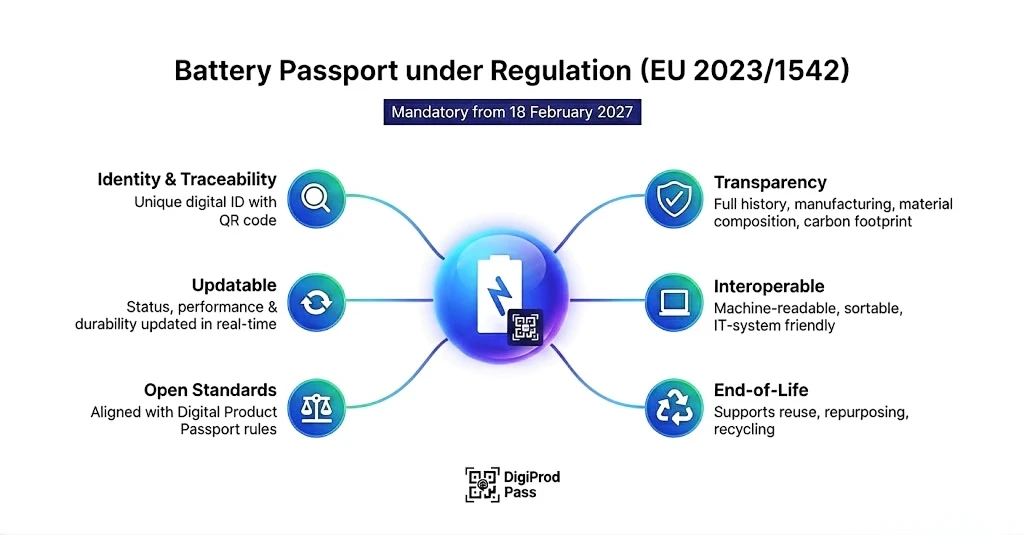
The EU Battery Regulation rolling out through 2027 adds requirements for carbon footprint tracking, recycled content, and lifecycle traceability via "Battery Passport" systems. All of this is easier when batteries are designed for disassembly. Modules can be pulled, graded, sent to second-life applications or recycling. Integrated packs have to be torn apart.
The policy direction is pretty clear: batteries are durable goods, not disposables. Designs optimized purely for manufacturing convenience are going to face more friction over time.
What This Means for Sourcing Decisions
Integrated architectures aren't wrong-they're just optimized for different objectives than what industrial applications require. CATL and BYD are building for automakers who need maximum energy density at maximum production volume. That's a legitimate engineering problem with a legitimate solution.
Industrial equipment is different. Ten-year lifecycles. Field service by customer technicians. Operating environments from freezers to deserts. Dozens of voltage and capacity variants across equipment brands.
If that's your situation, the questions worth asking any battery supplier:
When a cell fails, what happens? Can your technicians fix it on-site, or does the pack ship back to the factory?
How long to get a custom configuration? Weeks, or months?
What does warranty service actually cost-module swap or pack replacement?
Can the same product family handle different temperature environments, or do you need separate product lines?
The answers tell you whether you're buying something designed for your operating reality, or something that happened to be available.
We've been building modular packs for industrial applications for years specifically because that's what the applications require. The spec sheet numbers aren't as impressive as what you see from the big automotive battery suppliers. The ten-year cost of ownership usually is.


