


How is the Performance of Lithium-ion Power Batteries?
Last month we had a customer return a batch of cells claiming "poor performance." When our testing team ran the diagnostics, the cells were fine-the issue was that their system discharged at 2C continuously in a 40°C ambient environment, then they compared the results against datasheet numbers measured at 0.5C and 25°C. This kind of mismatch happens more often than the industry likes to admit, and it points to a fundamental issue: lithium-ion battery performance is not a single number. It's a response surface that shifts with temperature, load profile, state of charge, and age.
The CC-CV charging protocol-constant current to voltage limit, then constant voltage until current tapers-is standard practice, but what matters in application is the constant-current portion. That's where you get most of your capacity back quickly. We ran comparative tests on 242 Ah NCM cells at different charge rates: going from 0.1C to 0.5C cut the CC phase time by about 80%. The tradeoff is I²R loss, which scales with current squared. For a fleet operator who needs vehicles back on the road, that efficiency hit is acceptable. For a grid storage system optimizing round-trip efficiency down to the decimal, it's not.

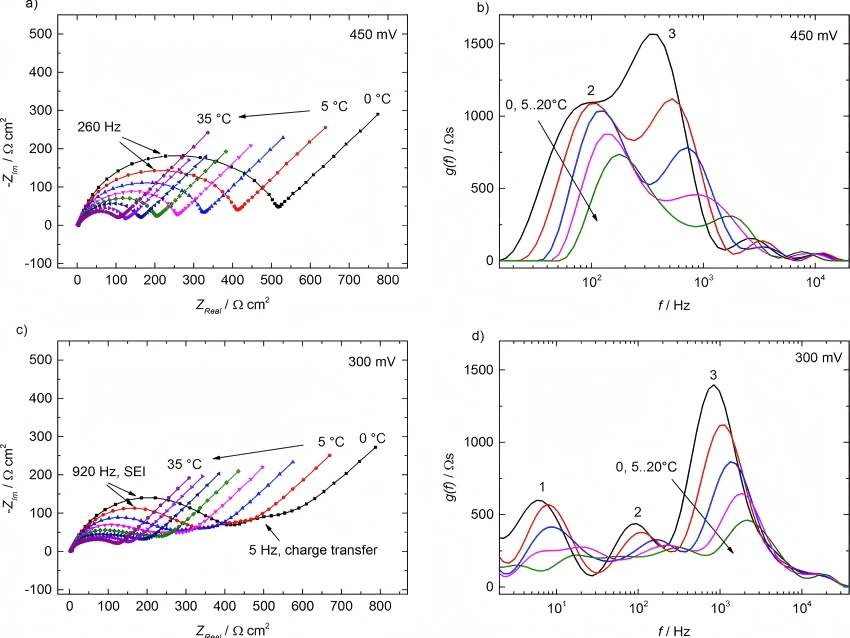
Temperature performance is where we spend most of our technical support hours, especially with customers in northern climates and Southeast Asian markets-opposite problems, same underlying physics. At -20°C, LFP cells drop to around 60% usable capacity. NMC holds better at roughly 85%, which is why you see it in premium EVs marketed for all-season use. The mechanisms are well-understood: electrolyte viscosity increases, SEI layer impedance rises, charge transfer slows at every interface. CATL's Shenxing Pro claims 478 km range from 20 minutes of -20°C charging (catl.com), which represents genuine progress on this front.
High-temperature operation creates different headaches. Cells work fine-sometimes better-at 35-40°C, but calendar aging accelerates significantly. We've tracked packs in hot-climate deployments that lost 8-10% capacity in the first year versus 3-4% for identical packs in temperate conditions. The degradation compounds: SEI layer thickens, consumes lithium inventory, raises impedance, generates more heat during cycling, which accelerates further degradation. A customer in the Middle East learned this the hard way when their second-year warranty claims spiked.
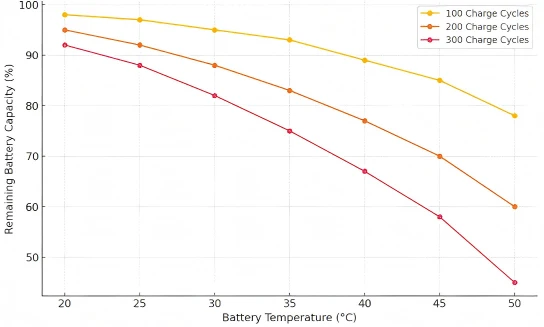
Cycle life numbers on datasheets assume specific conditions-usually 25°C, 1C/1C charge-discharge, 100% depth of discharge. Change any variable and the numbers shift dramatically. We tell customers that 50% DOD operation typically extends cycle life by 3-5x compared to full depth cycling. The difference between 500-1,000 cycles at 100% DOD and 3,000-5,000 cycles at 50% DOD has massive implications for total cost of ownership, but it requires oversizing the pack, which adds upfront cost and weight. Engineering is about tradeoffs; battery selection is no exception.
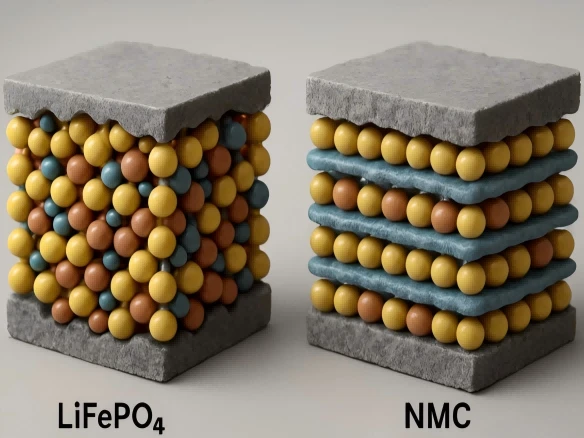
Safety performance comes down to thermal stability, and thermal stability comes down to chemistry. LFP's olivine structure holds oxygen atoms tightly-thermal decomposition doesn't begin until around 270°C, compared to 210°C for NMC. This is why LFP cells pass nail penetration tests that would send high-nickel cells into thermal runaway. It's crystallography, not marketing. China's new GB38031-2025 standard, effective July 2026, requires two hours of no fire and no explosion after thermal runaway initiation. According to industry surveys, about 78% of manufacturers already have compliant technology (greencarcongress.com). The remaining 22% have engineering work ahead of them.
Manufacturing quality matters more than most buyers realize-coating uniformity, drying completeness, contamination control. Battery University notes that "no practical method exists to quantify all conditions of a battery in a short, comprehensive test," which is why supplier track record matters alongside specifications.
Solid-state, silicon anodes, sodium-ion-these technologies are progressing from lab to pilot production. Amprius has demonstrated 500 Wh/kg with silicon anodes. CATL's sodium-ion Naxtra achieves 175 Wh/kg with 10,000-cycle life. Whether these reshape the market in three years or five, current-generation lithium-ion will remain the workhorse for most applications through this decade. The performance envelope keeps expanding, but the fundamentals of matching cell characteristics to application requirements haven't changed.


