


The transition from lead-acid to lithium-ion battery systems in electric forklift applications represents one of the most significant technological shifts in material handling equipment over the past decade. Lithium iron phosphate (LiFePO4) chemistry has emerged as the dominant solution for industrial motive power applications, offering energy densities between 120-180Wh/kg compared to the 30-50Wh/kg typical of traditional lead-acid configurations. This electrochemical advantage translates directly into operational efficiency gains that warehouse managers and logistics operators cannot afford to ignore.
Why Everyone Suddenly Cares About This
Here's the thing about forklifts that most people outside the industry don't realize: these machines run constantly. We're talking 16, sometimes 20 hours a day in large distribution centers. The old way of doing things-swapping out heavy lead-acid batteries, maintaining dedicated battery rooms with acid-resistant flooring and ventilation systems, having technicians check water levels weekly-that entire infrastructure becomes obsolete with lithium technology.
I've seen facilities spend upwards of $50,000 just on battery room construction. Acid fumes, spill containment, eyewash stations, the whole setup. Lithium packs don't care about any of that. You can charge them in the corner of your warehouse. No special room required.
The Chemistry Question
Not all lithium batteries are created equal, and this matters more than most buyers realize.
LFP (Lithium Iron Phosphate) dominates the forklift market for good reason. The thermal runaway threshold sits around 270°C, compared to roughly 150°C for NCM chemistries. When you're operating heavy machinery in environments where impacts happen-because let's be honest, forklift operators bump into things-that safety margin becomes non-negotiable. Cycle life typically ranges from 2,500 to 4,000 cycles at 80% depth of discharge.
NCM and NCA batteries show up occasionally, mostly in specialized cold storage applications where their superior low-temperature discharge characteristics justify the additional risk management requirements. But they're the exception.
LTO (Lithium Titanate) deserves mention because some manufacturers push it hard for ultra-fast charging scenarios. The technology works-you can genuinely charge these packs in 15-20 minutes-but the energy density penalty is severe. You're looking at roughly 70Wh/kg. For most operations, the math doesn't work out.
What Actually Happens Inside the Pack
The battery management system might be the most underappreciated component in the entire assembly. A good BMS does more than prevent fires.
Cell balancing alone can extend pack life by 20-30%. Individual cells within a module will inevitably age at slightly different rates due to manufacturing variations and thermal gradients during operation. Without active balancing, your weakest cell becomes the limiting factor for the entire pack. The system essentially becomes a chain-only-as-strong-as-its-weakest-link situation.
State of charge estimation in lithium chemistries presents genuine technical challenges. The voltage curve for LFP cells is remarkably flat through the middle 60% of the discharge cycle. You can't just measure voltage and derive SOC the way you could with lead-acid. Modern systems use coulomb counting combined with Kalman filtering and periodic recalibration based on known reference points (full charge voltage, discharge endpoints).
Temperature monitoring happens at multiple points-usually every 8-12 cells-with shutdown protocols triggering if any sensor exceeds threshold values. The CAN bus communication feeds this data to the forklift's main controller continuously.
The Money Conversation
This is where things get interesting, and where I've seen procurement teams make expensive mistakes.
Initial purchase price for a lithium pack runs approximately 2.5 to 3 times the cost of an equivalent lead-acid battery. That number scares people. It shouldn't, but it does.
Consider a typical 80V/500Ah application running two shifts:
Lead-acid scenario requires two battery packs (one charging while one operates), a charger, battery handling equipment, and the aforementioned battery room infrastructure. You're also replacing those batteries every 4-5 years. Labor costs for daily battery swaps add up-figure 15-20 minutes per swap, twice daily, at whatever your loaded labor rate happens to be.
The lithium pack lasts 8-10 years with proper management. No swapping. No battery room. Opportunity charging during breaks keeps it running indefinitely.
Run the TCO calculation over a 10-year horizon and lithium typically wins by 25-40%, depending heavily on local electricity rates and labor costs. Three-shift operations see payback in 18-24 months. Single-shift applications might never reach payback, which is why I always ask about utilization patterns before recommending anything.

Cold Storage: A Special Beast
Freezer applications below -20°C present unique challenges that deserve separate discussion.
Standard lithium packs experience significant capacity reduction at low temperatures-sometimes 30-40% loss at -25°C. The ionic conductivity of the electrolyte decreases dramatically. Internal resistance increases. Attempting to charge a severely cold pack risks lithium plating on the anode, which permanently damages cells and creates safety hazards.
Purpose-built cold storage batteries incorporate heating systems that activate before charging begins. Some designs use resistive heating elements; others circulate heated coolant. The pack won't accept charge until cell temperatures exceed a minimum threshold, typically around 0°C.
This adds complexity, cost, and potential failure points. But the alternative-bringing batteries out to ambient temperature before charging-defeats the operational advantages that justified the lithium investment in the first place.
Installation Realities
The plug-and-play marketing doesn't tell the whole story.
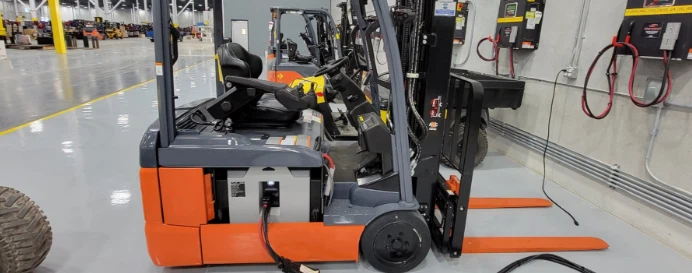
Weight distribution matters enormously in counterbalanced forklifts. Lead-acid batteries function as essential ballast; the truck is literally designed around that mass. Lithium packs weigh 50-70% less. Most manufacturers add steel ballast plates to compensate, but this needs proper engineering. I've seen poorly executed conversions where trucks became unstable under load.
Charger compatibility isn't guaranteed either. Lead-acid chargers use fundamentally different charging profiles-bulk, absorption, equalization stages-that will damage lithium cells. You need lithium-specific charging equipment with appropriate CC-CV curves and BMS communication capability.
The mounting dimensions sometimes work out, sometimes don't. Battery compartment modifications aren't unusual.
Certification Alphabet Soup
For anyone purchasing batteries, the regulatory landscape includes:
UN38.3 for transportation safety (mandatory for shipping)
IEC 62619 covering industrial lithium batteries specifically
UL 2580 in North American markets
CE marking for European deployment
Don't accept batteries without proper documentation. This isn't just liability protection-it's basic verification that someone actually tested the product before selling it.

Maintenance (Or Lack Thereof)
One of the genuine advantages: lithium packs require almost no routine maintenance.
No watering. No equalization charging. No acid neutralization. No terminal corrosion to clean. The BMS handles balancing automatically.
What you should do: periodic visual inspection for physical damage, connector condition checks, and data review from the monitoring system. Most fleet management software can flag cells showing abnormal behavior before they become problems.
The monitoring piece matters more than people realize. These systems generate substantial diagnostic data. Using it proactively extends pack life; ignoring it means replacing batteries earlier than necessary.
The Charging Philosophy Shift
Opportunity charging fundamentally changes how operations think about equipment management.
Lead-acid batteries prefer full discharge-charge cycles. Partial charging creates memory effects and stratification issues. You essentially need to plan your battery usage.
Lithium cells prefer partial cycles. Charging from 40% to 80% during a lunch break is fine-beneficial, actually. Keeping state of charge between 20% and 80% maximizes cycle life. You stop thinking about battery management as a discrete operational task and start treating it as a continuous background activity.
This enables genuine multi-shift operation without battery changes. One pack, one truck, 24-hour coverage. The productivity implications in high-throughput environments are substantial.
Where Things Go Wrong
Common failure modes worth understanding:
- BMS failures account for a surprising percentage of warranty claims. The electronics live in a harsh environment-vibration, temperature swings, electrical noise from motor controllers. Quality varies dramatically between manufacturers.
- Contactor welding occurs when the main power contactors fuse closed, usually due to inrush current events. Properly designed systems include pre-charge circuits to prevent this. Cheap designs sometimes don't.
- Communication faults between the BMS and forklift controller can leave trucks stranded even when the battery itself is perfectly functional. CAN bus implementation quality matters.
Cell failures happen but are relatively rare with reputable manufacturers. When they do occur, modular pack designs allow replacement of affected modules rather than the entire battery.

Looking Forward
Solid-state batteries remain perpetually "five years away" for automotive applications, but the technology timeline for industrial motive power likely stretches longer. The current liquid electrolyte systems work well enough that replacement pressure is limited.
More interesting near-term developments include silicon-anode cells that could push energy density past 200Wh/kg, and continued cost reductions as manufacturing scale increases. Battery-as-a-service models are gaining traction, particularly for smaller operations that can't absorb large capital expenditures.
The trajectory is clear. New forklift sales increasingly default to lithium configurations. Lead-acid isn't disappearing overnight-there's a massive installed base and the technology remains economically sensible for low-utilization applications-but the transition has passed its tipping point.
Whether this technology makes sense for a specific operation depends entirely on the details: utilization hours, shift patterns, environmental conditions, capital availability, and operational priorities. There's no universal answer. But understanding how these systems actually work-beyond the marketing materials-is the necessary first step toward making an informed decision.


