


Lithium forklift battery requirements vary by equipment type, even when two trucks use the same system voltage. Battery size and voltage provide a starting point, but they do not confirm complete forklift battery compatibility.
Counterbalance forklifts may have specific battery weight and peak current requirements. Reach trucks place greater emphasis on compact installation, repeated lifting demand, and vehicle communication. Pallet trucks, stackers, and tow tractors also require different approaches to capacity and charging.
This article explains how equipment design and duty cycle affect lithium forklift battery selection-and what should be checked before the final configuration is confirmed.
Forklift Battery Requirements at a Glance
"Electric forklift" can refer to several types of battery-powered material handling equipment. The table below provides a quick comparison of their operating demands and key battery matching factors.
| Equipment Type | Typical Operating Demands | Main Battery Requirements |
| 3-Wheel Electric Counterbalance Forklifts | Compact indoor operation, frequent turning, repeated acceleration, lifting, and direction changes | Compact dimensions, OEM-specified battery weight range, peak current, connector position, cable routing |
| 4-Wheel Electric Counterbalance Forklifts | Heavier load handling, repeated lifting, longer travel distances, and multi-shift operation | Battery weight range, continuous and peak current, usable capacity, runtime, structural and thermal performance |
| Reach Trucks | Narrow-aisle travel, repeated high-rack lifting, tight installation space, and frequent shift cycles | Compact battery size, peak lifting current, cable routing, SOC display or communication, charging windows |
| Electric Pallet Trucks | Frequent starts and stops, short-distance horizontal transport, and repeated warehouse routes | Compact installation, start-stop current, charging access, connector position, runtime |
| Electric Stackers | Short-distance travel combined with repeated lifting and pallet stacking | Lifting current, battery dimensions, lift frequency, usable capacity, charging availability |
| Electric Tow Tractors | Continuous towing along fixed or repeated routes, often with multiple trailers | Continuous traction current, total towing load, route length, usable energy, runtime, charging schedule |
Detailed Battery Requirements by Equipment Type
Each equipment type places different priorities on battery weight, compartment fit, discharge current, usable capacity, charging, and vehicle communication.
Electric Counterbalance Forklifts
For electric counterbalance forklifts, battery matching usually starts with weight, peak current, and runtime.
Battery weight range: The original battery may contribute to the forklift's counterweight. A lighter lithium battery may require a heavier enclosure or additional weight to remain within the forklift manufacturer's permitted range.
- Peak discharge current: Starting, accelerating, lifting, and changing direction create short periods of peak current demand. The cells, Battery Management System (BMS), contactors, cables, and connector should be rated for both the required continuous current and these short-duration peaks.
- Battery compartment fit: Length, width, height, fixing points, cable direction, and removal clearance must match the existing compartment.
- Capacity and charging: Load weight, shift length, operating hours, and available charging breaks determine the usable capacity and charger power required.

For 3-wheel models: Compact chassis dimensions make battery height, connector position, cable routing, and removal clearance especially important.
For 4-wheel models: Depending on the truck model and application, longer travel cycles or higher load demands may increase continuous current requirements and daily energy consumption, which can lead to a higher usable-capacity requirement.

Reach Trucks
For reach trucks, the main battery priorities are compact installation, peak discharge current for repeated lifting cycles, and vehicle communication.
- Compact battery dimensions: The battery must fit a narrow compartment without interfering with cables, connectors, fixing points, or battery removal.
- Lifting current: Repeated high-level lifting can create frequent peak current demand. Load weight, lift height, and lift frequency should be reviewed before the discharge specification is confirmed.
- Communication interfaces: Depending on the truck model, the battery may need to support SOC display, CAN communication, alarm signals, charger communication, or vehicle interlock.
- Opportunity charging: Short charging breaks may reduce the required battery capacity, but only when the charger power and charging schedule are matched to the actual shift pattern.
Electric Stackers
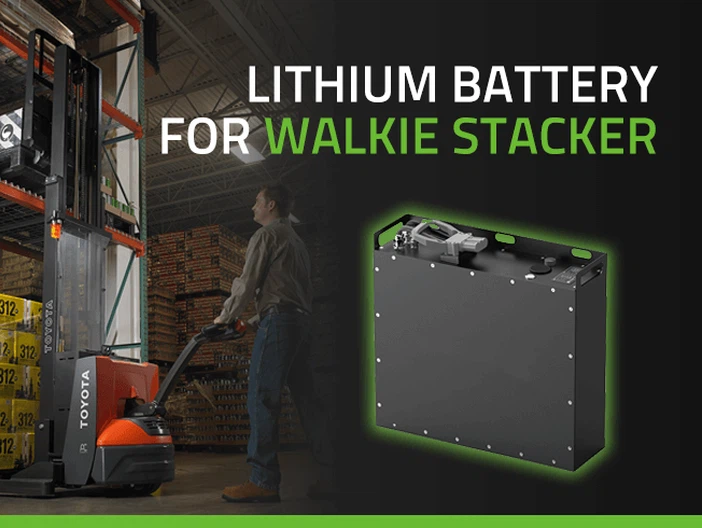
For electric stackers, the battery must support both traction and repeated hydraulic lifting.
- Peak lifting current: Load weight, lift height, and lifting frequency directly affect the required peak discharge capability.
- Battery dimensions: The battery, cables, and connector must fit within the compact chassis without limiting installation or maintenance access.
- Battery weight: Some stackers have specific battery weight requirements related to vehicle balance and stability.
- Capacity planning: Daily travel, number of lift cycles, shift length, and available charging time determine the final capacity and charger specification.
A battery selected only around travel runtime may meet the daily energy requirement but still lack the peak discharge capability needed for repeated lifting cycles.

Electric Tow Tractors
For electric tow tractors, battery requirements are mainly determined by continuous traction load, route energy use, and fleet charging.
- Continuous discharge: Total towing weight, trailer quantity, gradients, and surface resistance affect the continuous current required.
- Peak current: Starting with a heavy load or travelling on an incline may create short periods of higher current demand.
- Usable capacity: Route distance, daily cycles, operating hours, and stop-start frequency determine the required usable energy.
- Fleet charging: Charger quantity, vehicle rotation, charging time, and available charging bays should be planned together for multi-vehicle fleets.
The towing profile provides the main basis for determining discharge capability, usable energy, and charging requirements.
How Heavy-Duty Operation Changes the Battery Configuration
Heavy-duty operation is not a separate forklift type. It can apply to counterbalance forklifts, stackers, tow tractors, and other material handling equipment.
Higher loads, longer shifts, frequent lifting, gradients, vibration, and demanding temperatures may change several battery specifications:
- Higher continuous and peak current
- Greater usable battery capacity
- Stronger cell, module, and cable fixing
- More robust enclosure and connector protection
- Closer temperature monitoring and thermal control
- Different charging power or charging schedules
These operating conditions should be translated into defined current limits, usable capacity, enclosure protection, temperature-control strategy, and charger sizing during battery design.

How to Check Forklift Battery Compatibility
Forklift battery compatibility should be checked across mechanical fit, electrical performance, charging, vehicle interfaces, and working conditions. Exact requirements can still vary between forklift models within the same equipment category.
| What to Check | Why It Matters |
| Forklift Information | The brand, full model, system voltage, and original battery specifications establish the basic vehicle and electrical requirements. |
| Battery Compartment | Length, width, height, fixing points, cable direction, and removal clearance determine whether the battery can be installed correctly |
| Battery Weight Requirements | The forklift may specify a permitted battery weight range, especially where the battery contributes to vehicle stability or counterweight. |
| Connector and Charger | Connector type, cable rating, charger voltage, charging current, and charging profile must match the battery and vehicle system. |
| Communication | SOC display, CAN communication, alarm signals, charger communication, or vehicle interlock may be required for normal operation. |
| Duty Cycle | Load, lift frequency, daily operating hours, shift pattern, and charging windows affect battery capacity and discharge requirements. |
| Working Environment | Cold storage, outdoor use, dust, moisture, vibration, and temperature may require different enclosure, heating, or protection configurations. |
Together, these checks provide the technical basis for sizing the battery, defining the enclosure, selecting the charger, and confirming the required interfaces.
How Polinovel Handles Lithium Forklift Battery Selection
Polinovel turns vehicle, original battery, and duty-cycle data into a complete lithium forklift battery configuration. The review covers physical installation, discharge requirements, charging conditions, vehicle communication, and the working environment.
Establish the Original Battery Baseline
We review the forklift nameplate and original battery label to confirm:
- System voltage and rated capacity
- Original battery dimensions and weight
- Forklift brand and full model
- Existing charger information
This creates the starting point for the replacement.
01
Define the Physical Battery Design
The compartment is checked for length, width, height, fixing points, and removal clearance. Connector position and cable direction are also confirmed.
These details determine:
- Battery casing dimensions
- Connector and cable location
- Installation and lifting points
- Additional weight requirements, where needed
02
Size the Battery for the Actual Workload
Battery sizing combines daily operating hours with load, lifting frequency, shift pattern, and available charging breaks.
This helps define:
- Required battery capacity
- Continuous and peak current
- Suitable charger power
- Whether opportunity charging is needed
03
Match the Vehicle and Working Environment
- Where required, the configuration also considers CAN communication, SOC display, alarms, vehicle interlock, and charger communication.
- Cold storage, outdoor work, dust, moisture, and heavy vibration may require changes to the enclosure, heating system, temperature-control strategy, connector protection, or internal fixing.
04
The final configuration is confirmed only after the installation, discharge, charging, communication, and environmental requirements have been reviewed together.
What Information Should You Send?
You do not need a complete technical specification to begin lithium forklift battery selection. In most cases, Polinovel can start the compatibility review with three photos:
- Forklift nameplate
- Original battery label
- Battery compartment and connector
These photos help identify the forklift model, original voltage and capacity, available installation space, and electrical connection.
For a more accurate battery recommendation, please also provide:
- Battery compartment dimensions
- Original battery weight and any OEM-specified weight requirement
- Daily operating hours and number of shifts
- Typical load and lifting requirements
- Available charging time
- Existing charger information
- Working temperature and environment
- Communication or display requirements
Even if some details are unavailable, send what you have. Our team can review the information and advise what is still needed before the battery configuration is confirmed.
Lithium forklift battery requirements change with the equipment design, load profile, installation space, and charging pattern. Forklift type helps narrow the options, but battery size, voltage, weight, power output, and communication must still be checked against the specific vehicle.
Send Polinovel the forklift nameplate, original battery label, and battery compartment photos. Our team will review the information and recommend a lithium forklift battery configuration matched to your equipment and working conditions.
Related Reading: Lithium Forklift Battery Requirements for Automated Warehouses
Frequently Asked Questions
What information is needed to size a lithium forklift battery?
Choosing the right lithium forklift battery requires checking more than voltage and capacity. The forklift model, battery size, weight requirements, workload, charging conditions, and communication requirements should all be considered together.
Does a lithium forklift battery need the same weight as the original battery?
Not always. Some forklifts use the battery as part of the required counterweight, so the replacement must meet the specified battery weight requirements for the vehicle.
How can I check forklift battery compatibility?
Forklift battery compatibility depends on the vehicle model, battery compartment, connector, charger, communication system, and working environment. Providing the forklift nameplate, original battery label, and compartment photos helps confirm the correct configuration.
Can different forklift types use the same lithium battery configuration?
Not always. Counterbalance forklifts, reach trucks, pallet trucks, stackers, and tow tractors have different requirements for battery weight, current output, capacity, installation, and charging.


