


When a 48V fleet cart or 72V shuttle starts losing range mid-shift, dealers and fleet managers face a recurring decision: replace the aging flooded lead-acid bank like-for-like, or retrofit the cart to a single LiFePO4 pack. Comparing lithium vs. lead-acid at the brochure level rarely answers the questions that hold up a real shop quote.
The decision usually comes down to five physical and electrical checks: what battery string is actually in the tray today, which cables disappear and which stay, how much net installed weight comes off the chassis, whether the controller and charger match the pack's voltage and current limits, and how a single pilot cart behaves on your steepest routes. This guide focuses strictly on same-voltage retrofits (48V-to-48V and 72V-to-72V) rather than 36V conversions or 48V-to-72V powertrain rebuilds.
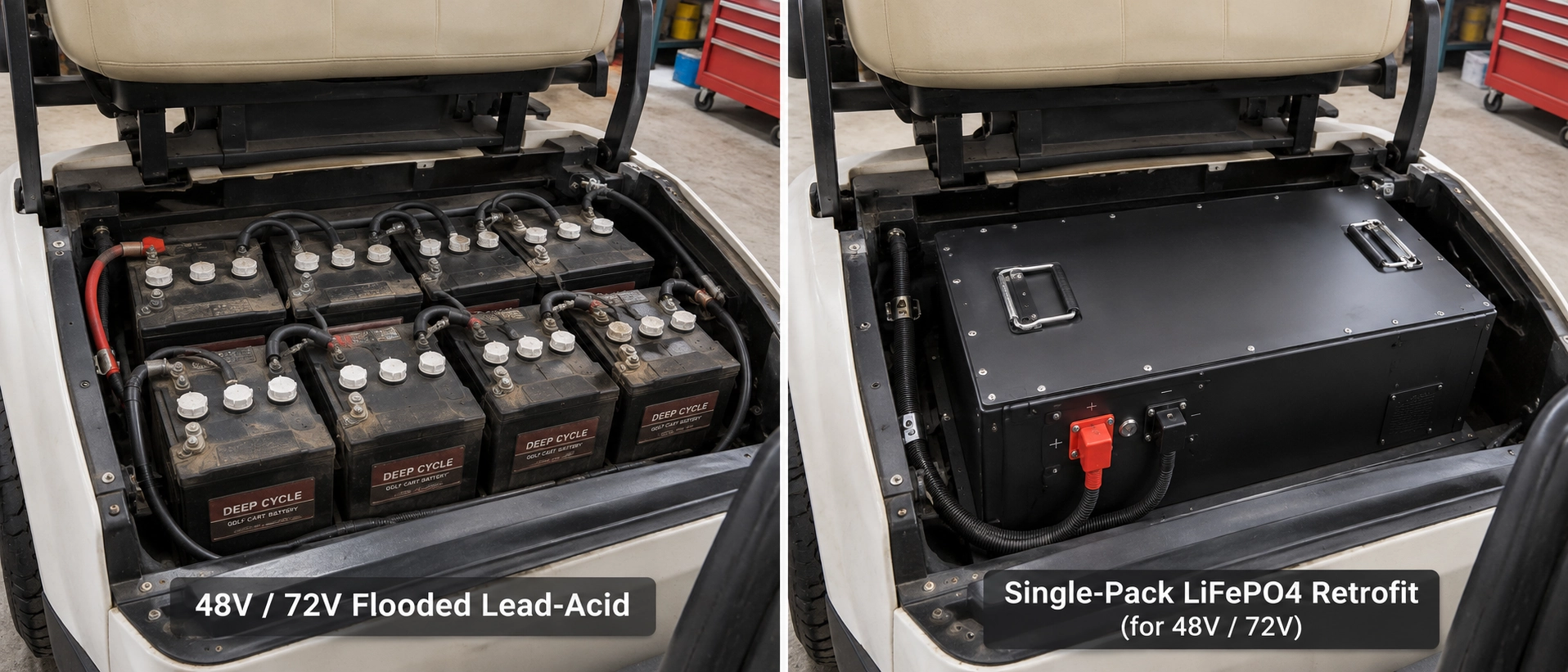
Start With the Battery String Already in the Cart
Before pricing a single-pack lithium retrofit, inspect the labels inside the battery compartment rather than assuming every cart in a voltage class uses 6V batteries. Fleet carts and commercial shuttles from different model years often run different series strings to reach the same nominal voltage, which directly changes teardown labor, jumper count, tray layout, and total removed weight.
In a pure series battery bank, the number of external inter-battery jumper cables equals the number of batteries minus one (N - 1). The table below shows three documented OEM configurations alongside one illustrative 12 × 6V arithmetic example for comparison.
| Existing String Configuration | Nominal System Voltage | Pure-Series Inter-Battery Jumpers (N - 1) | Reference Example / Basis |
|---|---|---|---|
| 8 × 6V flooded lead-acid | 48V | 7 jumpers | Club Car Transporter XL 48V DC OEM specification (Club Car) |
| 6 × 8V flooded lead-acid | 48V | 5 jumpers | Club Car Tempo 48V lead-acid configuration (Club Car) |
| 6 × 12V flooded lead-acid | 72V | 5 jumpers | E-Z-GO Express 72V AC 2018 launch configuration (Textron) |
| 12 × 6V (arithmetic example only) | 72V | 11 jumpers | Hypothetical 6V series calculation for comparison; not an OEM fitment claim |
Confirming whether a mixed-age fleet uses 8 × 6V, 6 × 8V, or 6 × 12V banks prevents misquoting mounting plates and shop hours on day one. For a foundational overview of how LiFePO4 chemistry behaves across utility and fleet vehicles, see our overview of golf cart LiFePO4 battery applications.
What One Lithium Pack Changes in the Battery Bay
Switching from a multi-battery flooded string to a single LiFePO4 enclosure simplifies the high-current interconnections inside the tray, but it does not turn the entire vehicle into a two-wire installation. Separating what is removed from what must still be audited keeps technicians from missing hardware on the quote.
Jumper Cables and the Installed Weight
Replacing a series string with one lithium pack eliminates the external inter-battery jumpers between each individual lead-acid battery unit (monoblock)-the cited OEM configurations use five or seven external inter-battery jumpers, depending on the number of batteries in the original series string-along with the individual terminal lugs, corrosion points, and watering manifolds tied to flooded cells. However, the cart's main traction positive and negative cables, primary circuit protection, charger leads and interlock wiring, state-of-charge (SOC) display or communication harness, and 12V accessory circuits remain part of the installation scope and must be verified against the pack's terminal layout and installation manual (Trojan Battery).
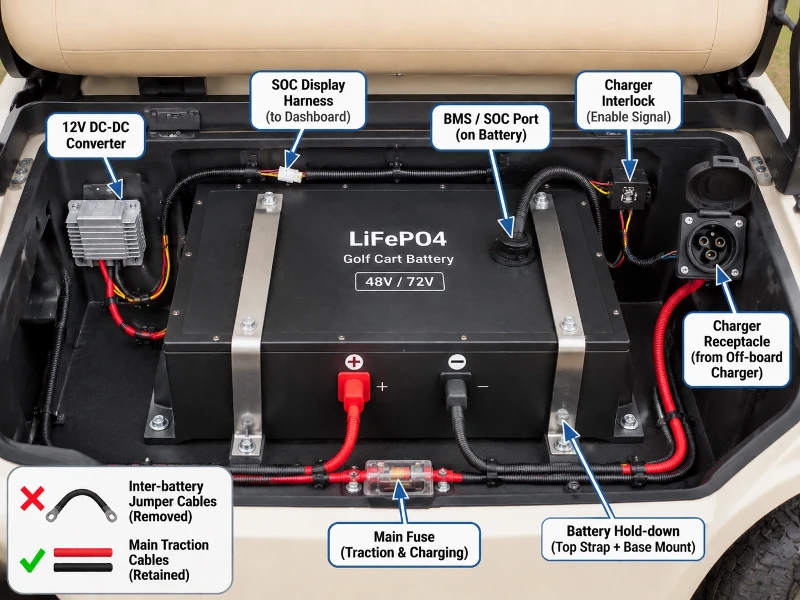
| Battery Bay Factor | Multi-Battery Flooded Lead-Acid String | Single-Pack LiFePO4 Enclosure |
|---|---|---|
| Inter-battery series jumpers | 5 or 7 cables in the cited OEM 48V/72V string examples | 0 external inter-battery jumpers |
| Remaining vehicle circuits | Main traction, charger, SOC meter, 12V accessory supply / DC-DC converter | Main traction, charger/interlock, SOC/comms, 12V accessory supply / DC-DC converter |
| Routine bay maintenance | Watering, acid cleanup, terminal corrosion checks | Sealed enclosure; periodic mechanical and terminal torque checks |
| Mass & tray footprint | Distributed across multiple heavy monoblocks | Concentrated in one lighter enclosure; requires proper hold-down |
To estimate weight reduction accurately, calculate from the exact batteries and hardware coming out of the cart rather than relying on generic percentage claims. Use the following formula for every vehicle platform:
Net Installed Weight Reduction = (Removed Batteries + Removed Hold-Downs, Jumpers, Watering Kit & Any Replaced Charger/Converter) − (New Lithium Pack + Mounting Brackets/Adapter Plates + Any New Charger, DC-DC Converter & Harnesses)
As a transparent arithmetic example for a 48V 8 × 6V platform (based on published product specifications as of November 25, 2026):
Baseline lead-acid string: 8 × Trojan T-105 6V flooded batteries at 62 lb each (496 lb total, or approximately 225 kg of bare battery mass; Trojan Battery).
Single-pack lithium reference: Our 48V 105Ah Classic48100 pack weighs 50 kg (51.2V nominal, 105Ah, or roughly 5.38 kWh nominal calculated as 51.2V × 105Ah; see Polinovel Classic48100 specifications).
Bare battery mass difference: Approximately 175 kg before accounting for removed steel hold-downs, replaced chargers/converters, or added lithium mounting brackets and harnesses.
This calculation is an illustrative bare-battery mass comparison only-it is not an equal-capacity comparison, not a physical weigh-in, not complete net installed weight reduction, and not an OEM fitment endorsement for any specific cart model. For 72V retrofits, weigh the actual removed 6 × 12V (or other) bank and hardware against our 78 kg 72V 105Ah pack and its mounting kit. Depending on the actual net installed weight reduction on a given cart, removing substantial mass from under the seat can also affect rear suspension ride height and weight distribution, so check ride and handling during the pilot install.
Why a Weak Battery Limits the String
In a series-wired lead-acid bank, every battery carries the same discharge and charge current. Differences in internal resistance or aging across series-connected units cause voltage imbalance, causing the weakest unit to degrade faster and reach its operating limits ahead of the rest of the string (Victron Energy). Under heavy load, a weak battery can pull total string voltage down prematurely, triggering controller output limiting or low-voltage shutdown even when resting voltage appears normal.
A single-pack lithium assembly eliminates external inter-battery string wiring by housing matched cells under an integrated Battery Management System (BMS) that monitors cell groups and enforces voltage, current, and temperature protections. Published BMS details vary by model: our 48V Classic48100 specification page explicitly lists cell balancing alongside temperature monitoring and protections, whereas our 72V 105Ah product page lists cell-voltage monitoring and multiple protection mechanisms without identical public cell-balancing detail-confirm model-specific BMS features directly with our engineering team. Even with an integrated BMS, usable pack capacity remains bounded by the weakest internal cell group: cell aging, cold operating temperatures, and cell-level voltage drift can still reduce available capacity over time (Victron Energy).
What Dealers Need to Check Before Specifying a Pack
Matching the nominal label-48V for 48V, or 72V for 72V-is only the starting point. Nominal LiFePO4 pack voltages, listed charge cut-off ceilings, and discharge cut-off points differ from traditional lead-acid labels, and physical dimensions increase substantially on 72V enclosures.
To help dealers evaluate our Polinovel 48V and 72V golf cart lithium packs for initial fitment checks, the table below summarizes our published product specifications as of November 25, 2026:
| Published Specification | Polinovel 48V 105Ah (Classic48100) | Polinovel 72V 105Ah |
|---|---|---|
| Nominal Voltage | 51.2V | 73.6V |
| Nominal Capacity / Calculated Energy | 105Ah (approx. 5.38 kWh nominal) | 105Ah (approx. 7.73 kWh nominal) |
| Listed Charge Cut-Off Voltage | 58.4V | 83.95V |
| Listed Discharge Cut-Off Voltage | 40V | 57.5V |
| Enclosure Dimensions (L × W × H) | 520 × 334 × 243 mm | 674 × 334 × 243 mm |
| Pack Weight | 50 kg | 78 kg |
| Listed Discharge Current | 200A* | 200A* |
| Product Specification Page | Polinovel Classic48100 specifications | Polinovel 72V 105Ah pack specifications |
*Confirm continuous vs. peak discharge rating, peak duration, and BMS reset conditions directly with our engineering team before sizing either pack to vehicle controller load.
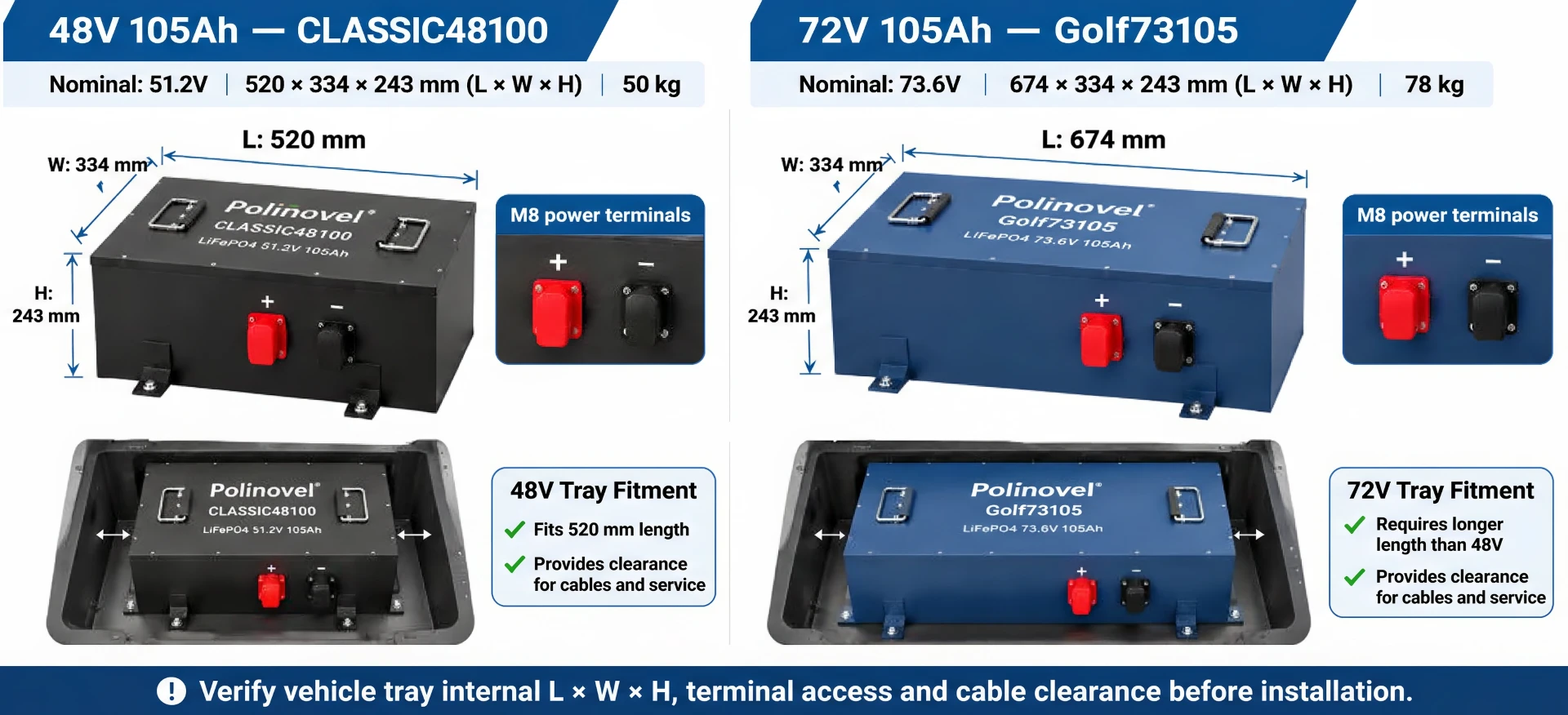
Tray, Controller and BMS Fit
Verify three mechanical and electrical boundaries before ordering hardware:
1. Physical envelope and hold-down: Measure clear tray length, width, and height against the pack enclosure (520 × 334 × 243 mm for the 48V pack; 674 × 334 × 243 mm for the 72V pack), leaving clearance for terminal lugs, main traction cable bend radius, and seat-frame clearance. Confirm whether a dedicated mounting tray or adapter plate is needed to anchor the single enclosure securely.
2. Controller voltage window: Compare the pack's listed charge cut-off voltage (58.4V on 48V systems; 83.95V on 72V systems) and listed discharge cut-off voltage (40V on the 48V pack; 57.5V on the 72V pack) against the cart controller's actual over-voltage and under-voltage fault thresholds. Note that a battery's listed discharge cut-off voltage is a pack specification and does not automatically match every vehicle controller's low-voltage protection setting.
3. Continuous and peak bus current: Check the cart's real-world current draw during full-load hill climbs and standing starts-especially on heavier 72V shuttles-against our engineering-confirmed continuous and peak discharge limits, peak duration, and BMS over-current reset behavior rather than assuming a listed 200A figure represents continuous capacity.
For fleets focused specifically on 48V capacity sizing and procurement trade-offs, see our 48V battery procurement guide.
Charging, 12V Accessories and Regeneration
Most retrofit delays and unquoted add-on costs happen outside the battery tray-especially on 72V platforms where voltage ceilings, converter ratings, and downhill regeneration margins are tighter:
Charger profile, BMS communication, and drive-inhibit interlock: A matching plug or nominal voltage label does not confirm charger compatibility. Verify three distinct items before reusing an existing charger: (1) the charger runs an approved lithium charge algorithm, (2) any required charger-to-BMS communication protocol matches the pack (Delta-Q Technologies), and (3) the vehicle's drive-inhibit interlock wiring correctly prevents driving while the charger is connected (Trojan Battery). Confirm approved charge profiles, compatible charger models, and interlock wiring against our documentation for your 48V or 72V pack.
12V accessories and SOC gauges: Some older carts supply 12V accessories through a dedicated voltage reducer or, in certain configurations, a tap across part of the lead-acid battery bank-an arrangement that cannot be assumed to remain suitable after a single-pack lithium conversion. Verify the original accessory supply circuit and use a properly rated DC-DC converter whose input voltage ceiling safely covers the pack's listed charge cut-off voltage (particularly up to 83.95V on 72V systems) and total accessory load. Also verify whether the existing dash gauge is compatible with the lithium pack or requires a dedicated SOC display and harness kit, as outlined in lithium retrofit installation manuals (Trojan Battery), and confirm display or CAN/RS485 protocol requirements with our engineering team.
Regenerative braking safety boundary: On hilly golf courses or resort shuttles, regenerative braking pushes current back into the battery on descents. At high SOC, or near cold or high internal cell temperature boundaries, BMS charge-current protection can restrict regeneration acceptance or trigger an automatic BMS disconnect. As Trojan Battery's OnePack User's Guide explicitly warns for low-speed vehicles with electronic drive and braking systems, sudden power loss during operation can cause loss of braking or sudden braking (Trojan Battery). Because Trojan's published thresholds apply only to Trojan products and must not be applied directly to Polinovel packs, always obtain written confirmation of allowable regenerative current, SOC and temperature limits, and controller interaction from both our engineering team and the cart controller manufacturer before approving hilly-route fleets.
Use the pre-quote triage matrix below to classify each cart model before issuing a binding fleet proposal:
| Check Item | Proceed to Pricing | Hold for Verification | Mismatch Identified (Scope Hardware) |
|---|---|---|---|
| Tray & Hold-Down | Pack fits clear tray with cable clearance; bracket spec confirmed | Tray dimensions estimated from brochure, not measured on cart | Tray too narrow/short or seat frame interferes; requires tray modification or alternate pack |
| Controller Voltage & Current | Controller input range covers pack charge/discharge cut-offs; confirmed BMS continuous/peak limits cover bus draw | Controller nameplate unreadable or BMS continuous/peak duration unconfirmed | Controller over-voltage trip below charge cut-off or bus current exceeds confirmed BMS limit |
| Charger, Comms & Interlock | Approved lithium charger/algorithm, BMS comms (if applicable), and interlock wiring confirmed | Existing charger brand known, but algorithm or interlock compatibility unverified | Legacy lead-acid-only charger without approved lithium profile; quote new charger |
| 12V Accessories & Gauge | DC-DC converter rated for full pack charge cut-off voltage and load; SOC display/comms confirmed | 12V supply wiring or dash gauge compatibility not yet verified on fleet carts | Bank-tapped accessories or converter input ceiling too low; quote DC-DC + gauge kit |
| Regenerative Braking | Flat terrain, or regen limits verified in writing with both battery and controller documentation | Cart has regen on hilly terrain; pack high-SOC/temp limits not yet confirmed | Unmanaged regen risks BMS disconnect on descents; requires engineering review |
Verify Hill Performance and Range on a Pilot Cart
Battery weight savings alone do not guarantee a fixed percentage increase in hill-climbing speed or driving range. Nominal energy (such as 5.38 kWh or 7.73 kWh) is a calculated specification, not a road-tested range guarantee; real-world results depend on passenger and cargo load, grade severity, tire pressure, temperature, and controller current limits.
Structured fleet rollouts typically validate fitment and technician workflow on initial vehicles before scaling across an entire property. For example, in a 2026 vendor-published case study, Trojan Battery reported that Egypt's Madinat Makadi Golf Resort began converting a roughly 60-cart fleet of two- and four-seat carts to Trojan 48V 105Ah single-pack lithium units with local dealer Hydroturf handling installation support and technician training-though independent route energy logs and controlled A/B comparisons were not published, and third-party vendor deployments do not establish performance benchmarks for Polinovel packs (Trojan Battery).
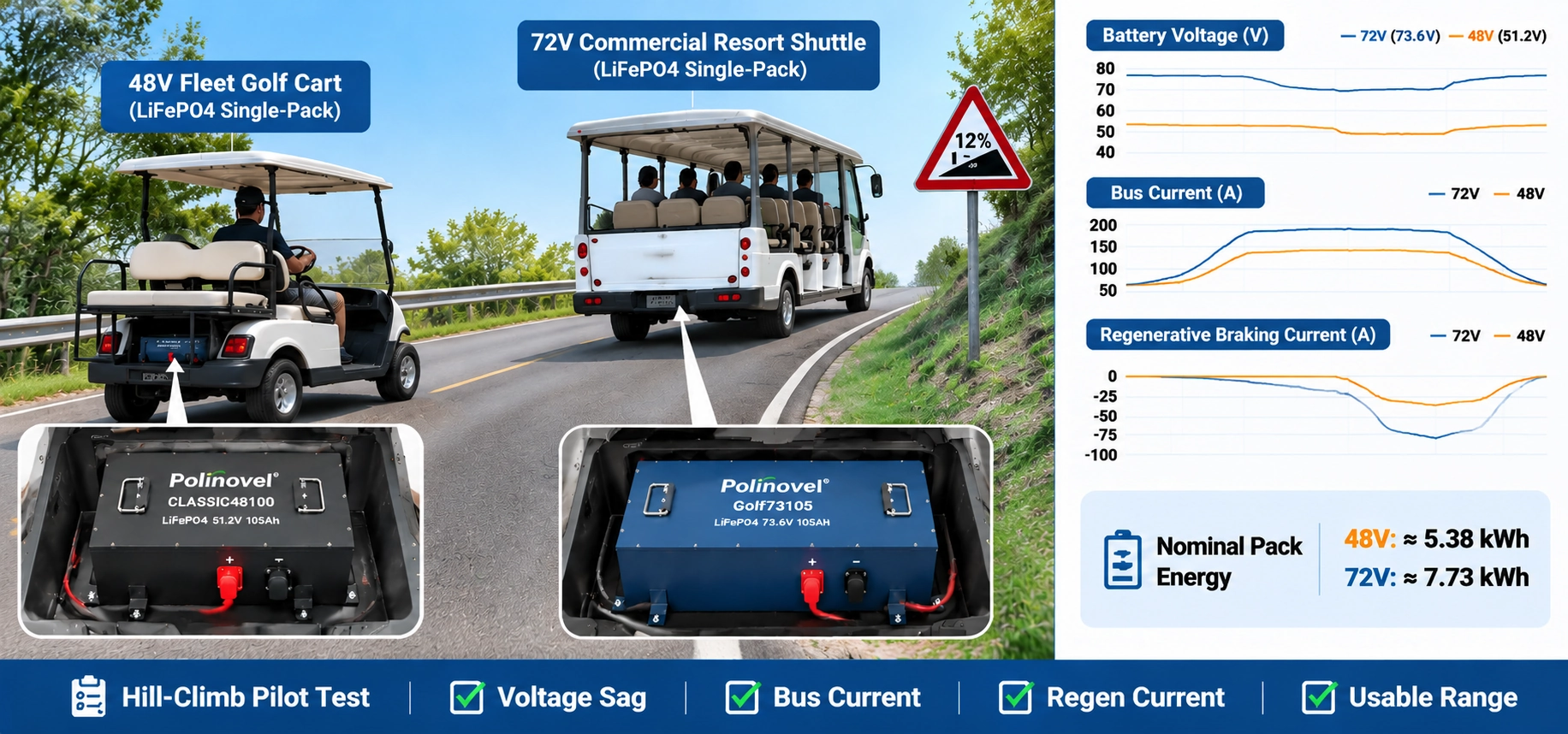
Before committing to a multi-cart purchase order, run a controlled pilot validation on one representative cart from each platform and log the following baseline:
1. Standardize the test loop: Run the exact same cart (or an identical platform in comparable mechanical condition) over the same course or shuttle loop, with identical passenger/cargo weight and verified tire pressure.
2. Record installed weights: Weigh the removed lead-acid batteries and hardware (including any replaced charger or converter) against the installed lithium pack, brackets, harnesses, and any new charger or converter components.
3. Log hill-climb electrical and thermal behavior: Record ambient temperature, battery temperature (or BMS-reported cell temperature, where available), starting SOC, speed on the steepest grade, controller/bus current draw, and voltage sag under full payload.
4. Verify regenerative braking under approved procedures: First obtain written allowable regenerative charge current, SOC, and internal cell-temperature boundaries from both our engineering team and the cart controller manufacturer (note that protection thresholds follow internal cell temperature rather than ambient air temperature alone). Have qualified technicians log starting SOC, battery temperature, regenerative charging current, and charge-acceptance limits under a protocol with explicit stop criteria for unexpected braking changes, charge-current limiting, or BMS disconnects. Do not schedule full-charge, cold-temperature, or high-temperature steep-grade regenerative braking tests unless written authorization and operating conditions are provided by the battery manufacturer.
5. Measure usable energy and faults: Track Wh per mile (or km), usable kWh down to the fleet's normal recharge threshold, full recharge time, and any BMS fault codes.
During both pilot testing and batch rollout, log exact pack model numbers, serial number ranges, installation dates, and service contacts by cart ID. Maintaining batch-level traceability is standard fleet risk management-underscored by the 2023 U.S. CPSC recall of specific RELiON InSight 48V lithium battery serial ranges for thermal burn and fire hazards, where identifying affected units depended on model and serial records (U.S. CPSC).
For broader operational steps on staging chargers, maintenance schedules, and multi-cart deployment, see our guide on fleet lithium conversion planning.
Build a Retrofit Quote From the Cart's Actual Specs
An accurate dealer quote starts with standardized field data from the maintenance bay. Hand the intake list below to your shop foreman or fleet maintenance supervisor so every sub-fleet can be priced without mid-project change orders:
Vehicle identification: Make, model, model year, and cart count per configuration (separate mixed-age sub-fleets).
Existing battery bank: Brand, individual battery voltage (6V, 8V, or 12V), quantity, and measured or labeled weight.
Battery bay geometry: Clear tray length × width × height, hold-down bolt locations, and overhead seat clearance.
Drive & braking hardware: Controller nameplate (make, model, voltage/current ratings) and whether the cart uses regenerative braking.
Charging setup: Existing charger make, model, connector type, and onboard vs. offboard mounting.
12V loads & instrumentation: List of 12V accessories, existing accessory power supply or DC-DC converter input rating, and current dash gauge type.
Operating profile: Typical passenger/cargo load, steepest grades, daily distance, and seasonal ambient temperature range.
When assembling the commercial proposal, itemize the full retrofit scope rather than the battery pack alone: the lithium pack, mounting brackets or adapter plates, charger replacement or algorithm reprogramming, DC-DC converter and SOC meter kit, technician labor hours, and scheduled cart downtime. For broader budgeting context across voltage classes, review our breakdown of battery replacement costs by voltage.
You can compare available 48V and 72V enclosure dimensions and ratings across our Polinovel golf cart LiFePO4 battery range. Once your shop has gathered the vehicle nameplate and tray measurements, Send Your Cart Specs to Polinovel for a Fitment Review-include your cart make/model/year, existing battery configuration, controller and charger models, clear tray dimensions, and cart quantity in your message so our team can provide an initial fitment assessment and engineering confirmation of pack dimensions, voltage and current boundaries, and a pilot-cart configuration before quoting the full fleet.


