


What Kind of Battery Does a Forklift Use?
Lead-acid or lithium. That's it. That's the answer.
But you're not here for that. You're here because someone in procurement is pushing lithium, or someone in finance is pushing back on the upfront cost, or you've got a fleet of trucks that keep dying and you need to figure out if it's the batteries or the operators or the charging protocol or what.
I've been doing industrial batteries for about eleven years now. Technical side at Polinove currently, we make LFP packs. Before that I was at-actually, doesn't matter where I was before, point is I've seen enough fleet conversions go wrong to have opinions about this.
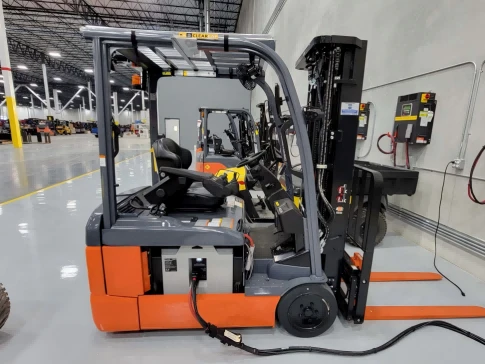
What's Running Out There
Lead-acid is still most of the installed base. I've seen estimates anywhere from 58% to over 70% depending on who's doing the counting and what they're counting. The spread tells you how fuzzy the data is. Market research firms love to publish these numbers like they're gospel but half the time they're extrapolating from survey responses with like a 12% response rate.
Lithium has been eating into new purchases, especially anything multi-shift. Makes sense when you do the math, which I'll get to.
Hydrogen exists. Maybe 50,000 units worldwide? Mostly pilots and PR exercises. I've toured exactly one facility where hydrogen actually made economic sense and that was only because they had a sweetheart deal on power and some kind of state subsidy thing I didn't fully understand. For everyone else it's a decade away minimum, probably more.
Lead-Acid
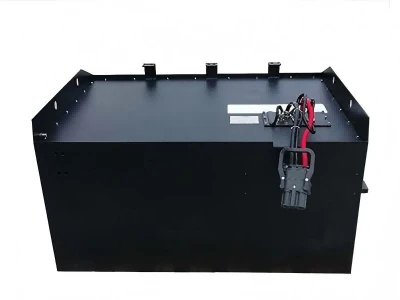
The chemistry is 160 years old. Lead plates in sulfuric acid. Works fine. Industrial units run 24V up to 80V, capacities from 200Ah to over 1,000Ah depending on equipment class.
Weight matters here. These things weigh anywhere from 900kg to two tons. That's not incidental-it's counterweight. The forklift needs that mass to not tip over when you pick up a loaded pallet. This becomes a whole thing when people try to swap in lithium without thinking it through. I watched a retrofit go sideways at a food distribution operation a few years back where they saved money by skipping the ballast addition, truck went forward with a full pallet, operator bailed, product went everywhere. Nobody got hurt but it was a mess. Six weeks to get the insurance sorted, plus the damaged racking, plus the product loss. All because someone wanted to save four hundred bucks per truck on counterweight.
Anyway the maintenance situation is where lead-acid becomes a problem for high-utilization facilities.
You've got weekly watering-every cell in every battery, and if your operators are actually doing this correctly I'd be surprised because half the time when I audit facilities the specific gravity readings are all over the place which tells me either nobody's watering properly or nobody's testing properly or both. Equalization charging, which is controlled overcharging to prevent stratification but if you do it wrong you accelerate corrosion on the positive grids. Terminal cleaning. The 8-8-8 rule which everyone knows and nobody follows: eight hours running, eight hours charging, eight hours cooling.
That cooling period is the killer. Third shift ends at 6am, batteries go on charge, day shift starts at 7am and needs trucks. What happens? Someone pulls a battery that's been charging for an hour. Do that repeatedly and you're knocking 30-40% off the service life. There was a study-I want to say PHL Scientific but I might be mixing it up with something else-showing something like 47% of flooded lead-acid batteries fail before hitting rated lifecycle. Not manufacturing defects. Just operational abuse.
AGM and TPPL are in between. Sealed so no watering, faster recharge, better in some ways. Still not lithium. Transitional tech.
LFP vs NMC vs Whatever Else
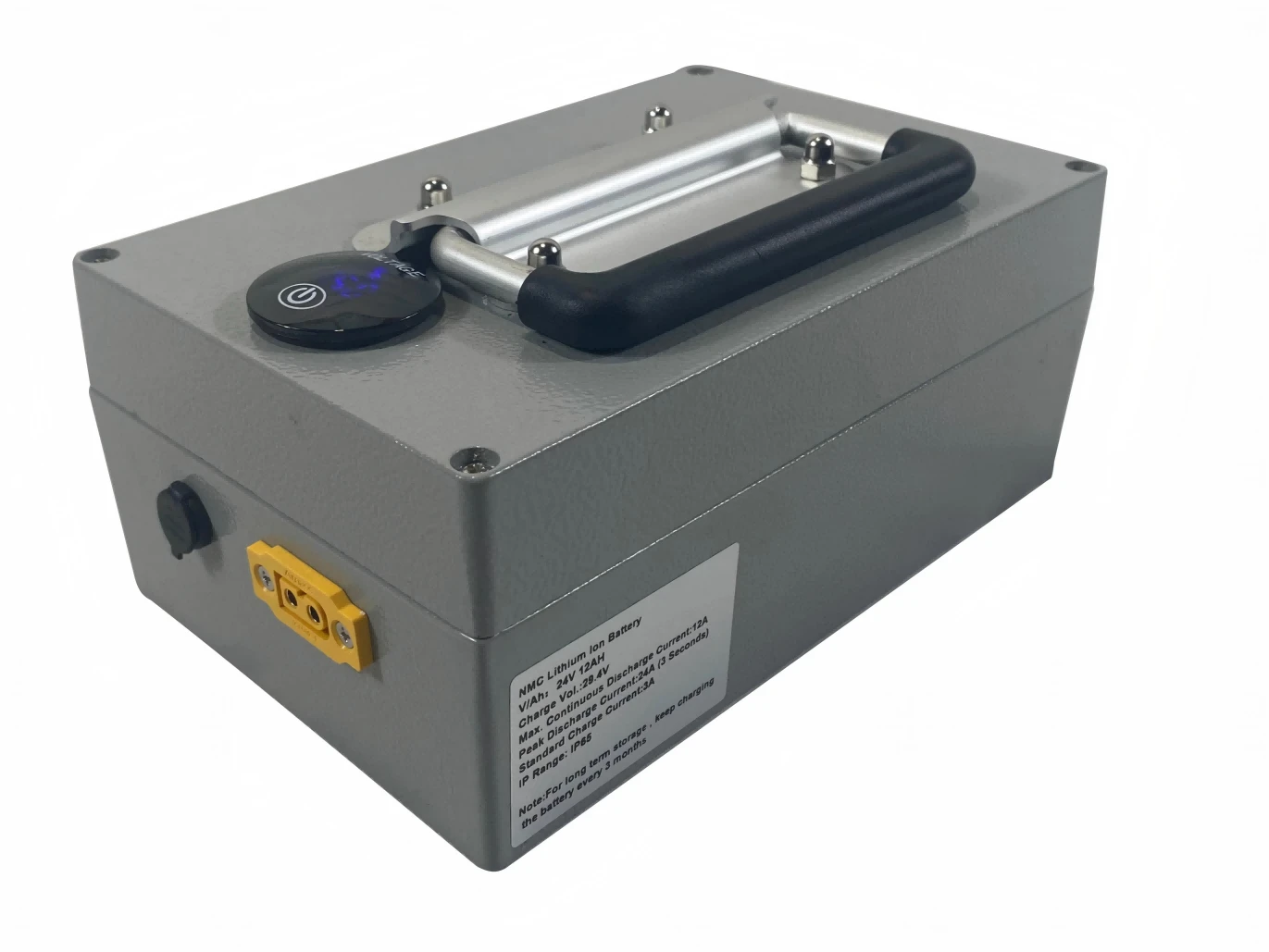
When someone says lithium forklift battery they mean LFP. Lithium iron phosphate. Not the stuff Tesla puts in cars-that's mostly NMC, nickel manganese cobalt.
There's a reason for this and it's not complicated.
LFP thermal runaway threshold is around 270°C. You really have to try to set one on fire. NMC starts going into thermal runaway somewhere in the 150-210°C range depending on a bunch of factors-state of charge, cell age, how it was manufactured, ambient conditions. There's some research on the failure modes, I think PowerTech Systems has published stuff on this, the exact mechanisms are complicated but the short version is: puncture an LFP cell and you get venting, puncture certain NMC cells under bad conditions and you get a fire.
For a warehouse with forklifts operating around racking and workers and inventory worth millions of dollars, that margin matters.
The other thing is cobalt. NMC has it, that's what the C stands for. Cobalt supply chains are a mess-geopolitically unstable, ethically questionable sourcing, price volatility. LFP has no cobalt. Increasingly I'm seeing procurement teams specify cobalt-free just because it simplifies their ESG documentation.
Energy density: LFP runs maybe 90-160 Wh/kg, NMC is higher, 150-270 Wh/kg or thereabouts. For EVs chasing range this matters a lot. For forklifts where you want the mass anyway? Less of an issue.
Cycle life is where LFP really pulls ahead. There's a paper from maybe 2014, I think first author was Omar, in Applied Energy-I don't have the citation handy but it showed LFP doing over three thousand cycles at full depth of discharge. Shallow cycling extends that dramatically, like into the tens of thousands. NMC doesn't hold up the same way under heavy use.
Some of our installations are past five thousand cycles now. Still performing fine. We'll see where they actually hit end of life.
One thing that doesn't get talked about enough: you can't charge lithium when it's really cold. Well, you can, but you shouldn't. Below freezing you risk lithium plating on the anode which permanently damages the cells. Our packs have protection that blocks charging when the pack is too cold, plus heating elements to bring temperature up first. But operators need to understand this. If power goes out overnight in winter and the packs sit cold, they need to warm up before charging. I've had maybe three or four calls from facilities that didn't understand this and were confused why their batteries wouldn't charge at 6am in January.
Cold Storage Specifically
This is where we do a lot of business so I'll spend some time on it.
Lead-acid loses capacity in the cold. Rough numbers from what I've seen in the field: at freezing you're maybe looking at 75% of rated capacity, at -18°C it's down to 40-something percent. And you can't charge below freezing-the chemistry just doesn't work at those temperatures. So facilities pull trucks out of the freezer, move them to a heated charging area, charge, then send them back into the cold. That temperature cycling creates condensation. Water gets into connectors and seals and vents. Corrosion accelerates. Batteries fail faster than they should.
LFP with proper thermal management-heating elements, IP67 sealing-holds up much better. 85-90% efficiency at -20°C if the pack is designed for it.
There's a case study I reference a lot, BSLBATT documented it, cold storage operation running Linde trucks, I think it was Middle East somewhere. They were going through two or three lead-acid batteries per truck per day just to cover shifts. Each swap took twenty minutes, needed a crane, safety exposure during the changeover. After conversion they went to one battery per truck, maintenance savings were something like two thousand dollars a month per unit just from not having to water anymore. I don't have the link handy but it should be on their site if you search for their cold storage case studies.
Toyota specs their lithium cold storage trucks for a couple hours continuous at -30°C. Heated versions can stay in the freezer permanently.
Money
Everything depends on your specific situation so take these as rough benchmarks not predictions.
Lead-acid over five years you're probably looking at purchase cost around five grand, energy cost over the period maybe six grand, maintenance labor-and this is the big one-easily ten thousand if you're actually doing proper maintenance, plus you'll probably replace the battery at least once so another five thousand, plus whatever downtime costs you. Total somewhere in the low to mid thirties.
Lithium: higher purchase cost, call it fifteen to eighteen thousand, but energy cost drops to maybe four grand over the period, maintenance is basically nothing, no replacement, minimal downtime. Total around twenty, maybe low twenties.
The maintenance line is what moves the math. If you've got a fleet of forty trucks and you can eliminate a dedicated battery maintenance person, that's a hundred thousand plus in annual labor savings alone.
There's an eight-year study from UgoWork on a Texas 3PL, fifty trucks, they documented something like 2.9 million in savings after converting, payback was around month thirty. Lead-acid had needed replacement every four years-ish, lithium ran the whole study. I've referenced this a bunch of times with customers.
Payback timeline depends on utilization. Multi-shift 24/7 operations maybe 12-18 months. Single shift could be four or five years, which is long enough that some finance teams won't approve it. Know your numbers before you go into the budget meeting.
The Rest
BMS quality varies wildly and there's no good way to evaluate it without testing. Some of what's sold as commercial grade wouldn't pass basic safety validation. Worth asking vendors about cell balancing methodology, temperature monitoring, fault response times. But honestly that's a whole separate conversation.
Compliance: UL 2580 for North America, UN38.3 for international shipping, there's an EU battery regulation phasing in through 2027 with passport requirements. OSHA charging area requirements mostly apply to lead-acid because of hydrogen off-gassing. Get actual documentation on the specific models you're buying.
Bottom Line
Scenario A
Single shift, low utilization, good maintenance discipline? Lead-acid still makes sense. Parts are everywhere, your people know it.
Scenario B
Multi-shift, cold storage, high downtime cost? Lithium for most situations.
If you want to talk through specifics for your operation, reach out. engineering@polinovelpower.com. We do site assessments.


