


Formation Mechanism of the SEI Layer
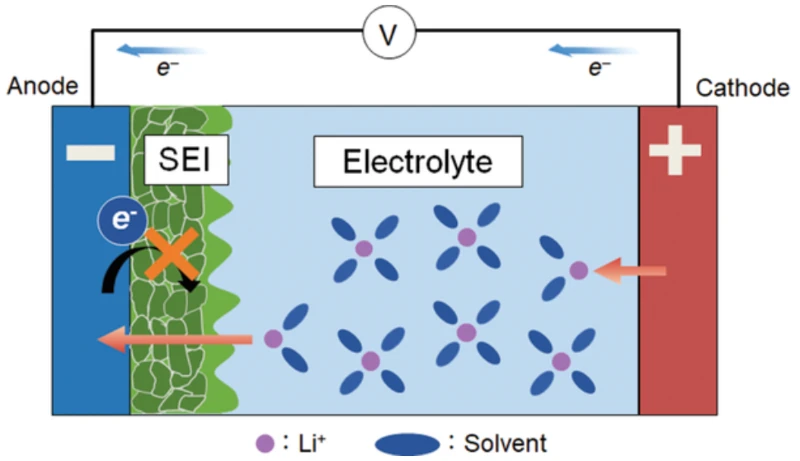
The SEI develops through a spontaneous electrochemical process when the anode potential drops below the electrolyte's reduction potential. During initial charging, electrolyte molecules react with electrons and lithium ions at the electrode surface, creating a complex mixture of organic and inorganic decomposition products.
This formation primarily occurs during the first few charge-discharge cycles, consuming a portion of the available lithium ions. The reaction involves ethylene carbonate (EC), the most common electrolyte solvent, which decomposes into lithium ethylene dicarbonate (LEDC) and ethylene gas. LEDC's instability then triggers secondary reactions, generating additional compounds that contribute to the SEI's heterogeneous structure.
The process is voltage-dependent. When the anode potential falls outside the electrolyte's thermodynamic stability window, reduction reactions initiate at the electrode/electrolyte interface. These reactions continue until the growing SEI layer becomes thick enough to prevent electron tunneling, effectively passivating the electrode surface.
Temperature significantly influences SEI formation kinetics. Higher temperatures accelerate the reduction reactions but can compromise the layer's stability. The charging current during formation also plays a crucial role-high currents favor inorganic component formation first, followed by lithium intercalation and organic compound generation.
Chemical Composition and Structure
The SEI exhibits a complex, multilayered architecture with distinct chemical zones. Analysis through X-ray photoelectron spectroscopy and cryogenic electron microscopy reveals a dual-layer structure: a dense inner layer adjacent to the electrode and a porous outer layer facing the electrolyte.
The inner layer consists primarily of inorganic compounds. Lithium carbonate (Li2CO3), lithium fluoride (LiF), lithium oxide (Li2O), and lithium hydroxide (LiOH) dominate this region. These materials provide mechanical rigidity and electronic insulation. Li2CO3 forms the primary component, while LiF-when present-contributes exceptional stability and ionic conductivity.
The outer layer contains mainly organic species. Lithium alkyl carbonates (ROCO2Li), lithium ethylene dicarbonate (LEDC), and polyethylene oxide (PEO)-type oligomers create a more flexible, less dense structure. This composition allows the outer layer to accommodate minor volume changes during cycling while maintaining contact with the electrolyte.
Recent research using advanced nuclear magnetic resonance spectroscopy has identified previously unknown complexity in SEI composition. LiF in the SEI exists as limited LiF-LiH solid solutions, forming both hydrogen-rich (LiH1-yFy) and fluorine-rich (LiF1-xHx) phases. This heterogeneous nature of LiF distribution significantly impacts lithium-ion transport pathways.
The total SEI thickness ranges between 10-50 nanometers in conventional lithium-ion batteries, though this can vary based on electrode material and electrolyte composition. Silicon anodes, which undergo substantial volume expansion, develop thicker SEI layers-sometimes reaching micron scale after extended cycling.
Critical Role in Battery Performance
The SEI fundamentally determines battery longevity and efficiency. A well-formed SEI enables long-term cyclability by preventing continuous electrolyte decomposition while facilitating lithium-ion transport. This dual functionality makes it perhaps the most important yet least understood component in lithium battery systems.
Capacity retention directly correlates with SEI stability. Each cycle where the SEI cracks and reforms consumes additional lithium ions and electrolyte, irreversibly reducing battery capacity. Studies tracking capacity fade in commercial cells attribute 60-70% of degradation to SEI-related phenomena. The consumed lithium during initial SEI formation typically accounts for 10-20% of the first-cycle capacity loss.
Rate capability depends heavily on SEI resistance. Lithium ions must traverse the SEI layer during every charge-discharge cycle. A thicker or less conductive SEI increases impedance, limiting how quickly the battery can charge or discharge. Electrochemical impedance spectroscopy measurements show SEI resistance can increase 3-5 times during the first 100 cycles, directly impacting power performance.
Safety considerations tie closely to SEI integrity. An unstable SEI contributes to lithium dendrite formation-needle-like structures that can pierce the separator and cause internal short circuits. Research on thermal runaway mechanisms demonstrates that SEI decomposition initiates self-heating at approximately 80-120°C. The organic components in the outer layer decompose first, releasing gases and heat that accelerate thermal events.
Recent 2025 studies on fast-charging and low-temperature batteries emphasize SEI microstructure importance. A fluorine-rich SEI with excessive, densely packed LiF impedes lithium-ion transport, while dispersed LiF aggregates enhance performance. This discovery challenges the traditional assumption that LiF-rich interfaces universally improve battery characteristics.
The Silicon Anode Challenge
Silicon anodes present unique SEI challenges due to extreme volume changes. During lithiation, silicon can expand up to 300%, while delithiation causes corresponding contraction. This dramatic cycling strain repeatedly fractures the SEI, exposing fresh silicon surfaces to the electrolyte.
Advanced electron microscopy studies reveal how SEI evolves on silicon electrodes. Rather than remaining on the particle surface, the SEI progressively grows inward through percolation channels created by vacancy injection and condensation during delithiation. This process forms a silicon-electrolyte composite structure that consumes active material and reduces capacity.
The SEI thickness on silicon anodes increases from tens of nanometers to several microns after hundreds of cycles. Cryo-scanning transmission electron microscopy images show heterogeneous SEI distributions, with some particles developing thick, porous layers while others maintain relatively dense coatings. This non-uniformity stems from particle-to-particle variations in surface chemistry and mechanical stress distribution.
Electrolyte additives like fluoroethylene carbonate (FEC) help stabilize silicon SEIs by promoting formation of more elastic, fluorine-containing components. However, even optimized SEI layers struggle to accommodate silicon's volume swings without some cracking. Current research focuses on artificial SEI coatings and structural modifications to silicon particles that distribute stress more evenly.
SEI in Solid-State and Metal Anode Batteries
Solid-state batteries with lithium metal anodes face different SEI dynamics. The interface between solid electrolytes and lithium metal forms an interphase layer through similar decomposition reactions, but mechanical properties become paramount. Traditional SEI materials developed for liquid electrolytes often prove too brittle for solid-state systems.
A 2025 breakthrough reported in Nature demonstrated a ductile SEI for solid-state batteries. By incorporating Ag2S and AgF components through substitution reactions with Li2S/LiF, researchers created an SEI that maintains structural integrity under high current densities (>1 mA/cm²) and areal capacities (>1 mAh/cm²). This ductility allows the interphase to accommodate lithium deposition without cracking-a critical requirement for solid-state battery commercialization.
Lithium metal anodes without protective coatings develop highly reactive, non-uniform SEI layers that fail to prevent dendrite growth. The native SEI on lithium metal is typically fragile and electrochemically unstable, providing insufficient protection against electrolyte reactions. This drives research into artificial SEI strategies that can withstand the dynamic lithium plating and stripping processes.
Interface engineering for anode-free batteries represents an emerging frontier. Recent 2025 work on MoS2 sacrificial thin films shows how controlled conversion reactions can create Mo metal and Li2S interlayers that reduce lithium nucleation overpotential. Such approaches could enable Li-free battery architectures with energy densities approaching 500 Wh/kg.

Engineering Better SEI Through Electrolyte Design
Electrolyte modification represents the most practical approach to SEI optimization. By adjusting solvent composition, lithium salt selection, and additive incorporation, researchers can tailor SEI chemistry without redesigning electrode structures.
Fluorinated compounds have emerged as particularly effective additives. Fluoroethylene carbonate (FEC) preferentially reduces before ethylene carbonate, forming a LiF-rich SEI with improved mechanical properties and ionic conductivity. Concentrations as low as 2-10% FEC in standard carbonate electrolytes substantially enhance cycling stability, particularly for high-capacity anodes.
High-concentration electrolytes (HCE) and localized high-concentration electrolytes (LHCE) fundamentally alter SEI composition by changing lithium-ion solvation structure. In concentrated systems, anions participate more directly in the solvation shell, forming contact ion pairs and aggregates. The resulting SEI contains more inorganic components derived from anion decomposition, creating thinner but more stable layers.
A 2025 study in Chemical Science demonstrated how nitrile-assisted carbonate electrolytes with fluorine-containing salts produce thinner, sulfur-containing SEIs that suppress solvent decomposition during high-rate cycling from -40°C to 55°C. These engineered electrolytes enabled pouch cells to retain 66.88% capacity after 200 cycles at extreme charge/discharge rates (3C charge, 5C discharge) at 55°C.
Weakly solvating electrolytes represent another promising direction. By using solvents with reduced lithium-ion coordination strength, these formulations promote anion-derived SEI components that facilitate faster lithium-ion transport and enable low-temperature operation. This approach has enabled graphite anode charging at temperatures below -20°C-previously considered impractical for lithium-ion batteries.
Artificial SEI Strategies and Design Principles
When native SEI formation proves inadequate, artificial SEI layers offer an alternative. These pre-applied protective coatings aim to control lithium deposition, prevent dendrite growth, and stabilize the electrode-electrolyte interface from the first cycle.
Effective artificial SEI design requires balancing three key properties. First, mechanical stability-either through high strength materials that resist cracking or adaptive materials that accommodate volume changes. Second, uniform lithium-ion transport with moderate conductivity, ideally approaching single-ion conduction. Third, chemical passivation to minimize parasitic reactions between lithium and the electrolyte.
Polymer-based artificial SEIs leverage material flexibility. A 2024 study demonstrated polyurethane elastomer (TPU) coatings that combine soft polyethylene oxide segments for ionic conduction with hard isophorone diisocyanate segments for mechanical strength. This dual-component design achieved 1300 hours of stable cycling at 1 mA/cm² and maintained performance even at 10 mA/cm².
Inorganic artificial SEIs offer superior ionic conductivity and dendrite suppression. Lithium silicate coatings (Li2Si2O5 and Li2SiO3) applied via dry coating methods create protective barriers that optimize ion transport kinetics while preventing mechanical deformation. However, these rigid materials struggle with significant volume expansion, limiting their application to graphite anodes or thin lithium metal foils.
Composite approaches combine organic and inorganic components. A 2024 jigsaw-structured SEI integrating fluorine-containing silane with polyether-containing silane achieved over 500 hours of reversible lithium plating and stripping. The fluorine groups prevent parasitic reactions while creating a dense structure, the ethylene glycol backbone facilitates rapid Li+ transport, and the cross-linked network provides mechanical robustness.
Recent innovations focus on ion-conducting pathways. Metal-organic frameworks (MOFs) with ClO4⁻-functionalized channels combined with flexible lithiated Nafion binders create highly efficient single-ion conducting pathways with superior ionic conductivity. The strong electronegativity of anchored ClO4⁻ groups establishes preferential lithium-ion transport routes through the SEI structure.

Advanced Characterization Techniques
Understanding SEI composition and evolution requires sophisticated analytical methods. X-ray photoelectron spectroscopy (XPS) remains the primary tool for chemical analysis, identifying lithium salts, organic carbonates, and inorganic compounds. However, XPS results vary significantly with sample preparation-exposure to air and moisture alters surface chemistry within minutes, complicating accurate characterization.
Cryogenic electron microscopy has revolutionized SEI visualization. By flash-freezing battery components in liquid nitrogen and maintaining sub-100K temperatures during imaging, researchers can observe SEI structure at near-native states. Cryo-TEM reveals nanoscale heterogeneity, showing grain boundaries between different phases and identifying preferential lithium-ion transport pathways through the interphase.
Operando techniques enable real-time SEI monitoring during battery operation. Electrochemical quartz crystal microbalance (EQCM) quantifies mass changes at the electrode surface with nanogram sensitivity. Combined with electrochemical impedance spectroscopy, these methods track SEI formation kinetics and growth mechanisms throughout cycling.
Advanced spectroscopy methods provide molecular-level insights. Surface-enhanced Raman spectroscopy and tip-enhanced Raman spectroscopy (TERS) achieve spatial resolution below 10 nanometers, mapping distributions of specific compounds like LEDC and PEO-type oligomers across electrode surfaces. Solid-state nuclear magnetic resonance using 19F and 6Li isotopes identifies previously unknown phases and their local coordination environments.
Computational modeling complements experimental characterization. First-principles calculations based on density functional theory (DFT) predict reduction potentials for different electrolyte components, helping identify which species decompose first. Molecular dynamics simulations reveal how electric fields alter electrolyte structure near electrode surfaces, influencing the onset of decomposition reactions.
Current Research Frontiers and Future Directions
SEI research in 2024-2025 focuses on extreme operating conditions. Fast-charging requirements demand SEIs that maintain low impedance while preventing lithium plating. Wide-temperature operation necessitates materials that remain flexible at -40°C yet stable at 60°C. High-voltage cathode compatibility requires SEIs that withstand oxidative conditions exceeding 4.5V vs Li/Li+.
Multivalent-ion batteries extend SEI challenges to new chemistries. Magnesium-ion batteries struggle with severe anode passivation due to the divalent nature of Mg²+ ions, which form more resistive SEI layers than Li+. Calcium-ion batteries show similar issues. Recent computational studies using ab initio molecular dynamics explore how salt and solvent selection influence SEI formation on magnesium and calcium anodes, seeking combinations that enable reversible metal deposition.
Machine learning accelerates SEI optimization. High-throughput computational screening evaluates thousands of potential electrolyte additives, identifying candidates with favorable reduction voltages and SEI-forming properties. Kinetic Monte Carlo simulations informed by first-principles calculations predict SEI growth dynamics over microsecond to second timescales, bridging quantum mechanics and battery operation.
Self-healing SEI concepts draw inspiration from biological systems. Electrolytes containing reactive additives that preferentially migrate to cracks or defects in the SEI could enable autonomous repair. Early demonstrations show promise, though achieving true self-healing while maintaining electrochemical stability remains challenging.
Sustainability considerations increasingly shape SEI research. Water-based artificial SEI formation processes offer environmental advantages over toxic solvents. A 2024 breakthrough used guar gum dissolved in water to create hollow nanofiber protective layers through electrospinning, extending lithium metal anode lifespan by 750% while ensuring complete biodegradation within one month.
SEI Impact on Battery Commercialization
The transition from laboratory research to commercial products hinges on SEI control. Automotive companies specify battery lifetimes exceeding 1000 charge-discharge cycles with less than 20% capacity fade. Achieving this requires SEI stability unprecedented in early lithium battery designs.
Manufacturing consistency presents significant challenges. SEI formation depends on electrode surface cleanliness, moisture content, formation protocols, and temperature control during initial cycling. Variations in these parameters lead to cell-to-cell performance differences that compound in large battery packs. Industrial formation processes must balance SEI quality with production throughput-slower, controlled charging improves SEI uniformity but increases manufacturing time and cost.
Quality control methods for SEI remain imperfect. Unlike electrode thickness or electrolyte fill level, SEI characteristics cannot be easily measured non-destructively. Manufacturers rely on electrochemical fingerprinting techniques-measuring impedance, voltage curves, and efficiency during formation-to infer SEI quality. Advanced facilities are implementing in-line X-ray or optical measurements, though direct chemical analysis of the SEI in production environments remains impractical.
The cost-performance tradeoff affects electrolyte selection. Additives like FEC improve SEI quality but increase electrolyte cost by 15-30%. High-concentration electrolytes demand 3-5 times more lithium salt, substantially raising material costs. Manufacturers must weigh these expenses against performance gains and warranty costs from premature failure.
Frequently Asked Questions
How thick is the SEI layer in a typical lithium battery?
The SEI typically measures 10-50 nanometers in standard lithium-ion batteries with graphite anodes. This dimension can increase to 100-120 nanometers depending on electrolyte composition and cycling conditions. Silicon anodes develop much thicker SEI layers-often reaching several hundred nanometers or even microns after extensive cycling due to volume expansion causing repeated layer formation.
Can the SEI layer be removed or reset?
The SEI cannot be easily removed without damaging the electrode. Some research explores controlled SEI dissolution using specific solvents, but this typically occurs during battery recycling rather than maintenance. The most practical approach involves managing SEI growth through proper battery operation-avoiding extreme temperatures, limiting depth of discharge, and using appropriate charging protocols.
Why does the SEI continue growing after the first charge cycle?
While the bulk of SEI formation happens during initial cycles, slow growth continues throughout battery life. This occurs because the SEI isn't perfectly stable-minor cracks develop from electrode volume changes, exposing fresh surface to electrolyte. Additionally, some electrolyte components slowly permeate through the existing SEI, causing continued decomposition reactions. This parasitic growth consumes lithium ions and increases impedance, contributing to capacity fade.
How does temperature affect SEI stability?
Temperature profoundly impacts SEI behavior. High temperatures (>45°C) accelerate side reactions and can decompose SEI components, particularly organic species. Low temperatures (<0°C) reduce ionic conductivity through the SEI and can cause lithium plating rather than intercalation. The optimal temperature range for SEI stability is typically 15-35°C. Recent research on wide-temperature electrolytes aims to create SEI layers that remain functional from -40°C to 60°C.
Data Sources:
Peled, E. (1979). The electrochemical behavior of alkali and alkaline earth metals in nonaqueous battery systems. Journal of the Electrochemical Society, 126, 2047-2051. [https://doi.org/10.1149/1.2128859]
Heiskanen, S. K., Kim, J., & Lucht, B. L. (2019). Generation and evolution of the solid electrolyte interphase of lithium-ion batteries. Joule, 3(10), 2322-2333. [sciencedirect.com]
He, Y., Jiang, L., Chen, T., et al. (2021). Progressive growth of the solid–electrolyte interphase towards the Si anode interior causes capacity fading. Nature Nanotechnology, 16, 1113-1120. [nature.com]
Russell, A., et al. (2025). Revealing the roles of the solid–electrolyte interphase in designing stable, fast-charging, low-temperature Li-ion batteries. Proceedings of the National Academy of Sciences, 122(13), e2420398122. [pnas.org]
Nature (2025). A ductile solid electrolyte interphase for solid-state batteries. [nature.com]
Ossila. Introduction to the Solid Electrolyte Interphase (SEI) Layer. [ossila.com]
ScienceDirect Topics. Solid Electrolyte Interphase - an overview. [sciencedirect.com]
Grepow. The SEI, and the Effect It Has On The Battery. [grepow.com]


