


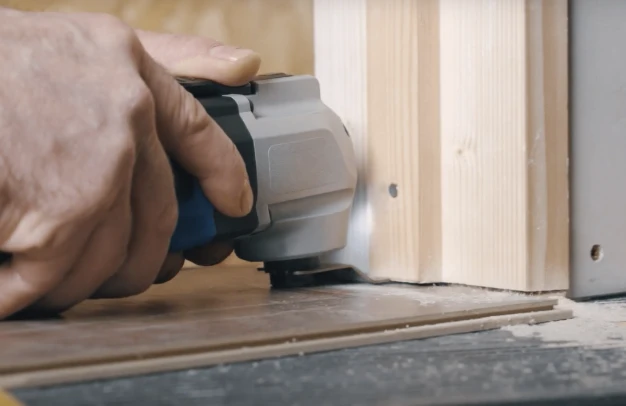
An oscillating multi-tool is a handheld power tool that swings a blade, pad or scraper back and forth through a very small arc, thousands of times per minute. Because the accessory never spins or travels in long strokes, the tool can start a cut in the middle of a panel, cut flush against a floor or wall, sand into tight corners and scrape out grout or adhesive - all by swapping the accessory rather than the tool.
Its advantage is access and control, not raw speed: for long, straight or deep cuts, a circular saw, reciprocating saw or grinder is usually faster. This guide explains how the tool works, which jobs it suits, which specifications are worth comparing, and - because Polinovel designs and builds lithium battery systems - how the battery pack in a cordless model affects cutting power, runtime and service life.
How an Oscillating Multi-Tool Works
Inside the head, an eccentric drive converts motor rotation into a rapid side-to-side swing of the output shaft. Two numbers describe that motion:
- Oscillation angle - the total arc the accessory swings through. Published specifications for current cordless models sit at roughly 2.8° to 4°. A wider arc removes material faster; a narrower arc is easier to control and transmits less vibration.
- Oscillations per minute (OPM) - how many times the accessory swings each minute. Current models list variable ranges such as 5,000–20,000 OPM. Low settings help start cuts accurately and protect finished surfaces; high settings suit soft materials and rough work.
The design traces back to medicine. In 1967 Fein introduced a plaster cast saw whose oscillating blade could cut a hard cast without cutting the patient's skin. Fein later adapted the mechanism for removing bonded windshields (1985), brought the MultiMaster to the construction and trades market in 2007, and in 2016 developed the Starlock accessory interface together with Bosch, according to Fein's history of the MultiMaster. Once the original patent protection ended in the late 2000s, most major tool brands launched their own versions.
| Tool | Accessory motion | Where it is strongest | Main limitation |
| Oscillating multi-tool | Small, fast side-to-side arc | Plunge cuts, flush cuts, corners, grout and adhesive removal | Slow on long or deep cuts; blades wear quickly in hard materials |
| Reciprocating saw | Long back-and-forth strokes | Fast demolition cuts through framing, pipe and mixed material | Aggressive and hard to control near finished surfaces |
| Rotary tool | Continuous high-speed rotation | Small-scale engraving, grinding and detail cutting | Low power for construction-scale work |
| Detail / orbital sander | Orbital or random-orbit pad motion | Flat surface sanding over larger areas | Cannot cut; limited reach into tight inside corners |
What It Is Good At and When Another Tool Is Better
| Job | Typical accessory | Why the multi-tool works | Consider another tool when… |
| Cutting openings in drywall, panels or subfloor | Wood or bi-metal plunge blade | The blade can enter the face of the material without a starter hole | You are cutting full sheets - use a track or circular saw |
| Undercutting door jambs and trim for new flooring | Flush-cut wood blade | The blade lies flat on a spacer and cuts parallel to the floor | Many jambs need cutting - a dedicated jamb saw is faster |
| Trimming nails, bolts, dowels or pipe in tight spaces | Bi-metal or carbide-tipped blade | Controlled cutting with little clearance and minimal kick | Material is thick steel - an angle grinder or band saw cuts faster |
| Removing grout between tiles | Carbide- or diamond-grit segment blade | A narrow blade follows the joint without chipping the tile face | A whole floor is being stripped - use a dedicated tile removal method |
| Scraping caulk, adhesive, vinyl or old finishes | Rigid or flexible scraper | Vibration helps the blade work under bonded material | Large flat areas - a floor scraper or chemical remover may be quicker |
| Sanding corners, profiles and small details | Triangular hook-and-loop pad | The pointed pad reaches inside corners other sanders miss | The surface is large and flat - an orbital sander is more efficient |

Accessories and Mounting Systems
Results depend as much on the accessory as on the tool. Before buying blades, check two things: the mounting interface and the material the accessory is made for.
Mounting interface. Older and many budget tools use the open "universal" or OIS-style pattern, where the accessory is clamped over pins on the tool's shaft. Starlock uses a three-dimensional "bottle cap" profile that seats the accessory into the holder instead of onto it, which Fein says improves power transfer and makes tool-free changes faster. Starlock accessories come in three classes - Starlock, StarlockPlus and StarlockMax - matched to tool power, so confirm the tool manufacturer's compatibility guidance rather than assuming every Starlock accessory fits every Starlock tool.
Accessory material.
- High-carbon steel (HCS) blades - wood, plastic, drywall; dull quickly on nails.
- Bi-metal blades - wood with embedded nails, soft metals, PVC and copper pipe.
- Carbide-tipped blades - harder materials and abrasive composites where bi-metal teeth wear fast.
- Carbide- or diamond-grit blades and rasps - grout, mortar, tile edges, cement board; these grind rather than saw.
- Scrapers - rigid for heavy adhesive, flexible for caulk and slightly curved surfaces.
- Sanding pads - triangular pads with hook-and-loop paper in the grit sequence the finish requires.
Specifications Worth Comparing
- Speed control. A variable dial or trigger matters more than the top OPM figure, because most precision work starts slow.
- Oscillation angle. Choose a wider arc for demolition and fast material removal; a narrower arc for finish carpentry and tile work.
- Accessory interface. A widely supported interface keeps blade costs and availability under control over the tool's life.
- Vibration control. Isolated heads and balanced drives reduce hand fatigue and make it easier to hold a line during long sessions.
- Power source. Corded tools never run out of runtime; cordless tools trade some sustained power for mobility. For cordless models, the battery platform deserves as much attention as the tool body - see the next section.
- Practical extras. Depth stops, LED work lights and dust-extraction ports matter for specific trades; ignore them if your work does not need them.
The Battery Side: What Powers a Cordless Oscillating Multi-Tool
On a cordless multi-tool, the battery pack sets the ceiling for cutting power, how long you can work before swapping packs, and how many years the pack stays useful. Most of the confusion buyers run into comes from how pack voltage and capacity are labelled.
12V, 18V, 20V MAX and 24V Are Cell Counts, Not Power Ratings
A tool pack is built from lithium-ion cells wired in series. Each cell typically has a nominal voltage of about 3.6V and reaches about 4V or slightly more when fully charged with no load. The number of cells in series sets the pack voltage; whether the brand prints the nominal or the maximum figure on the label is a marketing choice. As Pro Tool Reviews explains, 18V and 20V MAX packs both use groups of five cells in series - "20V MAX" refers to the no-load maximum and "18V" to the nominal value.
| Label you see | Cells in series | Nominal voltage (3.6V per cell) | What the label is based on |
| 12V MAX | 3 | 10.8V | Maximum (no-load) voltage |
| 18V | 5 | 18V | Nominal voltage |
| 20V MAX | 5 | 18V | Maximum (no-load) voltage - same cell arrangement as 18V |
| Six-cell packs (some sold as "24V") | 6 | 21.6V | Varies by brand - check the nominal figure in the manual |
Practical rule: compare platforms by cell count and nominal voltage, not by the number on the box. Real-world cutting performance also depends on the motor, electronics and cell quality, so two packs with the same voltage can still perform differently.
For more on how nominal ratings work across battery chemistries, see our explainer on nominal voltage in lithium batteries.
Amp-Hours Tell You Capacity; Watt-Hours Let You Compare
Amp-hours (Ah) describe charge capacity at the pack's voltage, so they only compare fairly within one voltage class. Watt-hours (Wh = nominal volts × amp-hours) describe stored energy and work across platforms. For example, a 4Ah pack on a 10.8V-nominal platform stores about 43Wh, while a 4Ah pack on an 18V-nominal platform stores about 72Wh. A higher-Ah pack on the same platform adds runtime and weight, which matters on a tool you hold overhead or at arm's length.
Why the Tool Can Stop While the Gauge Still Shows Charge
Every pack has internal resistance. When a hard cut or a dull blade raises the current draw, the pack's terminal voltage drops in proportion to that current. If the voltage under load falls below the cut-off set by the pack or tool electronics, the tool shuts down to protect the cells - even though the resting charge gauge still shows capacity left. Easing pressure, sharpening or replacing the blade, or switching to a larger pack usually lets the tool keep running.
The same effect becomes stronger when cells are cold, when the pack is heavily aged, or when a small pack is asked to supply high current. Packs with more cells in parallel share the current between more cells, so each cell works less hard and the voltage drop under load is smaller.
Making Tool Packs Last
Lithium-ion packs wear through two routes: cycling and calendar ageing. Battery University (BU-808) identifies heat and long periods at full charge as the main stress factors, treating storage above about 30°C as elevated temperature. Its estimates for common cobalt-based lithium-ion cells stored for one year at 25°C show about 96% recoverable capacity when stored at 40% charge versus about 80% when stored at 100% charge. Exact figures vary by cell chemistry and manufacturer, but the guidance translates directly to tool packs:
Keep packs cool. Do not leave packs in hot vehicles or in direct sun on a jobsite.
Store partly charged. For storage longer than a few weeks, store packs partly charged rather than full, in a cool place.
Partial discharges are fine. Lithium-ion has no memory effect and does not need regular full cycles.
Cool before charging. Let a hot pack cool before recharging after a heavy cutting session.
Retire damaged packs. Replace packs that are swollen, damaged, or that get unusually hot in normal use.
Using an Oscillating Tool On or Near Battery-Powered Equipment
Maintenance teams in warehouses, factories and facilities often use multi-tools to trim panels, cut fasteners or remove adhesive and old mats on forklifts, pallet jacks, floor scrubbers and aerial work platforms. These machines carry large traction batteries that hold substantial energy even when the machine is switched off. A few precautions apply before any cutting, sanding or scraping work:
Isolate the energy source first. In the United States, servicing and maintenance work is covered by OSHA's control of hazardous energy standard (29 CFR 1910.147, lockout/tagout), which includes stored electrical energy. Use the equipment's battery disconnect or connector as the manufacturer's service manual specifies, and lock or tag it before starting.
Never cut, drill, sand or pry into a battery enclosure, cell, busbar or power cable. Damage to a lithium battery can cause internal short circuits and fire, and some packs remain energised even with the main connector unplugged.
Control metal swarf and conductive dust. Cover exposed terminals and connectors before cutting metal nearby, and vacuum chips away afterwards rather than blowing them into the battery compartment.
Follow the equipment and battery manufacturer's instructions for any work inside or around the battery compartment, and refer battery service to qualified personnel.
Same Chemistry, Different Scale: Tool Packs and Industrial Traction Batteries
The questions that decide whether a cordless tool keeps running - voltage under load, usable energy, discharge current, temperature and pack protection - are the same questions that decide whether a fleet of electric equipment gets through a shift. What changes is scale and duty cycle.
| Attribute | Cordless tool pack | Industrial traction pack (Polinovel range) |
| Nominal voltage | About 10.8V to 21.6V, depending on cells in series | 24V to 144V configurations |
| Capacity | A few amp-hours per pack | 80Ah to 800Ah configurations |
| Typical cell format and chemistry | Cylindrical lithium-ion cells, about 3.6V nominal each | Prismatic LiFePO4 cells, 3.2V nominal each |
| Usage pattern | Short bursts of high current, swapped and bench-charged | Hours of continuous duty in forklifts, scrubbers, AWPs and AGVs |
| Protection and monitoring | Protection electronics in the pack and tool | Battery management system with optional CANbus, RS485 or Bluetooth communication |
| Environment | Handheld, mostly indoor or jobsite use | Optional IP54–IP67 enclosures and self-heating for cold storage |
Polinovel does not manufacture power-tool battery packs. Our work is motive-power lithium systems for material handling, industrial and low-speed electric equipment. If your facility runs battery-powered machines and you are weighing a lead-acid-to-lithium change, a capacity upgrade or a pack built around an unusual compartment, you can review our custom LiFePO4 battery engineering options or browse our lithium batteries for floor scrubbers and sweepers.
Explore Custom LiFePO4 Battery Solutions
Frequently Asked Questions
Q: Is an oscillating tool the same as a multi-tool?
A: In power-tool catalogues, "multi-tool", "oscillating tool" and "oscillating multi-tool" usually describe the same product. The term "multi-tool" is broader, though: it can also mean a rotary tool or a folding hand tool, so check the product type before buying.
Q: Can an oscillating multi-tool cut metal?
A: Yes, with a bi-metal or carbide-tipped blade it can cut nails, screws, thin sheet, copper and thin-wall pipe, especially where there is little clearance. It is slow on thick steel, and metal cutting wears blades quickly, so use low-to-medium speed and light pressure.
Q: Is a 20V MAX multi-tool more powerful than an 18V model?
A: Not because of the label. Both use five lithium-ion cells in series; "20V MAX" quotes the maximum no-load voltage and "18V" the nominal voltage. Differences between tools come from the motor, electronics, cells and accessory interface.
Q: Why does my cordless multi-tool cut out during hard cuts?
A: Under heavy load the pack's voltage drops because of its internal resistance. If it falls below the protection cut-off, the tool stops even though charge remains. Reduce pressure, use a sharp blade matched to the material, keep packs warm in cold weather, or switch to a larger-capacity pack.


