


What is Lithium Manganese Oxide?
Lithium Manganese Oxide (LMO) is a cathode material used in lithium-ion batteries, with the chemical formula LiMn₂O₄. It features a three-dimensional spinel crystal structure that enables efficient lithium-ion movement during battery charging and discharging cycles.
The Spinel Structure Advantage
The defining characteristic of LMO lies in its spinel crystal structure, classified under the space group Fd3m. This cubic lattice arrangement positions oxygen atoms at specific points while manganese and lithium ions occupy octahedral and tetrahedral sites respectively. The three-dimensional framework creates interconnected pathways for lithium ions to move freely, which translates directly into practical battery performance.
This architectural design solves a problem that plagues two-dimensional cathode materials. Instead of forcing ions to travel along limited planar routes, the spinel structure offers multiple pathways in three dimensions. The result is faster ion transport, reduced internal resistance, and better current handling capability. Studies show this structure maintains its integrity even during rapid charge-discharge cycles, making LMO particularly suited for applications requiring quick power delivery.
The manganese content in LMO exists in a mixed valence state, with equal proportions of Mn³⁺ and Mn⁴⁺ ions occupying octahedral sites. This mixed oxidation state plays a critical role in the electrochemical reactions that occur during battery operation, allowing for reversible lithium insertion and extraction.
How LMO Functions in Lithium Batteries
During the discharge process, lithium ions migrate from the anode through an electrolyte to the LMO cathode, where they occupy tetrahedral sites within the manganese oxide framework. Electrons flow through the external circuit, generating electrical current. When charging, this process reverses-lithium ions extract from the cathode and return to the anode.
The voltage characteristics distinguish LMO from other cathode chemistries. LMO batteries typically operate at a nominal voltage of approximately 4.0V, slightly higher than lithium cobalt oxide (LCO) systems. This higher voltage contributes to improved energy output per unit mass, though the overall energy density remains moderate compared to nickel-rich cathode materials.
The intercalation mechanism in LMO occurs through a process where lithium ions reversibly insert into and extract from the spinel structure without significantly disrupting the manganese-oxygen framework. This structural stability during cycling is both an advantage and a limitation, which we'll explore in the challenges section.
Primary Applications and Use Cases
LMO batteries excel in applications demanding high power output over short durations. Power tools represent a major market segment, where manufacturers value LMO's ability to deliver substantial current for drilling, cutting, and fastening operations. The quick discharge capability matches the intermittent, high-power nature of tool usage.
The automotive sector employs LMO in hybrid and electric vehicles, though often in combination with other cathode materials. The Nissan Leaf and Chevy Volt, for example, have utilized LMO-NMC (Nickel Manganese Cobalt) blended cathodes. This hybrid approach leverages LMO's high power capability for acceleration while relying on NMC for sustained range. Recent data indicates approximately 30% LMO content in such blended systems provides optimal performance balance.
Medical devices benefit from LMO's safety profile and power characteristics. Surgical instruments, portable defibrillators, and infusion pumps incorporate LMO batteries because thermal stability reduces fire risk in critical care environments. A 2024 analysis of medical battery safety found zero recorded fire incidents with LMO batteries in clinical settings, compared to isolated incidents with other lithium-ion chemistries.
Electric bicycles and scooters increasingly adopt LMO technology, particularly in Asian markets. The combination of cost-effectiveness and adequate power delivery suits the typical usage patterns of these vehicles-short trips with occasional high-power demands for hill climbing or rapid acceleration.
Energy storage systems for renewable integration also utilize LMO, though this application faces competition from lithium iron phosphate (LFP). A Swedish solar farm project in 2025 deployed 50 MWh of sodium-manganese oxide batteries (a variant technology), demonstrating ongoing innovation in manganese-based energy storage.
Material Advantages
The abundance of manganese makes LMO economically attractive. Manganese ranks as the 12th most abundant element in Earth's crust, far more plentiful than cobalt or nickel. This availability translates to stable pricing and reduced supply chain vulnerability. Current market data shows LMO materials cost approximately 20% less than nickel-cobalt-manganese (NCM) alternatives when accounting for raw material expenses.
Environmental considerations favor LMO over cobalt-intensive chemistries. Manganese extraction, while not without environmental impact, avoids many ethical concerns associated with cobalt mining in certain regions. The material's non-toxic nature simplifies handling during manufacturing and recycling processes. Battery recycling facilities can process LMO with established metallurgical techniques, recovering manganese for reuse in new batteries or other industrial applications.
Thermal stability represents a significant safety advantage. LMO cathodes resist thermal runaway-the cascading failure mode where battery temperature rapidly increases, potentially causing fire or explosion. Testing according to UL standards demonstrates LMO exhibits 58% lower thermal runaway risk compared to standard lithium-ion configurations. The spinel structure's inherent stability means LMO maintains performance at elevated temperatures, operating safely up to 60°C (140°F) without significant degradation.
Fast charging capability stems from the three-dimensional ion pathways. LMO batteries can accept charge at rates exceeding 1C (full charge in one hour) without substantial performance degradation. This contrasts with some cathode materials that suffer capacity loss under rapid charging conditions.
Technical Challenges and Limitations
Capacity fading during extended cycling presents LMO's most significant challenge. LMO batteries typically deliver 300-700 charge cycles before capacity drops to 80% of original-considerably fewer than the 1,500-3,000 cycles achieved by LFP batteries. This limitation stems from manganese dissolution into the electrolyte, a phenomenon that accelerates at elevated temperatures.
The dissolution mechanism involves Mn²⁺ ions detaching from the cathode structure, particularly in the presence of hydrofluoric acid (HF) that forms from electrolyte decomposition. These dissolved manganese ions migrate to the anode, where they deposit and interfere with the solid electrolyte interphase (SEI) layer. Over time, this process degrades both electrodes, reducing overall battery capacity and performance.
Energy density limitations restrict LMO's competitiveness in applications requiring maximum storage capacity. LMO batteries achieve approximately 100-150 Wh/kg, compared to 150-250 Wh/kg for NMC and 250-300 Wh/kg for high-nickel cathodes. For electric vehicles prioritizing long driving range, this energy density gap translates directly into reduced mileage per charge or increased battery weight to achieve equivalent range.
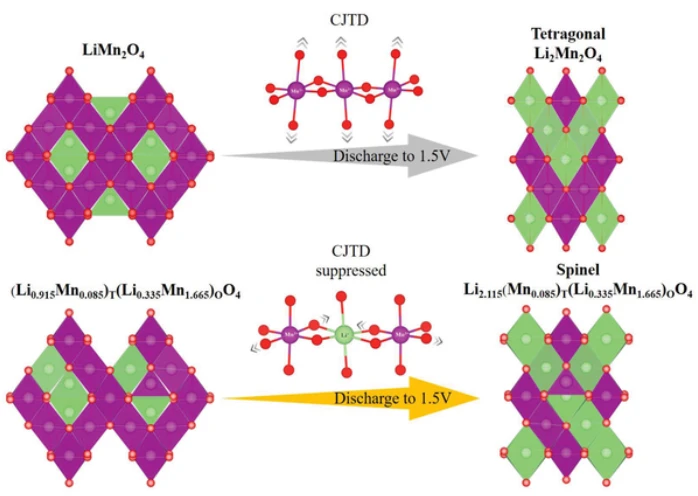
The Jahn-Teller effect poses another structural challenge. When discharged below approximately 3V, Mn³⁺ ions undergo a geometric distortion that transforms the cubic spinel structure into tetragonal symmetry. This phase transition causes anisotropic volume changes-the crystal expands more in certain directions than others. Repeated cycling through this transition generates mechanical stress, contributing to capacity fade and eventual structural degradation.
Researchers have pursued various mitigation strategies. Surface coatings using materials like aluminum oxide (Al₂O₃), titanium dioxide (TiO₂), or conductive carbon layers can inhibit manganese dissolution by creating a protective barrier. A 2024 study demonstrated that atomic layer deposition of Al₂O₃ coatings extended cycle life from 500 to 1,200 cycles by preventing direct electrolyte contact with the cathode surface.
Doping strategies involve substituting small amounts of foreign elements into the spinel structure. Incorporating elements like aluminum, nickel, or chromium can stabilize the crystal structure and reduce the Jahn-Teller effect. Research published in 2024 showed that dual substitution with aluminum and fluorine in LiMn₂₋ₓAlₓO₄₋yFy compounds improved high-temperature stability significantly.
Material Variants and Compositions
Beyond the basic LiMn₂O₄ spinel, several variants have emerged to address specific performance requirements. Lithium-rich manganese oxide (LRMO) materials, with the general formula Li₁₊ₓMn₂₋ₓO₄ or layered Li₂MnO₃ compounds, offer increased capacity exceeding 250 mAh/g. These materials gained attention in recent years as researchers work to overcome their inherent challenges with voltage fade and initial inefficiency.
High-voltage spinel variants like LiNi₀.₅Mn₁.₅O₄ (LNMO) operate at approximately 4.7V, delivering higher energy density around 200 Wh/kg. Toyota announced plans in 2024 to release a prototype electric vehicle utilizing LNMO cathodes by 2026, targeting a 400 km range. The challenge with LNMO lies in electrolyte stability at elevated voltages, which degrades and produces gas during cycling. A fluorinated electrolyte developed by researchers in 2023 reduced gas formation by 90%, addressing this limitation.
Composite cathode architectures blend LMO with other materials to optimize performance. CATL's M3P battery combines manganese-rich compositions with phosphate-based chemistry, achieving 15% lower cost than standard NMC batteries while maintaining competitive performance. These blended approaches represent an industry trend toward customized cathode compositions tailored for specific applications rather than single-chemistry solutions.
Layered manganese oxide structures, while less common than spinels, offer different performance characteristics. A 2024 study on Li-birnessite, a layered lithium manganese oxide with controlled structural disorder, demonstrated reversible cycling close to theoretical capacity by suppressing unwanted phase transitions. This research direction suggests that careful structural engineering at the atomic scale can overcome traditional LMO limitations.
Manufacturing and Synthesis Methods
Commercial LMO production typically employs solid-state synthesis, where lithium carbonate (Li₂CO₃) or lithium hydroxide (LiOH) reacts with manganese oxide precursors at elevated temperatures (700-900°C). The calcination process forms the spinel structure, with particle size and morphology controlled through temperature, time, and precursor selection.
Advances in manufacturing aim to reduce costs and improve material properties. A 2024 study developed a complete synthesis pathway starting from manganese ore rather than refined electrolytic manganese dioxide (EMD). This direct-from-ore approach, using acid leaching followed by thermal decomposition and solid-state reaction, achieved 96.1% manganese extraction efficiency while producing LMO with electrochemical performance comparable to conventional materials.
Solution-based synthesis methods like hydrothermal or sol-gel techniques offer better control over particle size and morphology. These approaches can produce nanoscale LMO particles with increased surface area, potentially improving rate performance. However, solution methods generally cost more and scale less easily than solid-state synthesis for commercial production.
Surface modification techniques applied during or after synthesis can enhance LMO performance. Coating processes using chemical vapor deposition, atomic layer deposition, or wet chemical methods apply protective layers that mitigate manganese dissolution. The coating thickness, typically 5-20 nanometers, must balance protection against ion transport resistance-thicker coatings offer better protection but slow lithium-ion movement.
Market Dynamics and Outlook
The global LMO cathode market reached $2.31 billion in 2024, with projections indicating growth to $4.29 billion by 2033 at a compound annual growth rate of 7.1%. This expansion reflects both increased lithium battery demand overall and LMO's specific advantages in certain applications.
Regional dynamics show Asia Pacific dominating with approximately 54% market share ($1.25 billion in 2024). China, Japan, and South Korea host major battery manufacturers and drive both production and demand. Government incentives for electric vehicles and renewable energy storage in these countries directly benefit LMO adoption. North America and Europe together account for roughly 45% of the market, with growth driven by automotive electrification and energy storage projects.
Competition from alternative cathode chemistries shapes LMO's market position. Lithium iron phosphate has gained significant ground, particularly in China, due to its superior cycle life and safety characteristics. The price gap between LMO and LFP has narrowed as LFP production scaled up. However, LMO maintains advantages in specific power and voltage, preserving its niche in high-power applications.
Policy developments influence LMO adoption. The European Union's 2027 Battery Regulation imposes sustainability requirements and material traceability mandates. These regulations potentially favor manganese-based chemistries over cobalt-intensive alternatives due to lower environmental and ethical concerns. Some proposals include surcharges on cobalt content, which could make LMO 20% cheaper than NMC in certain markets if implemented.
Research funding reflects continued interest in manganese-based batteries. The U.S. Department of Energy allocated $2 billion for manganese-based battery research and development from 2024-2027, focusing on improving energy density and cycle life while maintaining cost advantages. This investment signal suggests governmental recognition of manganese's role in diversifying battery supply chains away from critical minerals like cobalt.
Solid-state battery integration represents a potential breakthrough for LMO technology. Solid electrolytes eliminate the liquid electrolyte that facilitates manganese dissolution, potentially solving LMO's primary degradation mechanism. QuantumScape's 2024 data on LMO paired with ceramic electrolytes achieved 500 cycles at 1C rate, though interfacial resistance remains three times higher than liquid electrolyte cells. Toyota's solid-state prototype using LiMn₂O₄ cathode with Li₃PS₄ electrolyte demonstrated 300 Wh/kg energy density, approaching NMC performance levels while maintaining LMO's safety advantages.

Comparison with Other Lithium Battery Chemistries
Understanding LMO requires context within the broader lithium battery landscape. Lithium cobalt oxide (LCO) offers higher energy density (140-180 Wh/kg) but suffers from poor thermal stability and high cost. LCO dominates portable electronics where size matters more than cost or longevity, but safety concerns limit its use in larger format applications.
Lithium iron phosphate (LFP) provides exceptional cycle life (2,000-5,000 cycles) and superior safety, operating at lower voltage (3.2V nominal). LFP's energy density (90-120 Wh/kg) falls below LMO, but its longevity makes it economical for applications where frequent replacement costs exceed initial purchase price. China's electric vehicle market increasingly favors LFP for standard-range vehicles, while LMO-NMC blends remain common in markets prioritizing performance.
Nickel manganese cobalt (NMC) batteries offer the highest energy density among current commercial options (150-250 Wh/kg), making them preferred for long-range electric vehicles. However, NMC costs significantly more due to nickel and cobalt content, and thermal stability concerns require sophisticated battery management systems. LMO's power delivery exceeds NMC in short bursts, giving it an edge for hybrid applications requiring rapid acceleration.
Lithium titanate (LTO) batteries use a modified anode rather than a different cathode, but the comparison proves instructive. LTO offers extreme longevity (10,000+ cycles) and safety but at very low energy density (50-80 Wh/kg). The combination of LTO anodes with LMO cathodes creates batteries optimized for specific applications like fast-charging bus systems, demonstrating how chemistry pairing can target niche requirements.
Recent Research Breakthroughs
The pace of LMO innovation accelerated in recent years as researchers addressed longstanding limitations. A 2024 study in the Journal of the American Chemical Society described a layered lithium manganese oxide with controlled structural disorder that achieved reversible cycling near theoretical capacity. The researchers used ion exchange and controlled dehydration to create a metastable Li-birnessite structure that suppressed manganese migration and dissolution.
Surface modification strategies continue evolving. Researchers in 2024 demonstrated that graphene encapsulation of LMO particles improved capacity by 15% while extending cycle life. The flexible graphene layer accommodates volume changes during cycling while providing electrical conductivity and protecting against manganese dissolution. This approach represents a broader trend toward nanoscale engineering of cathode materials.
Concentration gradient structures emerged as a promising direction. Rather than uniform composition throughout each particle, these materials vary composition from core to surface. The gradual transition eliminates the interface mismatch that causes cracking in simple coated structures. Several research groups reported improved stability at high voltages using this approach, though commercial implementation remains limited.
Machine learning applications have begun optimizing LMO synthesis and performance. Researchers used computational models to predict dopant combinations that enhance structural stability, reducing the trial-and-error experimentation traditionally required for materials development. A 2024 study successfully predicted optimal aluminum-nickel co-doping ratios for high-temperature performance, which subsequent experiments confirmed.
Environmental and Sustainability Considerations
The environmental profile of LMO presents both advantages and challenges. Manganese extraction requires less energy-intensive processing than cobalt or nickel, and the element's abundance reduces pressure on concentrated ore bodies. However, manganese mining still generates environmental impact through land disturbance, water consumption, and potential contamination if not properly managed.
Life cycle assessments comparing different lithium battery chemistries show LMO performs favorably in carbon footprint due to lower processing requirements and elimination of cobalt. A comprehensive 2023 study calculated LMO batteries produce approximately 15-20% less greenhouse gas emissions during manufacturing compared to NMC equivalents on a per-kWh basis.
Recycling infrastructure for LMO exists within broader lithium battery recycling systems. Hydrometallurgical processes can recover manganese, lithium, and other components with high efficiency. However, the relatively low value of recovered manganese compared to cobalt or nickel reduces economic incentives for recycling. Policy mandates for battery recycling, such as those being implemented in Europe, will likely improve LMO recycling rates regardless of pure economics.
Second-life applications offer another sustainability pathway. LMO batteries degraded beyond automotive use often retain sufficient capacity for stationary energy storage, where weight and energy density matter less than in vehicles. Several pilot programs repurpose retired electric vehicle batteries containing LMO cathodes for solar power storage, extending overall useful life and improving total environmental impact.
Frequently Asked Questions
What makes LMO batteries safer than other lithium-ion types?
The spinel crystal structure of LMO provides inherent thermal stability that resists thermal runaway. Manganese oxide cathodes remain stable at higher temperatures than cobalt-based alternatives, and the absence of highly reactive cobalt reduces exothermic decomposition risk. Testing shows LMO batteries have 58% lower thermal runaway risk according to UL safety standards.
Why do LMO batteries have shorter lifespans than LFP batteries?
Manganese dissolution into the electrolyte causes progressive capacity fade in LMO batteries. Mn²⁺ ions detach from the cathode structure, particularly at elevated temperatures, and migrate to the anode where they interfere with electrode function. LFP batteries avoid this mechanism because iron phosphate forms a more stable structure that doesn't dissolve under similar conditions.
Can LMO batteries be used in extreme temperatures?
LMO batteries handle high temperatures better than many alternatives, operating safely up to 60°C (140°F). Cold temperature performance proves more challenging-like all lithium-ion batteries, LMO suffers reduced capacity and increased internal resistance below 0°C. The voltage depression from cold temperatures affects LMO similarly to other chemistries.
How does LMO compare to LFP for electric vehicles?
LMO offers higher voltage (4.0V vs 3.2V) and better power delivery for acceleration, but lower cycle life and slightly lower energy density. LFP excels in longevity and cost for standard-range vehicles, while LMO-NMC blends work well for performance-oriented vehicles requiring quick power delivery. Market trends show both chemistries coexisting for different vehicle segments rather than one replacing the other.

Data Sources
Research for this article drew from multiple authoritative sources including peer-reviewed publications in the Journal of the American Chemical Society, Battery & Supercaps, and Energy Storage Materials. Market data came from industry analysis firms including DataIntelo and Fortune Business Insights. Technical specifications referenced materials from battery manufacturers including NEI Corporation, Sigma-Aldrich, and CATL. Safety testing data came from UL standards and published safety assessments from the National Highway Traffic Safety Administration (NHTSA).


