


What Is cooling system?
Question from James Wong, Fremont, California.
I work at the old GM-Toyota NUMMI plant here and we just heard we're going to build an electric car someday. People keep talking about battery cooling. What's the real story?
Answered by Richard Flagan, Professor of Chemical Engineering and Environmental Engineering, Caltech.
(I do aerosol work mostly, but I've been dragged into a couple of battery projects with JPL and the auto companies lately.)
A lithium-ion pack makes a surprising amount of heat when you push it. A 60 kWh pack at 3C charge can dump 15–20 kW of heat. That's a small space heater running inside the floor of the car. Leave it alone and the middle cells hit 60 °C while you're still trying to get to 80 % charge. Life drops fast above 45 °C, so you have to pull the heat out.

Most packs now use flat aluminum cold plates about 4–6 mm thick with a stamped channel inside. You slide one plate between every two modules or under every row of pouches. The plate is filled with a thin layer of thermal paste against the cell bottoms. GM's Ultium plates are like that. Tesla used to wind a round tube under the 18650s and 2170s in a zigzag-looks like spaghetti, works fine, but it's a pain to assemble. The new 4680 pack in Texas went to a wider folded ribbon instead of a round tube. Easier to weld.
Coolant is almost always 50/50 water-glycol with the usual inhibitors. Some prototype race cars run pure glycol or even silicone oil, but nobody ships that to customers. Flow is usually 10–20 liters per minute for a big pack. The pump is a little 400 W brushless thing running on 12 V. It lives under the hood or in the frunk.
The radiator sits in front of the A/C condenser. At freeway speed you get plenty of air, but sitting at a Supercharger on a 110 °F day in Barstow the electric fan has to pull hard. That's why Tesla added the little octopus valve a few years ago-lets the chiller borrow cold refrigerant from the cabin A/C loop when it's really hot.
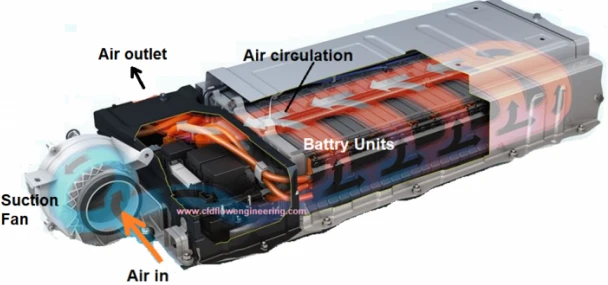
Temperature spread is the killer. If the coolest cell is 25 °C and the hottest is 40 °C you lose maybe 15–20 % of the pack's cycle life. So the inlet manifold has to split flow evenly. Some companies machine tiny orifices into each branch. Others just make the channels long and skinny so pressure drop forces equal flow. BYD's blade cell pack runs the coolant along the long edge of the cell instead of the bottom-claims better uniformity.
Cold weather is the part nobody talked about in 1999. Below about 0 °C you can't charge fast or you plate lithium metal and kill the cell. So the same loop that cools now has to heat. A 3–5 kW PTC heater sits in the reservoir or right after the pump. The BMS watches cell voltages like a hawk during preheat.
Pressure is usually 1–1.5 bar gauge. Keeps the boiling point up around 115–120 °C so you never get steam pockets if a cell decides to go exothermic.
We ran a 30-cell module on the bench last year at JPL. With cooling off it went from 25 °C to 65 °C in eight minutes at 200 A discharge. Turn the pump on at 12 L/min and it settled at 38 °C. Eight minutes versus never-that's why every serious pack has liquid cooling now.
That's the basic picture. The details change every model year, but the physics doesn't.


