


Your supplier quoted "5-year warranty." But what does clause 8 actually say?
Most purchasing teams compare duration and move on. Wrong metric. When your battery fails at month 30, what happens next depends entirely on language buried in sections most buyers never read.
Pro-Rata: Where the Real Cost Hides
Forklift battery warranties split into two structures. The gap between them can hit $3,000 on a single claim.
Full replacement is straightforward: failure within the covered period, new battery, zero cost. This window typically runs 2-3 years on lead-acid, 5 years on lithium from established suppliers.
Pro-rata kicks in after. If your battery fails 36 months into a 60-month warranty, you pay 60% of current retail, not your original purchase price. The replacement inherits whatever time remains. No reset.
And that 60% isn't universal. Some manufacturers layer a second depreciation based on cycle count, not just calendar months. Others calculate from MSRP rather than your negotiated price. We've seen the same failure point produce a $1,200 difference between two brands at identical sticker prices. That's money gone before you even file.
Get the actual pro-rata schedule in writing. Run the numbers at month 30, 40, 50.

The Maintenance Record Problem
Whose records count?
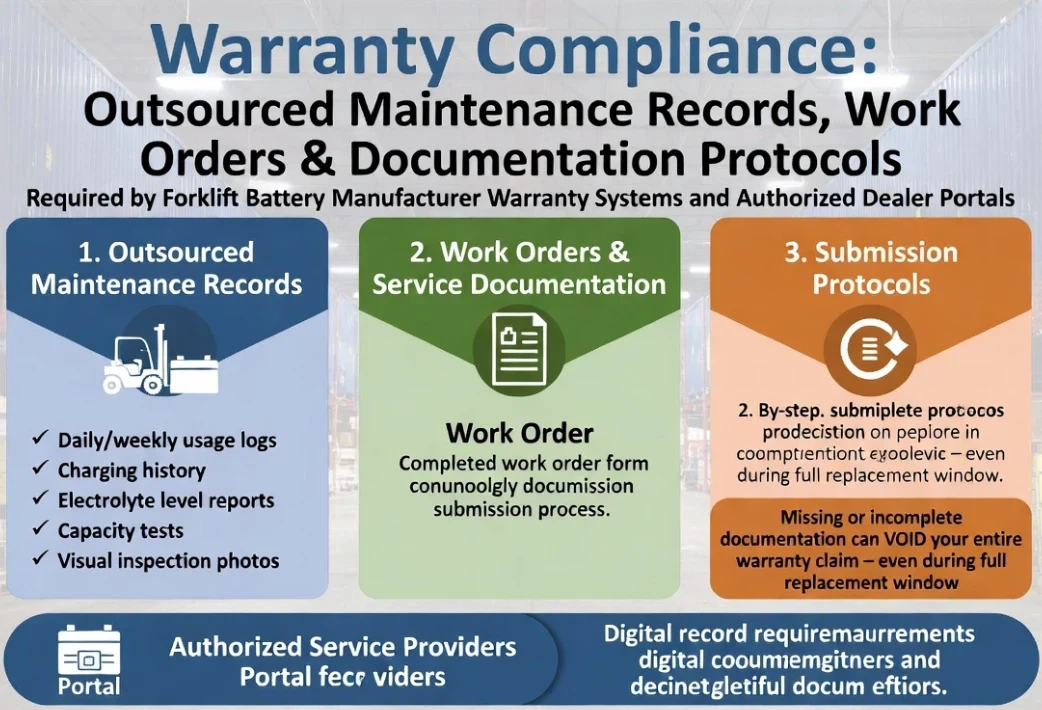
If your maintenance is outsourced - to your OEM's service arm, a third-party fleet company, an independent tech - ask this before signing: does the battery manufacturer's warranty system recognize records generated by external providers?
Often it doesn't. The manufacturer wants logs in their format, uploaded to their portal, by an authorized dealer. Your outsourced provider's work orders don't satisfy that, even if the maintenance was identical. You find out when you file.
We include documentation protocols in every installation. Our BMS generates records formatted for manufacturer portals by default. No parallel tracking system needed.
BMS and the Burden of Proof

When a claim gets filed, the manufacturer needs to determine defect versus misuse. With lead-acid, that means paper logs: watering records, equalization schedules, terminal inspections. Missing documentation shifts the burden to you.
Lithium with integrated BMS changes this. The system logs operating history whether your team recorded anything or not.
But if the manufacturer can't access that data remotely, you still carry the proof burden. Ship the battery back, wait 2-4 weeks minimum, absorb the downtime while the dispute plays out. If they can access it remotely, they pull the logs, confirm specs, approve replacement. Same battery, same failure, completely different experience.
We built our BMS for remote access specifically because of this. When you file, our team pulls full operational history within 24 hours. With 4000+ cycles and 5-year coverage standard, most claims never happen. When they do, the data's already there.
Where Contracts Actually Fail
The pro-rata schedule is the sharpest edge in any forklift battery warranty. Most contracts bury it. If yours doesn't include it as a separate exhibit, that schedule isn't contractually bound - it can change unilaterally.
Two other areas deserve the same attention.
Capacity testing. Industry baseline is 80% retention at warranty end. But how is that measured, and who pays? If it means shipping to an authorized facility at your cost, the warranty's practical value drops by that trip plus downtime. We do on-site measurement with portable equipment.
Exclusions. Mill, foundry, forging operations are commonly out. So are temperature extremes - 115°F ceiling, 50°F floor on many lead-acid warranties. Cold storage, outdoor staging, seasonal swings may already disqualify you. Our range is -20°C to 60°C, IP54 protection. Covers cold chain and most outdoor applications without triggering exclusions.

Before Your Next Renewal
If your contract's up in the next 6-12 months, or you're evaluating lithium conversion, this is the window.
We do a no-cost warranty audit. Send us your current terms - full document, not the summary - and our engineering team marks every ambiguity, every exclusion that applies, every clause that fails the tests above.
Takes 3-5 business days. Your renewal deadline isn't moving. Use the time.


