


Why Sub-Zero Environments Demand a Different Approach to Battery Power
At -20°C, a lead-acid forklift battery delivers less than half the capacity printed on its nameplate. That single fact reshapes everything about fleet sizing, shift planning, and total cost of ownership in cold storage operations.
Every warehouse runs on batteries. But cold storage isn't just another warehouse. It's an electrochemical stress test that most battery systems were never designed to pass. Here's what happens inside a forklift battery when cold storage temperatures drop below freezing. The electrolyte, whether sulfuric acid in lead-acid cells or the lithium salt solution in Li-ion packs, becomes more viscous. Thicker electrolyte means ions move slower. Slower ion transport means higher internal resistance. And higher resistance translates directly into less available power, longer charge times, and accelerated degradation. The cascade starts the moment ambient temperature drops below 15°C.

This matters now because cold storage capacity is expanding fast. The global cold storage market reached approximately $185.75 billion in 2025 and is projected to grow at a CAGR of 11.8% through 2033 (Grand View Research). More freezer warehouses mean more forklifts running in sub-zero conditions, and more operations confronting battery temperature challenges they haven't planned for.
The often-cited rule of thumb says a battery loses roughly 1% of its capacity per degree Celsius below 30°C. But that number hides more than it reveals. LFP cells lose around 6% by 0°C. Conventional lead-acid is already at 25% loss at the same temperature point. Below -10°C, both curves go nonlinear, and the 1%-per-degree approximation stops working for either chemistry (Forkliftaction).
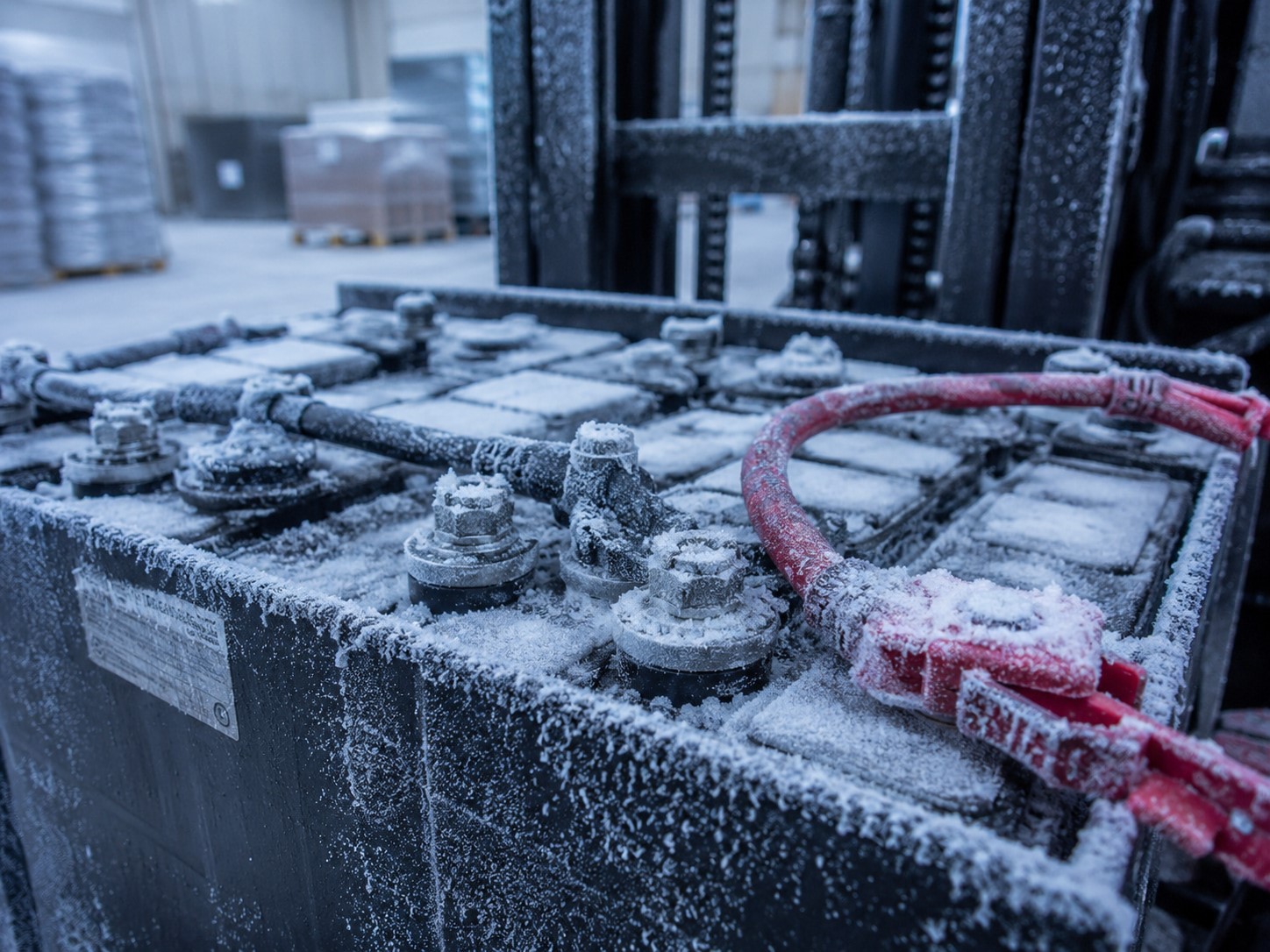
The Hidden Cost: How Cold Kills Forklift Batteries (and Your Budget)
The headline number most operations focus on is capacity loss, and it's bad enough. A fully charged lead-acid forklift battery operating at 0°C delivers only about 75% of its rated capacity. At -12°C, that drops to 56%. At -18°C, it's down to 45%. These aren't edge cases; they're the everyday reality of forklift battery performance in cold storage refrigerated and frozen environments (MHLNews).
But capacity loss is only the most visible problem. There are at least three other failure modes that quietly compound the damage, and they're the ones that end up costing more in the long run.
The first is what technicians call the "false reading" trap. When a lead-acid battery's internal temperature drops, its voltage reads higher than the actual state of charge. The forklift's discharge indicator tells the operator the battery is at 60% when it might actually be at 35%. Worse, the charger reads the same inflated voltage and terminates the charge cycle early, believing the battery is full. The result is chronic undercharging, shift after shift, until the battery's effective capacity is permanently reduced. The early warning most operators miss: forklifts start dying mid-shift on batteries that were reported as fully charged before the shift started. If this happens more than once a week, the false-reading cycle has likely already reduced effective capacity by 15–20%.
The second hidden cost is electrolyte freezing. A discharged lead-acid battery has dilute electrolyte with a freezing point that can rise as high as -7°C. In a -20°C freezer, that electrolyte freezes and expands, cracking plates and warping the casing. This is irreversible structural damage, not a performance dip you can recover from by warming the battery up.
Condensation: Why More Batteries Fail at the Loading Dock Than in the Freezer
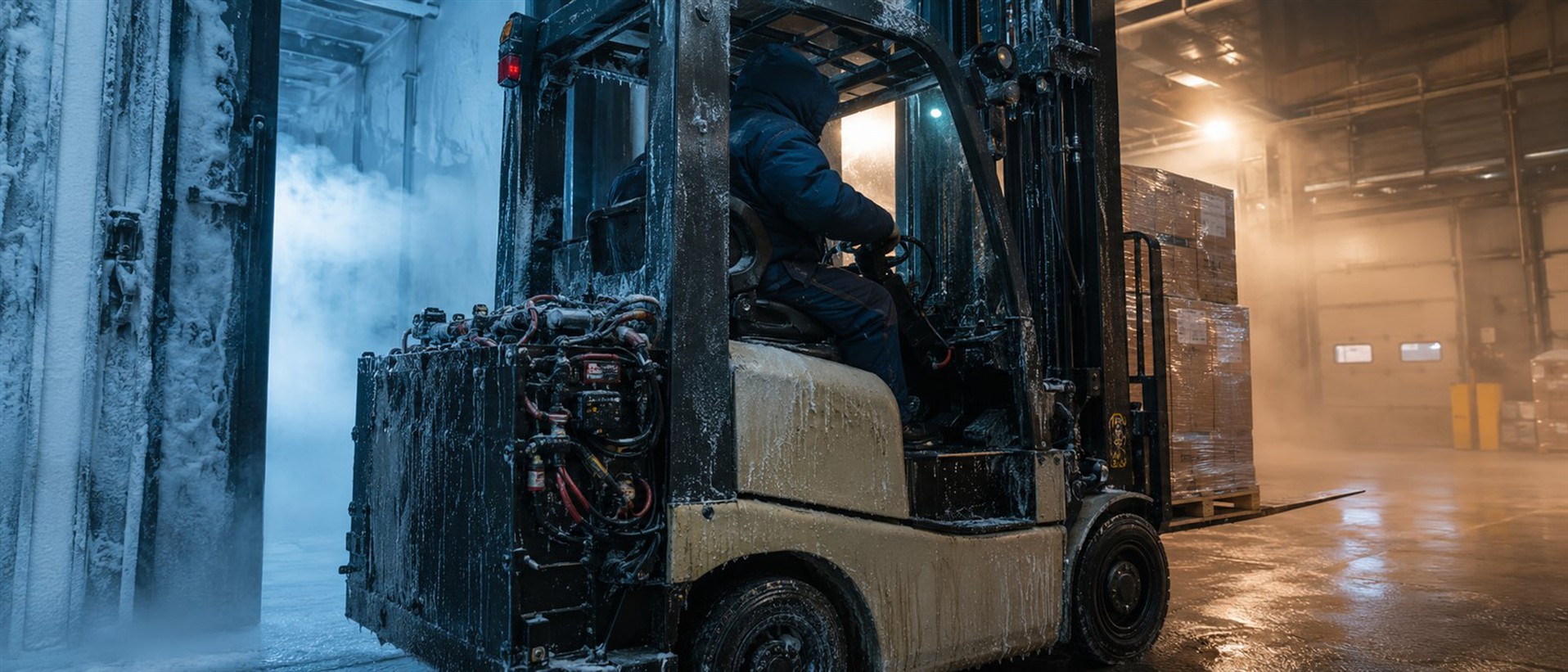
Most articles about forklift battery condensation prevention in cold storage focus on the cold itself. But in practice, more batteries are damaged by the transition between cold and warm zones than by sustained low temperatures alone.
When a forklift drives from a -25°C freezer into a 20°C loading dock, the temperature differential causes rapid condensation on every surface, including battery terminals, cable connectors, circuit boards, and the interior of the battery enclosure. Water droplets form within minutes. On electrical contacts, that moisture creates paths for short circuits and accelerates corrosion. On circuit boards, it can cause immediate component failure.
"This isn't theoretical. A case documented on the Forkliftaction industry forum describes a cold storage operation in Vietnam where reach trucks routinely moved from -25°C storage directly into ambient-temperature loading areas. Without a buffer zone between temperature areas, the electric motor compartment and control boards experienced severe condensation. Multiple units suffered control board failures that were initially misdiagnosed as manufacturing defects. The root cause was entirely environmental, and entirely preventable with proper facility design (Forkliftaction Forum)."
Preventing condensation requires a layered approach. The facility side needs buffer zones, transitional spaces held at an intermediate temperature where equipment can acclimate for 10–15 minutes before entering or exiting the cold zone. The battery side needs IP67-rated enclosures that seal out moisture, combined with internal silica gel desiccants that absorb any condensation that forms from trapped air. And the operational side needs protocols that prevent charging immediately after a cold-to-warm transition, because connectors with surface moisture can overheat and fail during high-current charging.
In facilities we've assessed, the dividing line is consistent: operations that enforce a minimum 5-minute acclimation protocol and use IP67-sealed battery enclosures see their first connector corrosion issues at the 5-year mark. Operations that skip acclimation and charge immediately after cold-to-warm transitions, which is most of them before we get involved, show corrosion failures within 18 to 24 months. The specific failure mode varies with daily temperature cycle count and local humidity, but the pattern is unmistakable once you've seen it across enough sites.
Lithium vs Lead-Acid in Cold Storage Freezer Environments: What the Data Actually Shows
The lithium-versus-lead-acid conversation in cold storage has been dominated by marketing claims on both sides. Here's what the measured data tells us across specific temperature points.
At 0°C, LiFePO4 cells tested at 1C discharge rate show a capacity reduction of approximately 6.4%. At the same temperature, lead-acid batteries have already lost 25% or more of their rated capacity (ScienceDirect). That gap widens dramatically as temperatures drop further. LFP batteries with thermal management maintain functional discharge capability down to -20°C. Lead-acid batteries at that temperature are operating at less than half their rated capacity, if they're still operating at all.
Cycle life tells an equally stark story. In cold storage conditions, lead-acid batteries typically deliver 500 to 1,000 cycles before requiring replacement, roughly 2 to 3 years of service. LiFePO4 packs in the same environment achieve 2,500 to 4,500 cycles, translating to 5 to 7 years of operational life. But these numbers assume thermal management keeps cell temperature above 0°C during charging. Without it, lithium cycle life in freezer applications can drop below 1,500 cycles, not far from TPPL territory, at triple the purchase price.
When evaluating a lithium forklift battery for cold storage, total cost of ownership is what matters. Factor in the elimination of battery swap infrastructure and the 41% electricity cost reduction documented in cold storage lead-acid-to-lithium conversions (Forkliftaction News), and the equation shifts heavily toward lithium, provided the battery has proper thermal management.
However, lithium batteries are not immune to cold-weather damage. Standard lithium cells charged below 0°C suffer from lithium plating: metallic lithium deposits on the anode surface that permanently reduce capacity and can create internal short-circuit risks (PMC/NIH). This means a lithium forklift battery without a built-in cold-charging protection system is potentially more dangerous in a freezer than a lead-acid battery, not less. The advantage of lithium only materializes when the battery includes BMS-controlled low-temperature charge lockout and, ideally, an integrated self-heating system.
For a broader comparison of these two chemistries across all forklift applications, our detailed analysis of lead-acid versus lithium-ion forklift batteries covers the full spectrum of performance, cost, and operational differences.
One more data point for operations that aren't ready for the full lithium investment: Thin Plate Pure Lead (TPPL) batteries represent an intermediate option with better cold resistance and no watering maintenance. But their cycle life of 800–1,200 cycles still falls well short of lithium. For any facility operating below -10°C for more than half of daily operating hours, TPPL is a cost-delayed solution, not a cost-effective alternative. You'll pay more than lead-acid upfront and still face replacement within 3 years.
Cold Storage Forklift Battery Heating: How BMS and Self-Heating Systems Determine Sub-Zero Performance
The most critical function of a cold storage battery management system is low-temperature charge protection. When cell temperature drops below 0°C, the BMS must prevent charging entirely. This isn't a nice-to-have feature. It's the primary defense against lithium plating, the degradation mechanism that causes irreversible capacity loss and, in extreme cases, internal short circuits that can escalate to thermal events. Research has shown that after 500 charge-discharge cycles at -10°C without proper thermal control, battery capacity can drop to levels that make the pack commercially useless, with post-mortem analysis revealing extensive lithium metal deposits on anode surfaces.
Self-heating systems address the charge-lockout problem by warming cells to a safe operating temperature before allowing charge current to flow. The most common industrial implementation, often called a cold storage forklift battery heater by operators, uses PTC (Positive Temperature Coefficient) heating plates mounted at the base of each battery module. Per standard industrial LFP battery specifications, when module temperature drops below approximately 5°C, the PTC elements activate automatically, drawing power from the charger to warm the cells until they reach around 25°C, the optimal window for charge acceptance. The warm-up duration depends on pack size and ambient temperature: a 400Ah pack in a -20°C environment typically requires 20–25 minutes, though insulation quality and pack geometry shift this number significantly.
Maintaining optimal cell temperature through integrated heating improves charge acceptance rates by approximately 18% compared to unheated batteries at the same ambient temperature. For a 20-truck operation with two-shift scheduling and standard 8-hour charge windows, that translates to roughly 25–30 minutes saved per charge cycle, often the margin that makes a two-battery-per-forklift rotation work instead of requiring a third battery. Eliminating that third battery set across the fleet can represent a six-figure capital reduction.
Beyond heating, effective thermal management for lithium forklift batteries in cold storage incorporates multi-layer insulation, typically PE (polyethylene) foam or similar thermal barriers wrapped around each module, to retain heat during operation and idle periods. The combination of active heating and passive insulation means the battery maintains a stable internal temperature even when the forklift is parked in a -30°C environment for hours. For deeper background on how thermal management systems work in motive power applications, our technical overview covers the design principles across battery chemistries.
There's a counterintuitive finding worth flagging for cold storage fleet managers. A study published in the International Journal of Energy Research found that at -10°C, batteries discharged at lower rates (0.5C) actually experienced more severe capacity degradation than those discharged at higher rates (2C) (Wiley). The mechanism relates to differences in SEI film formation and lithium deposition dynamics at various current densities under cold conditions. The practical implication: in sub-zero environments, operating closer to 1C discharge rather than the conventional "gentle" 0.5C is likely safer for long-term battery health. Use BMS capacity logs to track internal resistance across shifts. A 15% rise over two weeks signals it's time to review your discharge profile, not just schedule maintenance.
Temperature Zones and Operational Best Practices
Standard Refrigerated Storage
This is the most common cold storage temperature range for dairy, fresh produce, and general chilled goods. Standard LiFePO4 forklift batteries without dedicated heating systems typically perform adequately here, retaining 90%+ capacity throughout the range. Lead-acid batteries are still viable in this zone with proper management: keeping them fully charged, charging at room temperature, and rotating batteries between cold and ambient environments daily to stabilize internal temperatures. Forklift battery temperature range monitoring becomes important at the lower end of this zone; if operations frequently hit -15°C or below, the transition to heated lithium packs should be evaluated.
Frozen Storage
This is where lead-acid batteries become operationally impractical for freezer forklift battery life requirements. Capacity losses of 40–55% mean you're replacing or swapping batteries multiple times per shift. LiFePO4 batteries with integrated PTC self-heating and BMS cold-charging protection are the standard solution. Charging should take place either in a heated charging area or in-situ using chargers rated for cold environments, with the BMS pre-heating cells before charge current flows. Buffer zones between the frozen area and ambient spaces are strongly recommended to manage condensation. Maintenance intervals should be shortened: quarterly BMS diagnostics and annual capacity testing at minimum.
Ultra-Low / Deep Freeze
Pharmaceutical cold chain, specialized food processing, and certain industrial applications operate at these extremes. At these temperatures, even lithium batteries with standard heating may struggle to maintain cell temperature during extended idle periods. In our field deployments, packs that begin a -35°C idle with internal temperature below 10°C can drop below the heating activation threshold in under two hours, while pre-warmed packs starting above 20°C sustain adequate temperature through a full shift break.
Fully sealed, custom-engineered battery systems with redundant heating elements, heavy-duty insulation, and enhanced IP67 or IP68 enclosures are required. Forklifts should remain permanently in the cold zone, never cycling between deep freeze and ambient, to avoid thermal shock and condensation damage. Charging infrastructure must be installed inside the cold zone with BMS-controlled pre-heating sequences.
Across all zones, one operational principle holds: never let batteries sit idle in the cold below 30% state of charge. A cold, deeply discharged battery, whether lead-acid or lithium, is the highest-risk scenario for permanent damage.
How to Evaluate a Cold Storage Forklift Battery: Specification Checklist
When comparing cold storage forklift battery options from different suppliers, the marketing language tends to converge. Everyone claims "excellent cold performance." The specifications that actually differentiate a cold-storage-ready battery from a standard pack with a cold-weather label are specific and verifiable.
| Specification | What to Look For | Why It Matters |
|---|---|---|
| IP Protection Rating | IP67 minimum (dust-tight + immersion-rated) | Prevents moisture ingress from condensation; lower ratings allow water vapor penetration over time |
| Self-Heating System | PTC heating integrated at module level, BMS-controlled activation | Ensures cells reach safe charging temperature; external heating pads are less effective and less reliable |
| BMS Low-Temp Charge Lockout | Hard cutoff at 0°C (32°F) with no manual override | Prevents lithium plating; batteries without this feature risk permanent damage from cold charging |
| Heating Activation Threshold | Automatic activation below 5°C, target warm-up to 20–25°C | Too-high threshold wastes energy; too-low threshold leaves cells in the degradation zone |
| Cycle Life Test Conditions | Cycle life rating must specify test temperature, not just room-temperature data | For -20°C operations, a minimum of 2,000 cycles at operating temperature with ≤20% capacity fade is the functional threshold. Below that, you're paying lithium prices for lead-acid service life. |
| Communication Protocol | CAN bus or RS485 for fleet management integration | Enables real-time temperature monitoring, SOC tracking, and predictive maintenance across the fleet |
| Insulation Type | Multi-layer PE foam or equivalent thermal barrier per module | Passive insulation retains heat during idle periods; single-layer or no insulation loses heat in minutes |
| Certifications | UL2580 (vehicle application) and/or IEC62619 (industrial) | Third-party safety validation for abuse tolerance, critical in environments where failure is not an option |
One detail that separates experienced buyers from first-time purchasers: always ask the supplier to provide capacity retention data at the actual operating temperature of your facility, not at room temperature. A battery rated at 400Ah at 25°C might deliver 340Ah at -20°C, or it might deliver 280Ah. That 60Ah gap determines whether your forklifts finish a full shift or stall halfway through. Most suppliers won't volunteer this data unless you ask.
Explore Polinovel's cold storage-ready forklift battery solutions engineered with integrated thermal management, BMS-controlled self-heating, and IP67 protection for reliable operation in freezer and refrigerated environments.
Frequently Asked Questions
Q: Can you charge a lithium forklift battery inside a cold storage warehouse?
A: Not without a BMS-controlled self-heating system. Charging standard lithium cells below 0°C causes lithium plating, metallic deposits on the anode that permanently reduce capacity. Batteries with integrated heating warm cells to safe temperatures before allowing charge current to flow, enabling in-situ charging in cold environments.
Q: How much freezer forklift battery life can you expect compared to standard applications?
A: Lead-acid batteries lose 25% capacity at 0°C and up to 55% at -20°C, with cycle life dropping to 500–1,000 cycles (2–3 years). LiFePO4 batteries with thermal management lose approximately 6–8% at 0°C and achieve 2,500–4,500 cycles (5–7 years), but only with proper cold-charging protection.
Q: What causes forklift battery condensation in cold storage and how do you prevent it?
A: Condensation forms when forklifts transition between cold and ambient temperature zones. Moisture accumulates on battery terminals, connectors, and circuit boards, causing corrosion and potential short circuits. Prevention requires IP67-sealed battery enclosures, internal desiccants, buffer zones between temperature areas, and protocols that allow acclimation before charging.
Q: What is the best battery type for a -25°C freezer warehouse?
A: LiFePO4 with integrated PTC self-heating, BMS low-temperature charge lockout, and IP67 enclosure. Verify that cycle life data was tested at operating temperature, not room temperature, and that the minimum threshold is 2,000 cycles at operating temperature with ≤20% capacity fade.
Q: Why does my forklift battery indicator show full charge but die quickly in cold storage?
A: Cold temperatures inflate battery voltage readings. Both the forklift's gauge and the charger read voltage as higher than actual state of charge, causing premature charge termination and chronic undercharging. Temperature-compensated BMS algorithms correct for this by adjusting SOC calculations based on actual cell temperature.
For a broader comparison of lithium forklift battery options across manufacturers and applications, see our guide to evaluating lithium forklift battery brands.


