


Why the Price Tag on Your Forklift Battery Is Misleading You
A 36V lead-acid forklift battery runs somewhere between $2,000 and $6,000. A comparable lithium-ion pack costs $17,000 to $25,000. On paper, the decision looks obvious, until you realize you're comparing an iceberg's tip to its full mass below the waterline.
The real lithium vs lead acid forklift battery cost comparison has almost nothing to do with purchase price. Most online forklift battery ROI calculator tools get this wrong from the start. What actually drives your total spend over five or ten years is a stack of operational costs that never show up on the original invoice: maintenance labor, charging infrastructure, energy waste, battery room square footage, replacement cycles, and productivity losses that compound silently across every shift.
That gap between sticker price and total cost of ownership is exactly why you need a calculation framework, but only if it accounts for the right variables. Most tools available online don't.
The 7 Cost Variables Most ROI Calculators Leave Out
Based on TCO models we've built for fleet operators across 80+ countries, these are the seven variables that consistently separate accurate projections from misleading ones.
Coulombic efficiency and its real effect on your electricity bill. Lead-acid batteries convert roughly 85% of input energy into usable output. Under fast-charge conditions, that number drops below 50%. Lithium-ion exceeds 99% (Battery University). When your forklift battery cost per hour calculation ignores this efficiency gap, it underestimates energy savings by 30–40%. But here's what makes this variable tricky in practice: the efficiency delta widens significantly depending on your charging schedule and ambient temperature, which means a flat percentage estimate won't match your actual utility bills without site-specific adjustments.
Battery room square footage as opportunity cost. Lead-acid charging requires a dedicated, ventilated room, typically 500 square feet or more, with acid-resistant flooring and wash-down stations. Most calculators include the build-out cost but ignore what that space could earn as warehouse storage. In major metro and logistics corridor markets where industrial rent runs $8–$15 per square foot annually, that's $4,000–$7,500 in forgone revenue every year, compounding over the battery's lifecycle.
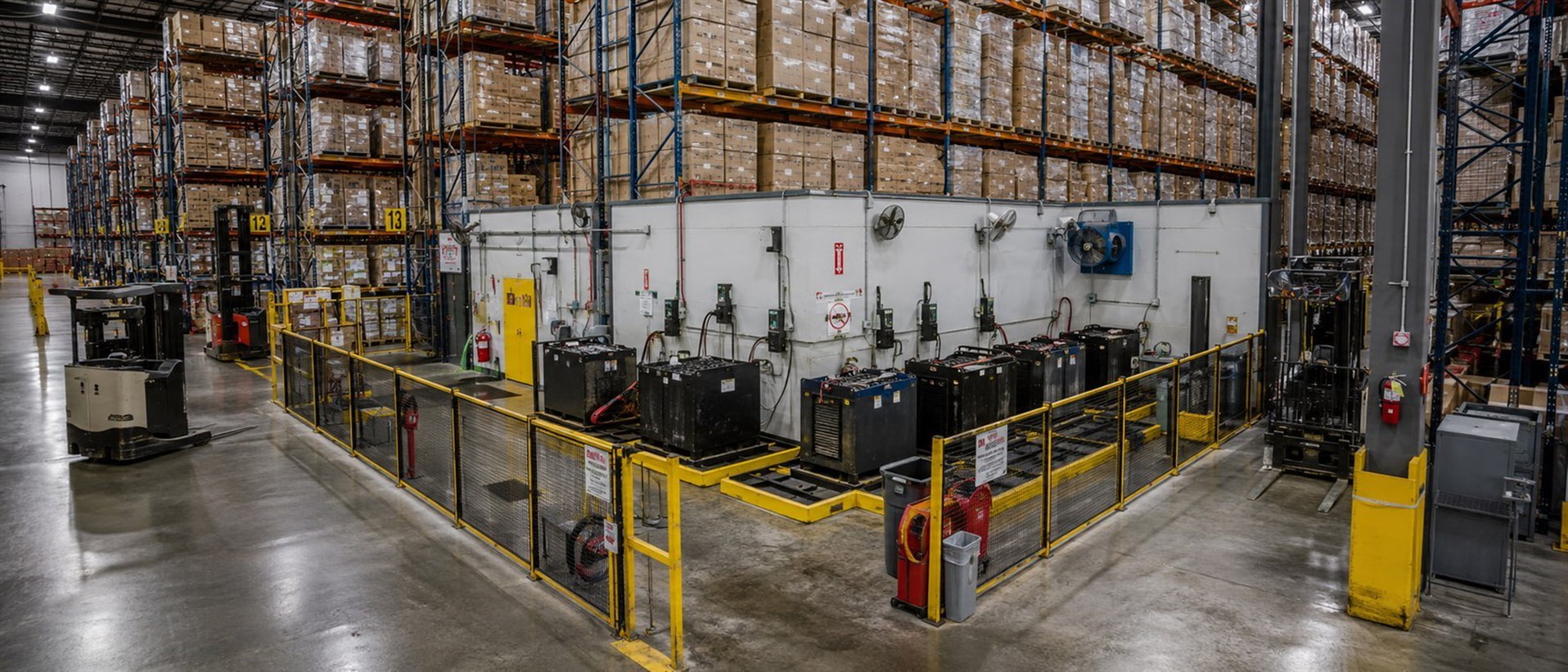
The maintenance labor "time tax." Watering a single lead-acid battery takes 15–20 minutes per week. For a 20-battery fleet (10 trucks with rotation), that adds up to roughly 400 minutes of labor weekly, or 6.7 hours. At a fully burdened rate of $25/hour, you're spending $167 per week, or $8,600 annually, on a task that doesn't generate any operational value. Most facilities never see this figure because watering time gets absorbed into general maintenance budgets rather than tracked as a battery-specific cost.
Voltage sag and the productivity loss nobody measures. Lead-acid voltage drops progressively during discharge, meaning forklifts slow down noticeably through the second half of a shift. Lifts take longer, travel speed falls, operators compensate with workarounds that add cycle time. Research from Raymond Corporation puts the productivity impact at up to 17%, and facility-level tests have measured break-even improvements of 10–16 months when this factor is finally included in the ROI calculation. Despite that, almost no forklift battery TCO comparison on the market accounts for it.
The 1-to-1 ratio versus the 2-to-3 battery rotation. Lithium supports opportunity charging during breaks, so one battery per truck is sufficient. Lead-acid multi-shift operations need two or three batteries per forklift for rotation, plus battery handling equipment to move 2,000+ pound packs. Buyers who compare single-battery sticker prices without applying the rotation multiplier are working with a fundamentally broken baseline, one that can distort the electric forklift battery savings calculation by 100–200%.
Cold storage surcharges. Lead-acid capacity drops by roughly half at –17°C, which forces freezer operations to install heated battery rooms at $5,000–$10,000 upfront and $1,000–$2,000 annually. Lithium packs operate normally from –20°C to 45°C without supplemental infrastructure. The practical outcome: cold-chain warehouse operations tend to see payback timelines 30–50% shorter than ambient-temperature facilities running identical fleet sizes and shift patterns.
Charger compatibility and conversion engineering. Dropping a lithium pack into a machine originally built for lead-acid isn't always plug-and-play. Voltage communication protocols between the battery management system and the charger may not match, and the lighter lithium pack can shift the truck's center of gravity enough to require ballast adjustments. These conversion costs, typically $500 to $2,000 per truck, need to appear in your forklift battery ROI analysis, or the payback timeline will be artificially compressed.
The difference between a credible total cost of ownership model and a misleading one comes down to whether these seven factors are included. Most online tools skip at least four of them.
How to Build a Forklift Battery TCO Model That Holds Up
Rather than depending on a generic online tool, you can construct a forklift battery total cost of ownership calculator tailored to your own operation. The framework has four steps, and here's what each one produces.
Step 1: Total current cost, capture every lead-acid expense, not just the battery. Include purchase price multiplied by your rotation ratio, replacement cost at the end of each battery lifecycle, charger acquisition, maintenance labor (watering + swaps + terminal cleaning), energy consumption adjusted for charger and battery efficiency, battery room build-out and operating costs, and extraction equipment.
Step 2: Total lithium cost. Same structure, different inputs. One battery per truck, zero watering labor, energy adjusted for 99% coulombic efficiency, no dedicated battery room, and a single charger per truck. Include conversion engineering (ballast adjustment + BMS-charger compatibility assessment).
Step 3: Net savings and payback period. Subtract lithium total from lead-acid total for gross savings. Divide the upfront cost premium by annual operational savings to get your break-even timeline in months, the single number that matters most when the CFO asks whether this project is worth funding.
Step 4: Sensitivity analysis. Model at least three scenarios: single-shift standard warehouse, multi-shift distribution center, and cold storage.
Here's what that looks like for a real scenario. The following lithium vs lead acid forklift battery cost comparison uses a 10-truck, two-shift warehouse running 48V counterbalance forklifts at $0.12/kWh electricity over a five-year period. Use this as your forklift battery ROI calculator template, swapping in your own fleet data:
| Cost Category | Lead-Acid (5-Year) | Lithium-Ion (5-Year) |
|---|---|---|
| Battery acquisition (LA: 20 units × $5,000; Li: 10 × $14,000) | $100,000 | $140,000 |
| Battery replacement at Year 4 (LA only) | $100,000 | $0 |
| Chargers (LA: 10 × $2,500; Li: 10 × $3,500) | $25,000 | $35,000 |
| Conversion assessment + ballast (Li only, $1,000/truck) | - | $10,000 |
| Maintenance labor: watering, swaps, cleaning ($8,600/yr) | $43,000 | $0 |
| Energy, efficiency-adjusted | $72,000 | $43,000 |
| Battery room: build-out + annual operation | $24,000 | $0 |
| Battery extraction equipment | $6,000 | $0 |
| 5-Year TCO | $370,000 | $228,000 |
Net 5-year savings: $142,000 (38%). Upfront premium: $42,000. Payback: ~30 months.
Payback derivation: lithium Year 1 capital ($140K + $35K + $10K = $185K) minus lead-acid Year 1 capital including battery room build-out ($100K + $25K + $6K + $12K = $143K) = $42K premium. Annual operating savings: $16,800 (LA operating $25,400/yr minus Li operating $8,600/yr). $42K ÷ $16.8K/yr = 2.5 years ≈ 30 months. Energy row based on 10 trucks drawing ~28 kWh/day across two shifts at $0.12/kWh, adjusted for system efficiency (charger × battery): 64% for lead-acid, 94% for lithium.
Your own forklift battery replacement cost calculator can be built from this template by swapping in your fleet size, local electricity rate, and labor costs. Your numbers will differ by $20,000–$60,000 depending on three site-specific variables: fleet mix, local electricity rate structure, and whether your operation includes cold storage. The energy cost row shifts most on facilities with demand-charge tariff structures, a detail we factor into every custom model.
Now run the sensitivity analysis across scenarios:
| TCO Variable | Single-Shift (Standard) | Multi-Shift (2–3 Shifts) | Cold Storage |
|---|---|---|---|
| Batteries per truck (lead-acid / lithium) | 1 / 1 | 2–3 / 1 | 2–3 / 1 |
| Battery room required | Yes (small) | Yes (large) | Yes + heated |
| Annual maintenance labor per truck | ~$400 | ~$800–$1,200 | ~$800–$1,200 + heating upkeep |
| Energy efficiency gap impact | Moderate | High | Very high |
| Typical lithium payback period | 48–60 months | 24–36 months | 18–30 months |
The payback range shrinks as operational intensity increases. That's not a marketing claim. It's an arithmetic consequence of how hidden lead-acid costs multiply under load.
Real Fleet Numbers: What Conversion ROI Looks Like in Practice
Theory is useful. Verified numbers close deals.
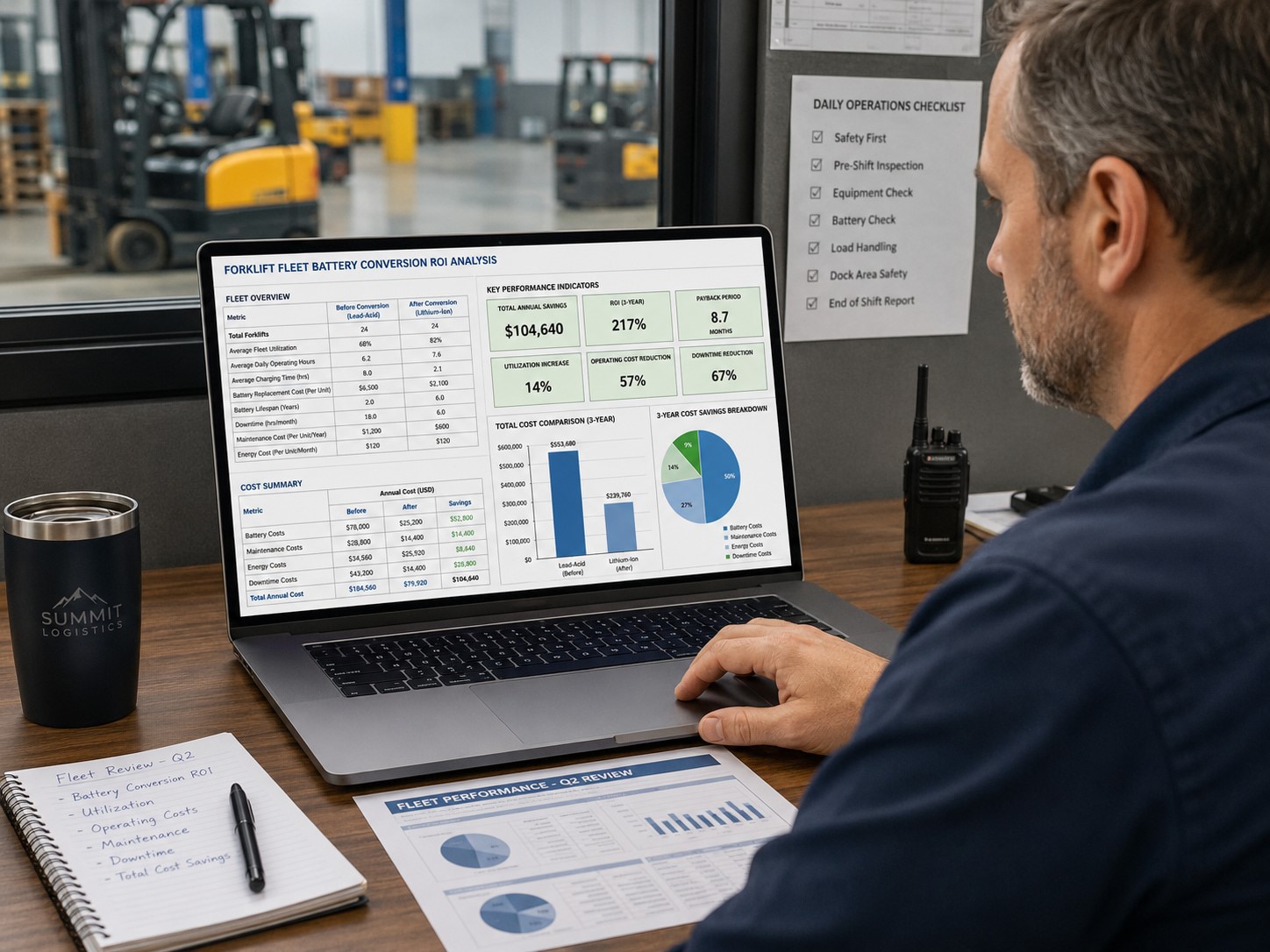
A Texas-based third-party logistics provider operating 50 Class I electric forklifts tracked its forklift fleet battery conversion ROI over eight years after switching to lithium. Total cost reduction reached approximately 56% compared to projected lead-acid expenditures, with break-even at 31 months. What moved this particular fleet's payback ahead of the industry-average 36-month timeline involved site-specific variables that generic calculators can't capture: fleet mix, shift overlap pattern, and regional electricity pricing.
A distribution center running 30+ forklifts across two shifts documented 40% less downtime and over $100,000 in combined annual savings on maintenance and energy after converting. The single largest contributor wasn't energy efficiency or maintenance elimination. It was the productivity gain from eliminating battery swaps during shift changes, a cost category that hadn't appeared in the facility's original projection.
For mid-size operations, a fleet simulation published by an industry battery manufacturer modeled 10 Class I forklifts running two shifts daily and showed the lithium option required roughly $20,000 more in upfront capital but generated $123,900 in operational savings over five years. If you want to understand how the underlying performance differences between lead-acid and lithium-ion translate to your own fleet profile, the same seven variables from the model above apply.
Where Fleet Conversions Go Wrong After the Numbers Check Out
The three mistakes below aren't calculation errors. They're execution failures that happen after the ROI model is approved and the purchase order is issued.
Not extracting battery labor hours before running the model. Section 2 explained why maintenance labor is a hidden cost. The execution problem is different: most warehouse ERP systems don't separate "forklift battery watering" from "general equipment maintenance." When procurement teams estimate instead of auditing, they typically undercount lead-acid labor by $3,000–$5,000 per year for a 10-truck fleet. The fix is a 2-week manual time study before the ROI model is finalized, not after.
Issuing the battery PO before the charger compatibility assessment is complete. Budget approval timelines and technical evaluation timelines rarely sync. Procurement teams under fiscal-year pressure sometimes sign the battery order before confirming that existing chargers support lithium BMS communication protocols. When mismatches surface post-purchase, unbudgeted costs of $2,000–$4,000 per truck appear. Understanding how lithium-ion forklift batteries interact with different charging architectures before the PO is signed prevents this entirely.
Converting hardware without converting operator charging behavior. Lithium's runtime advantage depends on opportunity charging, plugging in during 15-minute breaks rather than running full discharge-recharge cycles. In our experience deploying forklift battery systems across multi-shift warehouses, facilities that skip a structured 4–6 week adoption program with supervisory reinforcement forfeit 20–30% of projected runtime gains, enough to push a 30-month payback to 40+ months.
When Lithium Doesn't Make Financial Sense
Not every operation benefits from the switch, and pretending otherwise would undermine everything above.
For a single-shift operation running fewer than 8 hours per day with overnight charging, no cold storage exposure, and fleet replacement planned within 18 months, lead-acid almost always wins inside a 5-year TCO window. The hidden cost multipliers covered in Section 2 simply don't accumulate enough volume at low utilization to offset the lithium upfront premium within a reasonable payback period.
Operations with severe capital constraints, where the absolute priority is minimizing Day 1 cash outflow regardless of long-term cost position, may also find lead-acid defensible in the short term. The forklift battery cost analysis framework above is technology-agnostic; it just consistently favors lithium once daily runtime crosses roughly 12 hours and shift count reaches two or more.
Presenting Your ROI Analysis to the Budget Committee
Lead with the payback period expressed in months, not the cumulative savings over a decade. Decision-makers want to know when the investment turns cash-flow positive, not how much money a hypothetical future version of the company might save. Follow that with the annual operating cost reduction expressed as a percentage, because percentages are easier to benchmark against other capital projects competing for the same budget allocation.
Address the sticker-price objection head-on by showing the per-truck cost comparison with rotation multipliers applied. One visual showing "$18,000 in lead-acid batteries per truck over a five-year cycle versus $17,000 in lithium for the same period" reframes the conversation from "lithium is expensive" to "lead-acid is expensive, it's just spread across more line items."
Include one realistic downside scenario. Show what happens if opportunity charging adoption lags by six months or if three trucks need charger upgrades instead of one. If the pessimistic scenario still clears 36 months, that's the number to put in the executive summary.
Frequently Asked Questions
Q: How long does it take for a lithium forklift battery to pay for itself?
A: Multi-shift operations typically reach break-even within 24–36 months. Single-shift operations may require 48–60 months depending on utilization patterns and whether all TCO variables are optimized.
Q: What costs should a forklift battery TCO calculation include?
A: Seven variables: purchase price with rotation multiplier, maintenance labor, energy adjusted for coulombic efficiency, battery room opportunity cost, downtime and productivity impact, replacement frequency, and charger compatibility costs.
Q: Is lithium worth it for single-shift operations?
A: Often not, unless the facility runs cold storage or carries unusually high maintenance labor costs. The payback period lengthens significantly when utilization intensity is low.
Q: How much electricity does a lithium forklift battery save?
A: Typically 30–50% less energy consumption than lead-acid, driven by the difference in coulombic efficiency (99% vs. ~85%). Fleet-wide annual savings range from $5,000 to $15,000 depending on fleet size and local electricity rates.
Q: What's the most common ROI calculation mistake?
A: Comparing single-battery purchase prices without applying the rotation multiplier for multi-shift lead-acid operations. This alone can distort the comparison by 100–200%.
Get a TCO Analysis Built for Your Fleet
The framework above gives you the structure. The variables specific to your operation determine whether the numbers favor lithium or not.
Send us three numbers: fleet size, daily shift count, and electricity rate. Our application engineering team will return a custom 5-year TCO comparison within 48 hours, calibrated to your actual operating conditions rather than industry averages. We've built these models for 100+ fleet operators across 80+ countries.
Explore our material handling battery solutions to see voltage and capacity configurations, or compare lithium forklift battery brands if you've already decided the ROI works.


