


Last quarter a dealer in South Carolina called us after a batch install went sideways on seven Club Car DS carts. His tech had followed a single OBC bypass tutorial for the entire lot, except three of those carts ran IQ controllers and four ran Regen 2. The IQ carts started fine. The Regen 2 carts sat dead in the bay for two days while the team traced a wiring fault that didn't exist. That kind of callback eats margin faster than any battery discount can recover it, and at 47% lithium-ion market penetration (Mordor Intelligence), 48V golf cart battery installation volume is only going up. The gaps in publicly available guidance are becoming a real operational cost for any dealer running conversions at volume.

48V Means 51.2V. Your Controller May Not Know That.
Everyone calls it 48V. Electrically, it's a 16-series LiFePO4 configuration: 51.2V nominal, 58.4V at full charge. That wouldn't matter if controllers didn't care, but they do, and how those extra volts interact with your specific controller generation determines whether the install succeeds or becomes a diagnostic nightmare.
Consider what happens on a pre-2010 Club Car DS with a Curtis PMC 1204. That controller was built around a lead-acid charge profile topping out near 52V. Hand it 58.4V and it may trigger a high-voltage cutoff outright. Or worse, it runs but throws intermittent faults under load that look exactly like motor or solenoid failures, sending your tech through hours of unnecessary troubleshooting before anyone thinks to check input voltage. A Curtis 1268 or newer is programmable via 1313/1314 handheld and can be recalibrated. The 1204 cannot. It gets replaced.
"If you're quoting a lithium battery upgrade on a pre-2010 cart, controller replacement belongs in the project scope before the customer signs off. Not after."

Our golf cart LiFePO4 battery lineup is engineered with plug-and-play voltage compatibility across EZGO, Club Car, and Yamaha controller families, but even with a compatible battery, the controller check still comes first.
OBC Bypass and the Interlock Wire Nobody Warns You About
The single most common 48V lithium battery installation failure on Club Car models is an incomplete OBC bypass. Remove the OBC without the right procedure and the cart won't move. The danger is that "the right procedure" is actually three different procedures depending on the controller generation, and none are interchangeable.
Regen 1 (1995–1997 DS) is simple. Disconnect the OBC, route the yellow wire from the solenoid's small terminal to the controller's B- terminal, done. IQ-system carts (1998–2013) require a 10,000-ohm pull-down resistor bridging the blue and white wires from the 6-pin harness connector to the gray OBC output wire. Skip the resistor and the controller stays locked. Regen 2 is the trap. The connectors look nearly identical to IQ, but the bypass procedure is different. Applying IQ instructions to a Regen 2 cart is one of the most frequently reported errors in technician forums, and it leaves the cart immobilized with the tech convinced the battery is defective. Serial number decode tells you the controller generation in five seconds. That decode step needs to be the first line on any Club Car installation checklist.

There's a second wiring fault that catches installers on the same job. When you remove the original charging receptacle during a lithium conversion, a thin interlock wire from the charge port to the controller gets disconnected. That wire's job is to disable the drive system while the charger is connected. Leave it floating and the controller reads the open circuit as "charger still plugged in," locking out the motor. Battery is charged, solenoid clicks, nothing moves.
The fix is a five-second job: connect the interlock wire to the battery positive terminal. But if you don't know this circuit exists, you end up chasing a phantom fault. We've seen shops replace perfectly good controllers before someone finally spots that disconnected lead. For any dealer building a repeatable installation SOP for 48V lithium golf cart conversions, the interlock wire goes on the pre-test checklist right next to "verify BMS wake status."
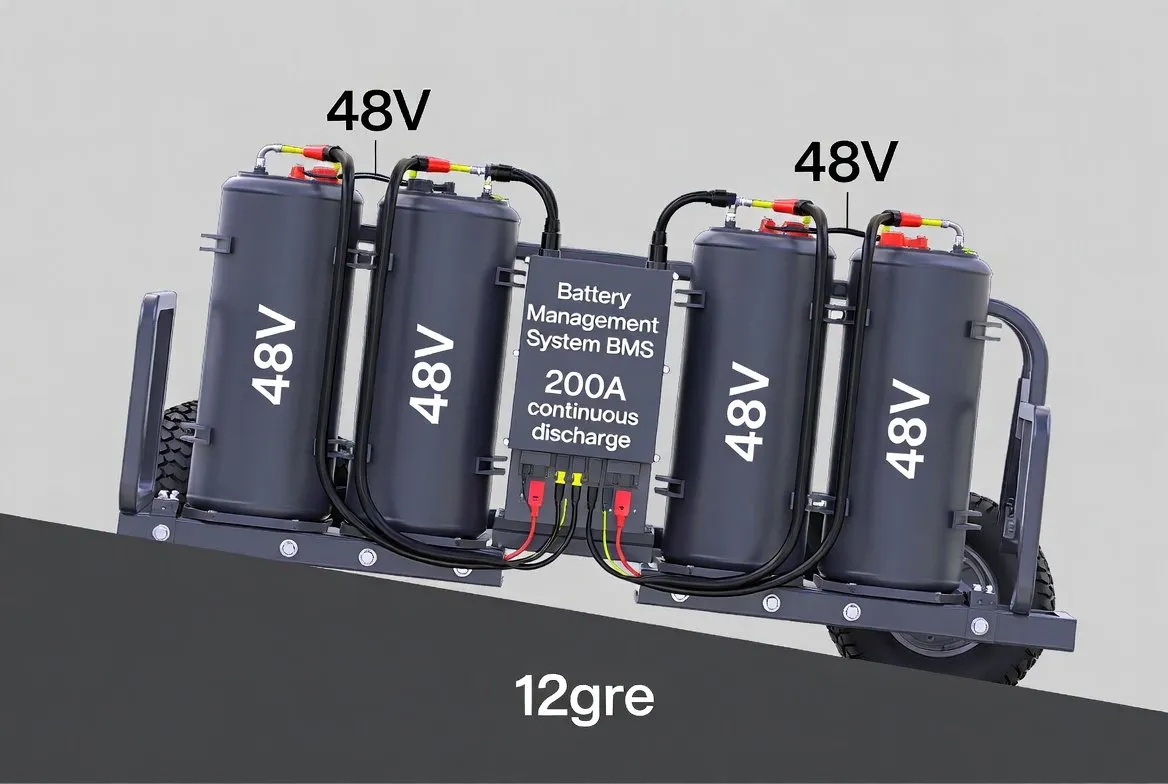
100A BMS on a 48V Cart Will Eventually Strand Someone on a Hill
In our load testing on a dual-passenger cart climbing a 12-degree grade, peak current recorded at 168A. That's well past the trip point of any 100A BMS, and it's why we set 200A continuous discharge as the minimum for our own packs.
A 48V golf cart battery installation sized with a 100A BMS works on flat ground. Add a real hill and a second rider, and the BMS trips mid-climb. Stock carts with factory controllers rarely exceed 200A continuous draw, so 200A handles most configurations. Aftermarket speed controllers or lifted suspensions with oversized tires push the requirement to 250A. Three numbers matter on any BMS datasheet: continuous, peak (30-second), and pulse (3-second) discharge ratings. If the spec sheet only shows one number, that tells you something about the product, not just the documentation.
Cell grade compounds this. EV-grade (Grade A) cells sustain high-current cycling without accelerated capacity fade. Storage-grade (Grade B) cells, common in budget packs marketed as "48V drop-in replacements," deliver acceptable first-season performance but degrade measurably faster under repeated acceleration and climbing loads. When we audit supplier samples, we reject any pack where the cell manufacturer and grade classification aren't disclosed. In our experience, that non-disclosure almost always means Grade B storage cells repackaged for motive use.
Regen Braking Creates a Problem Most Battery Specs Don't Mention
EZGO RXV models and several newer platforms feed energy back into the battery during deceleration. On lead-acid, this works without complaint. On LiFePO4, the BMS enforces a strict charge-current limit, and aggressive downhill braking can exceed it.
What happens next is counterintuitive: the cart cuts power while braking. Not while accelerating, not while idling. While braking. For a resort or community fleet, that's not a performance complaint. It's a liability exposure.
Two standard solutions exist: disable regen at the controller, or confirm the BMS charge-current rating exceeds maximum regen output. Our packs take a third approach. The BMS includes a built-in resistor that dissipates excess regen energy when the pack reaches full charge, preventing overcharge without cutting power to the drivetrain. Ask any 48V lithium battery supplier whether their BMS manages regen current or simply trips on it. Most don't include this feature, and most won't volunteer the distinction.
Scaling From Pilot to Fleet Without the Usual Overruns
Converting a single demo cart is engineering. Converting 200 carts across a resort property is project management, and this is where budgets blow up.
8–12 carts. 90 days. Select across your hardest use cases: the hilliest route, the longest daily mileage, the 14-hour maintenance shift cart. Measure real range per charge, charging duration at your facility's ambient temperature, any BMS fault codes, and maintenance labor hours against the lead-acid baseline. Operational data from your own property is the only thing that should drive the fleet commitment decision.

We've run this process across multiple markets. In a 48V Club Car fleet conversion in Thailand, we replaced six 8V Trojan lead-acid units per cart with a single 48V 100Ah LiFePO4 pack. Per-cart weight dropped over 200 pounds. The maintenance team's monthly battery work, previously 3–4 hours per cart for watering, terminal cleaning, and equalization charges, went to near-zero. A similar Yamaha fleet project in the UK replaced four Trojan packs per cart and added LCD monitoring for real-time SOC tracking across the fleet.
Lithium's opportunity charging capability changes your infrastructure math entirely. Instead of one dedicated charger per cart running 8–10 hour overnight cycles, you rotate carts through fewer stations with 1–2 hour top-ups during shift breaks. On a 200-cart fleet-scale battery installation, that infrastructure savings offsets a measurable portion of the battery premium. Total ownership cost over a decade typically runs 35–45% lower with LiFePO4, but that range depends entirely on climate, utilization rate, and whether the BMS and charger combination was correctly specified from the start. The Thailand and UK deployments are what a real pilot produces. Published cycle-life charts are not.
What Our Own Supply Chain Tells You About Choosing a Supplier
Rather than listing evaluation criteria you already know, here's how we actually run our own sourcing and manufacturing, because the battery behind your label is only as reliable as the standards enforced before it ships.
We source exclusively Grade A EV-rated cells. Every incoming lot must include the cell manufacturer's name and grade classification. We've rejected samples where this wasn't disclosed, and in practice, non-disclosure almost always means Grade B storage cells repackaged for motive applications. Every BMS ships with three independently tested discharge ratings: continuous, 30-second peak, 3-second pulse. We've seen competitors' "200A BMS" units where pulse tested below 220A, well short of what the marketing implied. All packs ship at IP67 (full submersion, not just splash resistance), with UL, CE, IEC, and UN38.3 certification.
On support: our BMS supports remote diagnostics via Bluetooth, and warranty claims process through engineering, not a call center. If a fleet goes down mid-season, the response window is hours, not weeks. These aren't theoretical checkpoints. They're the criteria that determine whether a battery performs as quoted over 4,000+ cycles or becomes a warranty line item by year two.
FAQ
Q: A customer's BMS shut off power mid-drive. What happened?
A: Most likely an overcurrent trip from an undersized BMS, especially on grades. If the pack shipped in sleep mode, it may need a charger connection or wake button press before first use. The BMS sizing section above covers amperage matching in detail.
Q: Does your BMS handle regenerative braking on EZGO RXV models?
A: Yes. The built-in resistor dissipates excess regen energy at full charge, preventing the overcharge cutoff that causes mid-braking power loss. Not all suppliers include this. If you're evaluating other packs for regen carts, ask specifically whether the BMS manages regen current or simply trips.
Q: Lead time on custom 48V configurations? Minimum order?
A: Standard SKUs (48V 105Ah and 150Ah) ship from stock. Custom voltage, capacity, and connector configurations typically require 4–6 weeks. MOQ depends on customization level.
Q: Can we speak with an existing fleet customer?
A: Yes. We connect prospective partners with operators running our packs in golf cart, utility vehicle, and GSE applications. Project case studies cover deployments in Thailand, UK, Philippines, USA, and Lithuania.
Polinovel engineers LiFePO4 battery systems for golf cart dealers, OEMs, and fleet operators across 80+ countries. If you're scoping a lithium conversion and need a controller compatibility assessment, contact our engineering team for a BMS specification review before you commit to a purchase order.


